

Valuation
This analysis assesses Dell Technologies in line with the MUMAK UMBRELLA Strategy. The valuation is carried out across five decision phases:
Geopolitics, Industry, Fundamentals, Market Sentiment, and Technical Analysis.
The goal is not to predict the future precisely. The goal is orientation. We put facts into context, highlight connections, and structure a transparent decision logic.
We explain – you decide.
Geopolitics
Classification
Dell Technologies holds a strategically relevant position within the global AI and enterprise infrastructure supply chain. The company’s servers, storage systems, networking solutions, and AI platforms depend on modern processors, memory chips, and networking components, as well as globally distributed production and supply chains. At the same time, the expansion of sovereign AI and in-house enterprise AI infrastructures increases the strategic importance of trusted infrastructure providers.
Dell benefits from the US’s leading role in AI infrastructure as well as rising enterprise demand for local, secure, and controllable computing environments. At the same time, the company remains exposed to trade restrictions, tariffs, semiconductor bottlenecks, and geopolitical tensions that can affect the availability and cost of modern components.
Opportunities
Growing sovereign AI initiatives could increase demand for locally controlled compute, storage, and data infrastructure.
Investments by the US and allied countries in AI infrastructure support demand for enterprise systems and related services.
Dell’s broad partner network – including NVIDIA and other AI technology providers – strengthens the company’s position as an integrator of complex AI infrastructures.
Enterprises that want to keep sensitive data within their own infrastructure can support demand for Dell AI Factory and the AI Data Platform.
Risks
Export controls and restrictions on advanced semiconductors can impair product availability and the addressable markets.
Tariffs or trade conflicts can raise component costs and pressure margins in the hardware business.
Dependence on a limited number of leading GPU and semiconductor suppliers increases supply chain risk.
Renewed global semiconductor shortages could prevent Dell from fully converting strong AI demand into shipments.
Key takeaway: Dell’s strategic role in enterprise and sovereign AI infrastructure supports a positive geopolitical assessment.
Industry
Classification
Dell operates at the intersection of enterprise IT, servers, storage solutions, networking technology, PCs, and AI infrastructure. The industry is currently being fundamentally reshaped by a major investment cycle in accelerated computing.
AI applications require not only GPUs, but also servers, high-speed networks, storage solutions, data orchestration, cooling, and implementation and lifecycle services – areas where Dell can participate across large parts of the infrastructure value chain.
Demand is increasingly expanding beyond hyperscalers to neocloud providers, government customers, and enterprises. According to Dell’s Q2 FY2027 materials, quarterly AI server orders reached $60.9bn, while the AI server backlog stood at $95.0bn at quarter-end. This points to exceptionally high near-term demand visibility. For the full year FY2027, Dell expects AI server revenue of around $74bn.
Valuation comparison: Dell vs. hardware/infrastructure peers
| Metric | Dell 2027e | Industry Average* | Valuation |
|---|---|---|---|
| P/E Ratio | 23.5x | approx. 20–30x | In line |
| EV / Revenue | 1.9x | approx. 2–5x | Stronger |
| EV / EBITDA | 15.0x | approx. 10–19x | In line |
| Dividend yield | approx. 0.5% | approx. 0.4–1.6% | In line |
*The peer group includes selected hardware and infrastructure companies such as HPE, Lenovo, Seagate, Western Digital, and NetApp. MarketScreener data, October 2026.
Opportunities
Investments in AI infrastructure could further support strong demand for accelerated server systems as well as the associated storage and networking solutions.
The increasing adoption of AI in enterprises expands Dell’s addressable market beyond large cloud providers.
Storage and data platforms can capture a larger share of AI infrastructure spend as enterprises move from pilots into production AI deployments.
Dell’s scale in the supply chain, along with its financing offering and global services, can differentiate the company in large and complex implementations.
Risks
The hardware business remains highly competitive and structurally has lower margins than software.
Demand for AI servers could concentrate on a limited number of very large customers.
Fast product cycles can create risks around inventory, pricing, and operational execution.
A slowdown in AI infrastructure investment would weigh on the company’s currently strongest growth driver.
Key takeaway: The AI infrastructure investment cycle opens up exceptional growth opportunities for Dell. At the same time, intense competition and the structural realities of the hardware business require disciplined operational execution.
Fundamentals
Classification
Dell delivered record results in the second quarter of fiscal year 2027. Revenue rose 58% year over year to $47.0bn, while operating income increased 204% to $5.39bn.
Dell’s fundamental profile has continued to improve. The company is benefiting in particular from accelerating demand for AI infrastructure and enterprise computing.
Key points
- After the decline in FY2024, revenue has recovered and is likely to reach a new high in FY2026.
- Operating income and net profit have improved in line with the stronger revenue trend.
- Profitability has recovered; both net margin and operating margin are back above prior cyclical lows.
- Consensus estimates point to a further significant expansion of Dell’s revenue through FY2029.
- Further growth is also expected in operating income and net profit. However, margins remain relatively moderate compared with asset-light technology companies.
Historical financial performance
Dell Technologies – revenue, operating income, net profit, and margins
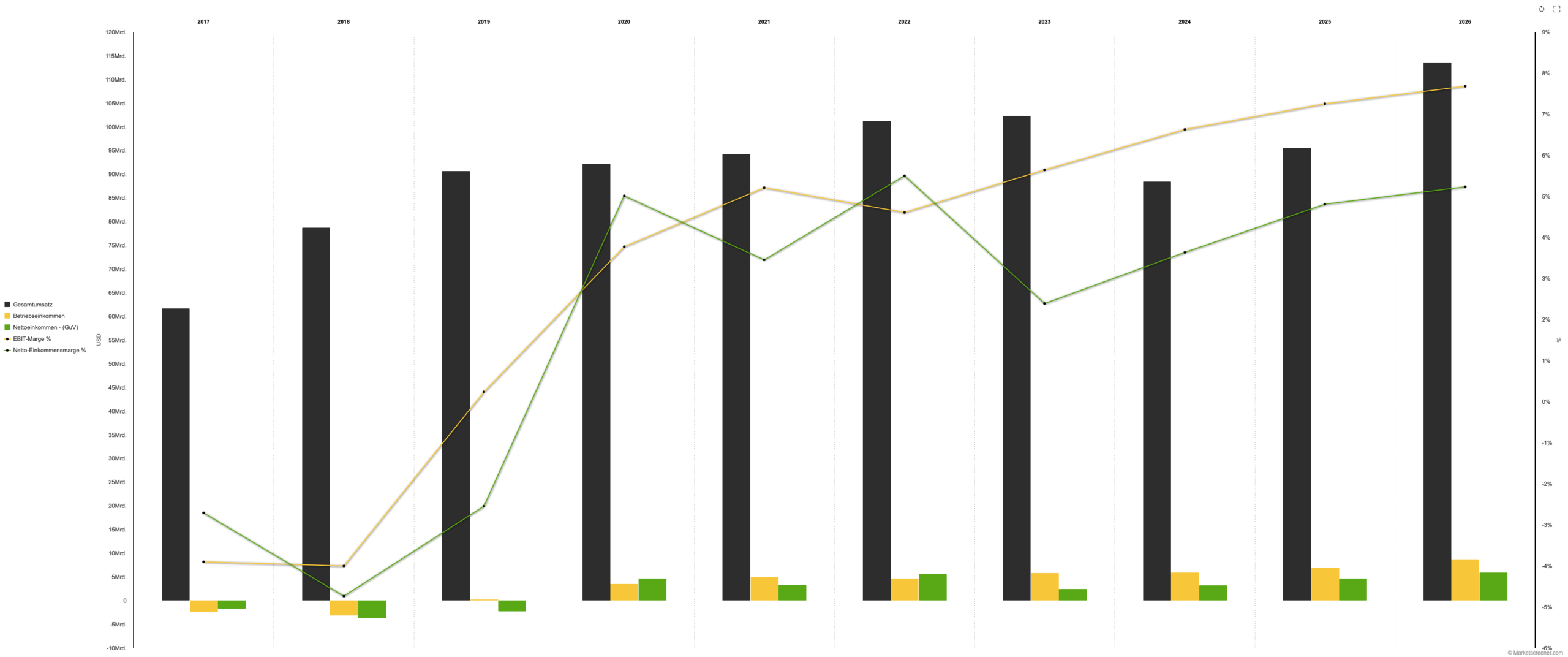
Dell’s historical financial performance highlights the cyclical nature of the business, while also showing the improvement in profitability in recent years. In the most recently shown period, revenue reached a new high.
Source: MarketScreener / S&P Global Market Intelligence.
Financial performance
| Key Figure | Q2 FY2027 | Q2 FY2026 | Change |
|---|---|---|---|
| Revenue | $47.0bn | $29.8 billion | +58 % |
| Operating Result | $5.39bn | $1.77bn | +204 % |
| Net Profit | $4.13bn | $1.16bn | +255% |
| Diluted EPS | $6.34 | $1.70 | +273% |
| Operating cash flow | $2.23bn | $2.54bn | −13% |
AI infrastructure momentum
| Metric | Q2 FY2027 |
|---|---|
| AI server orders | $60.9bn |
| AI server revenue | $16.4bn |
| AI server backlog | $95.0bn |
| Expected AI server revenue FY2027 | approx. $74bn |
The size of the backlog provides exceptionally high near-term demand visibility. At the same time, rapid growth in AI systems increases Dell’s dependence on the availability of key components, disciplined working-capital management, and the successful execution of very large infrastructure projects.
Financial outlook
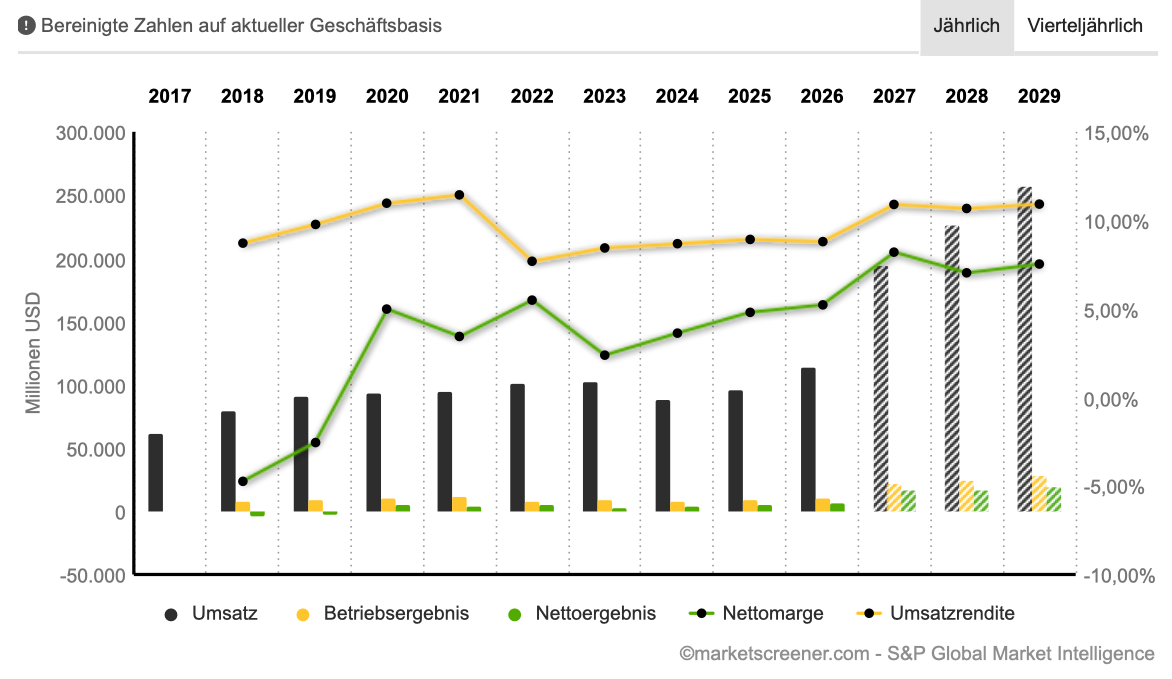
Outlook
Full-year FY2027 revenue guidance: around $192bn
FY2027 diluted GAAP EPS guidance: around $24.37
FY2027 diluted non-GAAP EPS guidance: around $25.50
Expected AI server revenue in FY2027: around $74bn
Opportunities
The record backlog provides high revenue visibility for the coming quarters.
Operating leverage could mean that earnings grow faster than revenue, provided execution remains successful.
Traditional servers, networking technology, and storage solutions can also benefit from the current data center modernization cycle.
Services and financing can strengthen customer retention and enable additional value creation around major infrastructure projects.
Risks
Operating cash flow declined year over year in the second quarter, even though earnings and net profit rose sharply.
AI server systems may have lower gross margins than higher-value software offerings, making product mix increasingly important.
A high concentration of large customers can amplify volatility between individual quarters.
Working-capital requirements can rise significantly during phases of very rapid hardware growth.
Key takeaway: Record revenue, strong earnings growth, and an exceptionally high AI server backlog support a positive fundamental assessment. At the same time, cash conversion and margin quality remain important factors to monitor.
News, analysts, and market sentiment
Classification
At the time of its inclusion in the UMBRELLA Strategy, market sentiment toward Dell was positive. The company had recently reported record results for Q2 FY2027, raised its full-year outlook, and further expanded its AI infrastructure offering.
On October 6, Dell also announced new features for the Dell AI Data Platform. These are intended to bring enterprise data into a trusted context for AI applications and AI agents.
Analyst sentiment was also largely positive, albeit less clear-cut than the fundamental growth profile. According to MarketScreener, the consensus of 29 analysts was “Accumulate”.
Analyst consensus
| Average Recommendation | ACCUMULATE |
| Number of Analysts | 29 |
| Average Price Target | approx. $586 |
| Distance to the average target | approx. +2% |
| Highest Price Target | $735 |
| Lowest Price Target | $480 |
Source: MarketScreener, October 7, 2026.
This highlights the significant increase in the importance of Dell’s AI infrastructure business.
Opportunities
Further upward revisions to earnings expectations could provide additional support for market confidence.
The Dell AI Data Platform extends the investment story beyond servers toward enterprise data infrastructure and agent-based AI.
High orders and the strong AI server backlog provide tangible operational evidence for the growth story.
Recent analyst price-target increases confirm continued confidence in execution.
Risks
The share price has already risen significantly, limiting upside versus the average analyst price target.
Market expectations are high, leaving less room for operational disappointments.
A slowdown in AI server orders or a slower conversion of backlog into revenue could trigger a rapid sentiment reversal.
Analyst price targets may reflect changes in hardware margins, supply constraints, or customer concentration with a lag.
Key takeaway: Record AI infrastructure demand and positive analyst revisions support positive market sentiment toward Dell. At the same time, valuation already reflects substantial optimism, leaving limited room for disappointment.
Technical analysis
Classification
At the time of its inclusion in the UMBRELLA Strategy on October 6, 2026, Dell Technologies showed a constructive technical picture. The stock remained in an established uptrend and traded above key medium- and long-term moving averages.
Key points
- Dell remained in a positive medium- and long-term trend.
- The share price traded above key moving averages, confirming the broader positive trend structure.
- The RSI remained positive without reaching an extremely overbought level.
- The MACD continued to signal positive momentum.
- The stock moved in the upper half of the Bollinger Bands, indicating sustained buying momentum.
- At the same time, proximity to the upper Bollinger Band and recent highs increased the likelihood of a short-term consolidation.
Technical indicators
| Indicator | Rating | Interpretation |
| RSI (14) | Positive | Around 60.6 – positive |
| MACD | Positive | approx. 7.18; buy signal |
| Bollinger Bands | Positive | Price above the middle band |
Opportunities
- A sustained move above recent highs could confirm a continuation of the existing uptrend.
- Positive RSI and MACD signals support further momentum as long as the current technical structure remains intact.
- Trading above the middle Bollinger Band supports the constructive short- to medium-term technical picture.
- Ongoing fundamental momentum from demand for AI infrastructure and data centers could provide additional support for the technical trend.
Risks
- The share price is already in the upper range of the Bollinger Bands, increasing the risk of short-term consolidation or profit-taking.
- A drop below the middle Bollinger Band would weaken the current short-term technical picture.
- A bearish MACD crossover would indicate fading momentum.
- A decline in the RSI below 50 could suggest that buying momentum is losing strength.
- After the preceding strong price rally, Dell remains vulnerable to higher volatility if market expectations for AI infrastructure growth soften.
Key takeaway: At the time it was added to the UMBRELLA Strategy, Dell Technologies showed a positive technical picture. The established uptrend and positive RSI and MACD signals supported momentum. At the same time, the proximity to recent highs means the risk of a short-term consolidation remains.
What currently speaks in favor of Dell Technologies?
- Record revenue and strong earnings growth in Q2 FY2027.
- $95bn AI server backlog and very strong order momentum.
- The outlook for revenue and earnings per share in FY2027 points to continued strong growth.
- Positive market sentiment and a broad Outperform consensus among analysts.
What currently speaks against Dell Technologies?
- The share price already reflects a substantial part of the AI growth story.
- At the current price level, the average analyst price target offers only limited additional upside.
- Dependence on the availability of advanced GPUs and semiconductors represents a relevant execution and supply-chain risk.
Summary
Dell Technologies was added to the UMBRELLA Strategy on October 6, 2026. The key drivers were in particular the combination of strong fundamental growth, high momentum in AI infrastructure, and exceptionally strong demand for AI servers.
The company is benefiting from a major investment cycle in accelerated computing and enterprise AI infrastructure. The high AI server backlog creates strong demand visibility and underscores Dell’s growing importance within the AI infrastructure value chain.
Key risks include valuation, the hardware business’s structural margins, dependence on global supply chains and advanced semiconductors, and the possibility of a slowdown in AI infrastructure investment after an exceptionally strong growth phase.
At the same time, the average analyst price target offers only limited additional upside versus the current price level. As a result, consistent operational execution, margin development, and disciplined risk management are becoming increasingly important.
Sources
- Dell Technologies, Q2 FY2027 financial results, September 1, 2026.
- Dell Technologies, Q2 FY2027 Performance Review / Webdeck, September 2026.
- Dell Technologies, Q2 FY2027 earnings call, September 1, 2026.
- Dell Technologies, “Turns Enterprise Data Into Trusted Context for AI Agents”, October 6, 2026.
- MarketScreener, valuation and analyst consensus on Dell Technologies, accessed October 6–7, 2026.


