


Bayer AG
Since our original Bayer analysis in early August, the fundamental picture has remained largely unchanged; however, there have been further developments regarding the legal situation and the technical picture.
Rather than recalculating the entire MUMAK model after every market move, this update focuses on the factors that have changed since our previous analysis: legal developments, market sentiment, and chart technicals.
What has changed since our last analysis?
Bayer continues to operate on the basis of the Q2 2026 results, which showed improved operational development, particularly in Crop Science; at the same time, cash flow, debt, and payments related to litigation remain key points of observation.
On the legal side, the next step in the proposed Roundup class action settlement has been postponed, with the final approval hearing now scheduled for September 14, 2026. This provides the parties with additional time to process motions to revoke previously declared opt-outs from the settlement following the U.S. Supreme Court’s Durnell decision.
Simultaneously, Bayer shares have entered a technical consolidation phase following the significant price increase in June and early July.
Against this backdrop, the focus is primarily on whether Bayer can confirm the improved operational and legal starting position while finding a new technical direction following the recent consolidation.
Rating
This analysis assesses Bayer AG under the UMBRELLA strategy using the MUMAK method.
The valuation is conducted across five decision-making phases: Geopolitics, Industry, Fundamentals, Market Sentiment, and Technical Analysis.
The goal is not to predict the future precisely. The goal is orientation. We contextualize facts, demonstrate causal relationships, and structure a comprehensible decision logic.
We explain – you decide.
Geopolitics
Classification
Bayer operates in two strategically important areas: food security and healthcare.
Demand for food, agricultural productivity, and medicines remains central even in times of geopolitical uncertainty. This gives Bayer a relatively defensive global position.
At the same time, regulatory and political decisions remain key drivers. Drug prices, approvals in the agricultural sector, and international trade rules can affect the business.
Overall, Bayer’s exposure to essential industries offers more opportunities than geopolitical risks.
Opportunities
- Food security: Governments are increasingly prioritizing a reliable food supply and higher agricultural productivity.
- Agricultural technology: Farmers need higher yields and more efficient production. This supports demand for seeds and crop protection solutions.
- Essential healthcare: Demand for medicines remains relatively stable even in times of economic or political uncertainty.
- Global presence: Bayer operates in around 80 countries. This reduces dependence on individual markets.
- Greater legal clarity in the US: The US Supreme Court’s decision in the Durnell case improves Bayer’s position against lawsuits alleging inadequate warning labels.
- Growing demand in healthcare: Oncology as well as cardiovascular and kidney diseases offer long-term growth opportunities.
- Diversification: Bayer combines agriculture and healthcare. Both areas serve fundamental global needs.
Risks
- Trade restrictions: Tariffs and trade conflicts can increase costs and disrupt supply chains.
- Geopolitical conflicts: Wars and political tensions can raise energy, logistics, and raw material costs.
- Agricultural conditions: Weather conditions, agricultural prices, and farmers’ income situation can influence demand.
- Drug prices: Governments can put pressure on the prices of pharmaceutical products.
- Regulation: Agricultural products require regulatory approvals in many countries.
- Patent expiries: The loss of exclusivity can increase competition and reduce revenues in the pharma business.
Key takeaway: Bayer benefits from its strong position in food security and healthcare, while the company’s global presence helps offset geopolitical and regulatory risks.
MUMAK.me Rating Phase 1: Positive = 1 MUMAK
Bayer AG
Industry
Assessment
Bayer operates in three major life science markets:
- Crop Science: seeds, crop protection, and agricultural technology
- Pharmaceuticals: prescription medicines
- Consumer Health: over-the-counter health products
Crop Science benefits from better operational execution, lower manufacturing costs, and a stronger seeds and traits business. In Pharmaceuticals, Nubeqa and Kerendia are growing rapidly, while Xarelto and Eylea are declining due to expiring exclusivity and increasing competition. Consumer Health remains stable but faces a weaker consumer environment in the USA.
Valuation Comparison
| Key Figure | Bayer 2026e | Industry average* | Rating |
|---|---|---|---|
| P/E Ratio | 20.5x | approx. 17-23x | Weaker / Highly valued |
| EBIT Margin | 12,5 % | approx. 17-25% | Weaker |
| Net margin | 4,7 % | approx. 10-18% | Weaker |
| Revenue Growth | approx. 0.4% | approx. 3-7% | Weaker |
*Based on Novartis, Roche, Sanofi, Merck KGaA, Corteva, and other major pharmaceutical and agricultural companies.
Source: MarketScreener, consensus estimates 2026, as of August 24, 2026.
Opportunities
- Global concerns regarding food security continue to support demand for innovation in agriculture.
- Climate change increases the need for resilient seeds and effective crop protection solutions.
- New pharmaceuticals could increasingly offset declining sales of established medications.
- Consumer Health provides a comparatively defensive and highly predictable demand.
- The combination of the healthcare business and agriculture gives Bayer a broad alignment with essential long-term demand drivers.
Risks
- Patent expirations in the pharmaceutical business create ongoing pressure to continuously renew the product portfolio.
- The development of new drugs remains capital-intensive, while clinical and regulatory successes are not guaranteed.
- Agricultural markets react sensitively to weather conditions, crop prices, and farmer spending.
- Environmental regulations could restrict the use of certain crop protection products.
- Bayer competes with more focused and, in some cases, more profitable peer companies.
Core Statement: Bayer operates in sectors supported by attractive long-term demand trends, where its presence in Health, Agriculture, and Consumer Health ensures broad diversification.
MUMAK.me Assessment Phase 2: Positive = 1 MUMAK
Bayer AG
Fundamentals
Assessment
Bayer’s results for the second quarter were operationally solid. Group sales rose by 2.2% on a currency- and portfolio-adjusted basis to EUR 10.872 billion, while EBITDA before special items increased by 1.9% to EUR 2.144 billion.
Revenue by Business Segment
| Segment | Sales Q2 2026 | Sales Q2 2025 | Change |
|---|---|---|---|
| Crop Science | EUR 4.910 billion | EUR 4.788 billion | +3,5 % |
| Pharmaceuticals | EUR 4.458 billion | EUR 4.470 billion | +0,8 % |
| Consumer Health | EUR 1.445 billion | EUR 1.427 billion | +1,5 % |
Source: Bayer Half-Year Financial Report Q2 2026.
Within Pharmaceuticals, sales of Nubeqa rose by 63.9% and Kerendia by 82.9% on a currency- and portfolio-adjusted basis. This was offset by significant declines for Xarelto and Eylea. This illustrates the size of the gap created by patent expirations that Bayer still needs to close.
The balance sheet is improving more slowly than the adjusted result. Free cash flow in the second quarter was EUR -371 million and EUR -2.691 billion in the first half, mainly due to payments related to litigation. Net financial debt amounted to EUR 33.647 billion as of June 30.
Financial performance
| Key Figure | Q2 2026 | Q2 2025 | Change |
|---|---|---|---|
| Revenue | EUR 10.872 billion | EUR 10.739 billion | +1,2 % |
| EBITDA before special items | EUR 2.144 billion | EUR 2.105 billion | +1,9 % |
| Net Income | EUR 0.219 billion | EUR -0.199 billion | Improved |
| EPS | €0.95 | EUR 1.14 | -16,7 % |
| Free cash flow | EUR -0.371 billion | EUR 0.125 billion | Lower |
Source: Bayer Half-Year Financial Report Q2 2026.
Financial Development
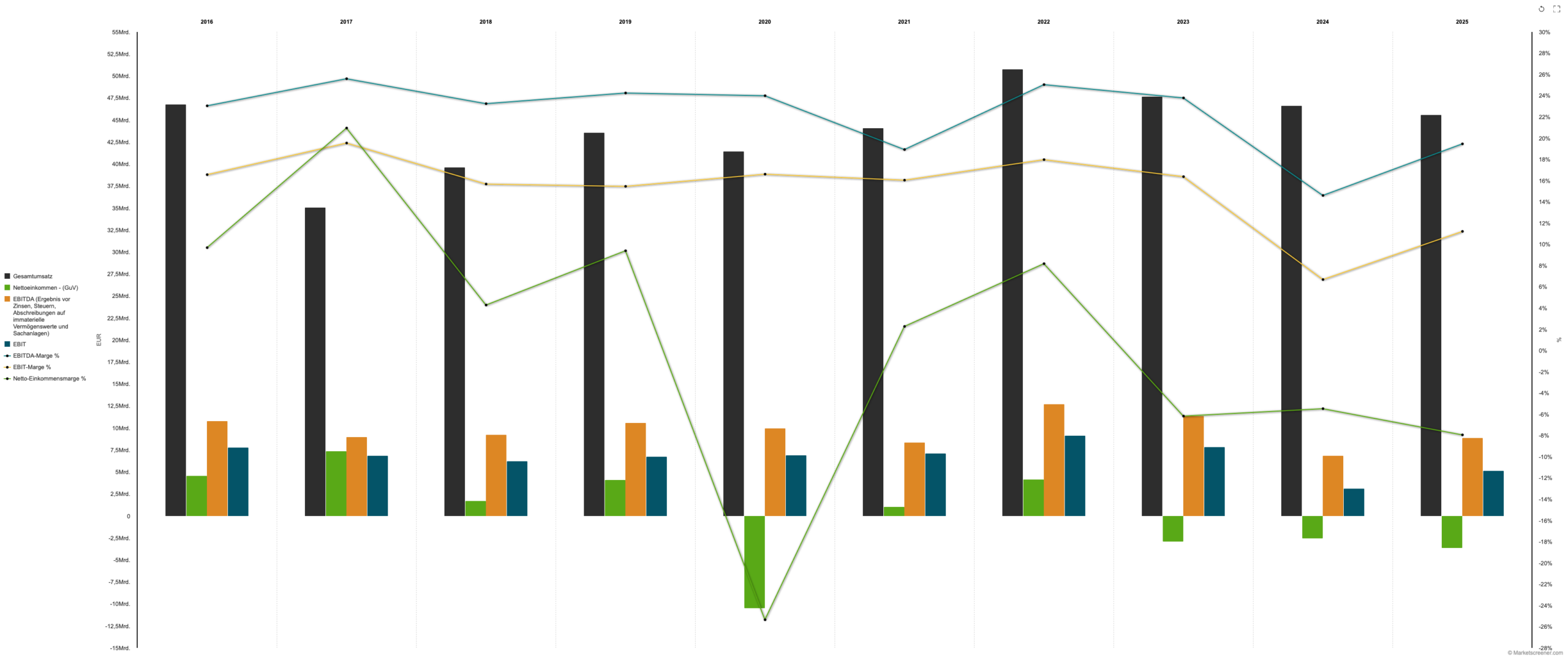
Key Observations:
- Sales peaked in 2022 and have fallen for three consecutive years on a reported basis.
- Adjusted EBITDA has also declined since 2022, although the first half of 2026 shows a significant operational recovery.
- Reported net income has been negative since 2023 because litigation costs, impairments, and financing costs overshadow the underlying earning power.
- The dividend remains at the legal minimum level while management prioritizes the balance sheet.
Outlook 2026
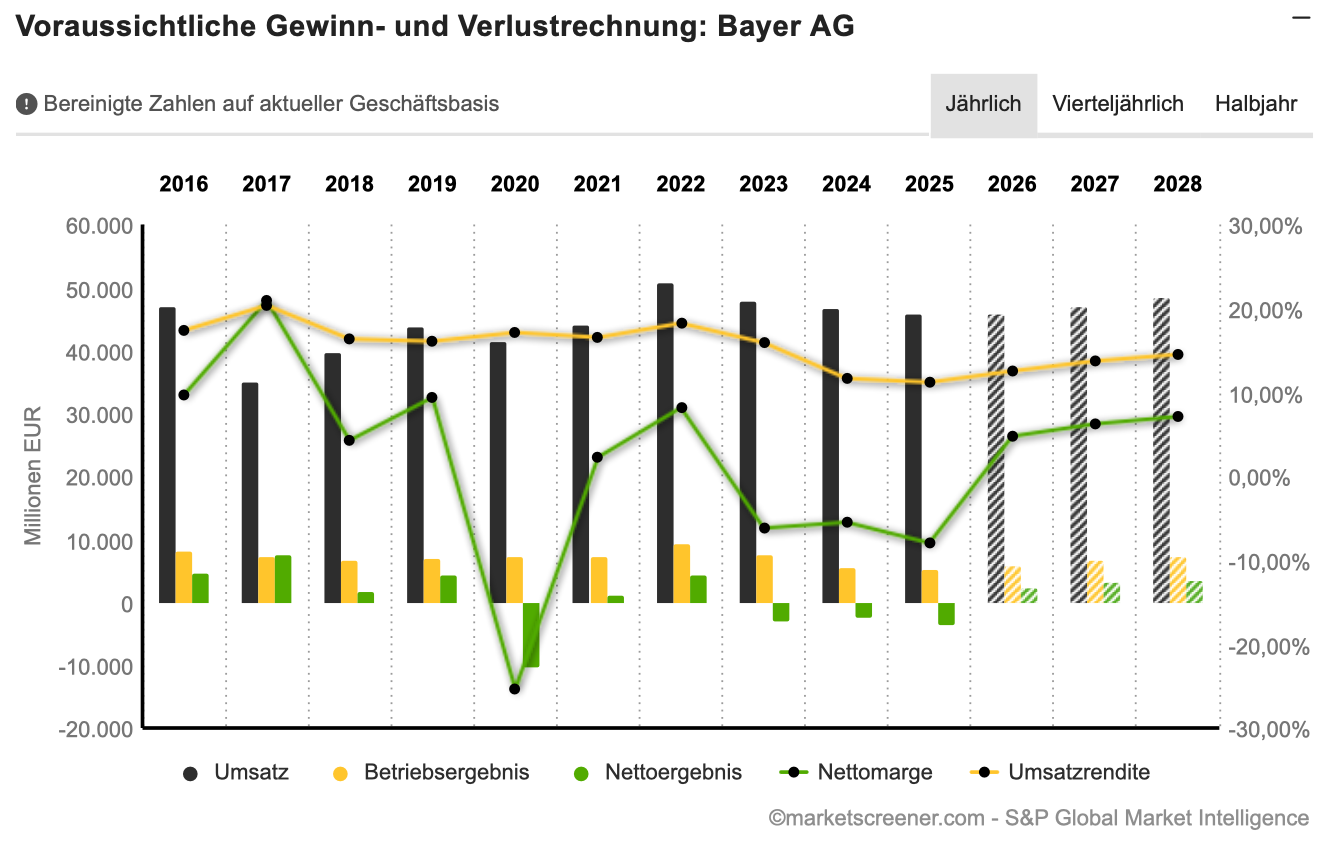
Source: MarketScreener consensus, August 5, 2026. Actual figures 2025; estimates 2026-2028.
The consensus forecast assumes a gradual recovery rather than a transformation into a high-growth company.
The forecasts indicate the following:
- Sales will remain largely stable in 2026 before growing again in the low single-digit percentage range.
- Adjusted EBITDA will start to rise again from 2027 as savings and new products gain weight.
- Reported net income is expected to turn positive again in 2026 and improve further through 2028.
Opportunities
- Crop Science achieved significant margin expansion, showing that the productivity program is taking effect.
- Nubeqa and Kerendia are growing fast enough to become significant replacement products for established drugs.
- The U.S. Supreme Court ruling significantly improves Bayer’s legal position in Roundup lawsuits regarding inadequate warning labels.
- Apollo’s EUR 3.0 billion capital contribution opens a credible path to reducing debt by year-end.
Risks
- Free cash flow remains negative as litigation payments consume operational cash flow.
- Net financial debt remains high relative to earnings and market capitalization.
- The declining performance of Xarelto and Eylea continues to weigh on the Pharmaceuticals division.
Key takeaway: Fundamentals are improving, but cash flow and leverage currently prevent an unreservedly positive valuation. Nevertheless, the trend appears to be moving in the right direction.
MUMAK.me Assessment Phase 3: Positive = 1 MUMAK
Bayer AG
News, Analysts, and Market Sentiment
Assessment
Market sentiment toward Bayer remains positive, supported by recent operational results; however, the legal situation remains a major influencing factor. Recent developments have improved the outlook regarding Roundup litigation, while payments from legal proceedings and the remaining pending lawsuits represent significant uncertainty.
Bayer’s Q2 2026 results provided a solid operational foundation.
In the pharmaceutical business, newer products such as Nubeqa, Kerendia, and Beyonttra are increasingly supporting the transition from established products like Xarelto and Eylea. Further regulatory progress, including the expanded approval of LYNKUET in Canada, complements the development of Bayer’s pharma portfolio.
The legal environment has also developed more constructively following the U.S. Supreme Court decision in the Durnell case, which strengthened Bayer’s position regarding the preemption of federal law in Roundup lawsuits alleging inadequate warnings. Nevertheless, litigation continues to have a significant financial impact: in the first half of 2026, litigation-related cash outflows amounted to approximately EUR 2.5 billion.
External valuation analyses have also turned more constructive recently; an analysis published via Yahoo Finance/Simply Wall St calculated Bayer’s fair value at approximately EUR 54.92, suggesting a valuation below the determined fair value based on the assumptions used there. While this provides an additional sentiment indicator, it does not replace the fundamental MUMAK valuation model.
Analyst Consensus
| Average Recommendation | ACCUMULATE |
| Number of Analysts | 18 |
| Average Price Target | approx. 56.8 EUR |
| Upside to Average Target | +18,3 % |
| Highest price target | 65 EUR |
| Lowest Price Target | 46 EUR |
Source: MarketScreener consensus, August 24, 2026.
The analyst consensus remains positive, with the average price target sitting approximately 18.3% above the underlying reference price.
Interesting Fact
Apollo Transaction
Bayer agreed with Apollo on an equity injection of EUR 3 billion.
Apollo will acquire a minority stake in a new company into which Bayer will contribute its long-acting contraceptive business. Bayer will retain the majority stake and operational control.
The transaction strengthens the balance sheet without Bayer having to sell the entire business. Closing is expected in the second half of 2026, subject to regulatory approval.
Opportunities
- Improved Legal Outlook: The Durnell decision strengthens Bayer’s position in Roundup litigation and could help reduce long-term legal uncertainty.
- Pharma Pipeline: The growth of Nubeqa, Kerendia, Beyonttra, and LYNKUET could increasingly offset the pressure from declining sales of established products.
- Crop Science Development: Improved profitability in the second quarter supports the Group’s operational performance.
- Analyst Expectations: The current average price target of 56.83 EUR indicates further potential compared to the current share price.
Risks
- Ongoing Legal Risks: The Roundup and PCB proceedings continue to represent significant legal and financial uncertainty.
- Cash Flow Burden: Payments related to litigation remain high and significantly impacted free cash flow in the first half of 2026.
- Patent Expirations: Declining contributions from established pharma products, particularly Xarelto and Eylea, must be increasingly offset by newer growth products.
- Execution Risks: Bayer must continue to demonstrate sustainable improvement in profitability, cash generation, and debt reduction.
Core Statement: Market sentiment toward Bayer remains positive, supported by progress in the pharma pipeline and a more constructive legal environment.
MUMAK.me Evaluation Phase 4: Positive = 1 MUMAK
Bayer AG
Technical Analysis
Assessment
The technical picture for Bayer shares has weakened in the short term following the significant uptrend between May and July.
On August 24, 2026, the stock was trading at approximately 47.45 EUR. After the price had been above 50 EUR in early August, the stock entered a consolidation phase and is currently trading below the recent resistance area.
Development over the past weeks/months
(As of August 24, 2026)
| Indicator | Rating | Interpretation |
|---|---|---|
| RSI (14) | Neutral | At around 48.5, the RSI is near the middle of its range, signaling neither an overbought nor an oversold situation. |
| MACD | Negative | The MACD line has fallen below the signal line, indicating weaker short-term momentum; however, both lines remain above the zero line, meaning the overall recovery has not yet been fully invalidated. |
| Bollinger Bands | Neutral | Following the decline from the upper band, the stock is trading in the lower half of the Bollinger Band range. The bands have begun to narrow, suggesting a consolidation phase and lower short-term momentum. |
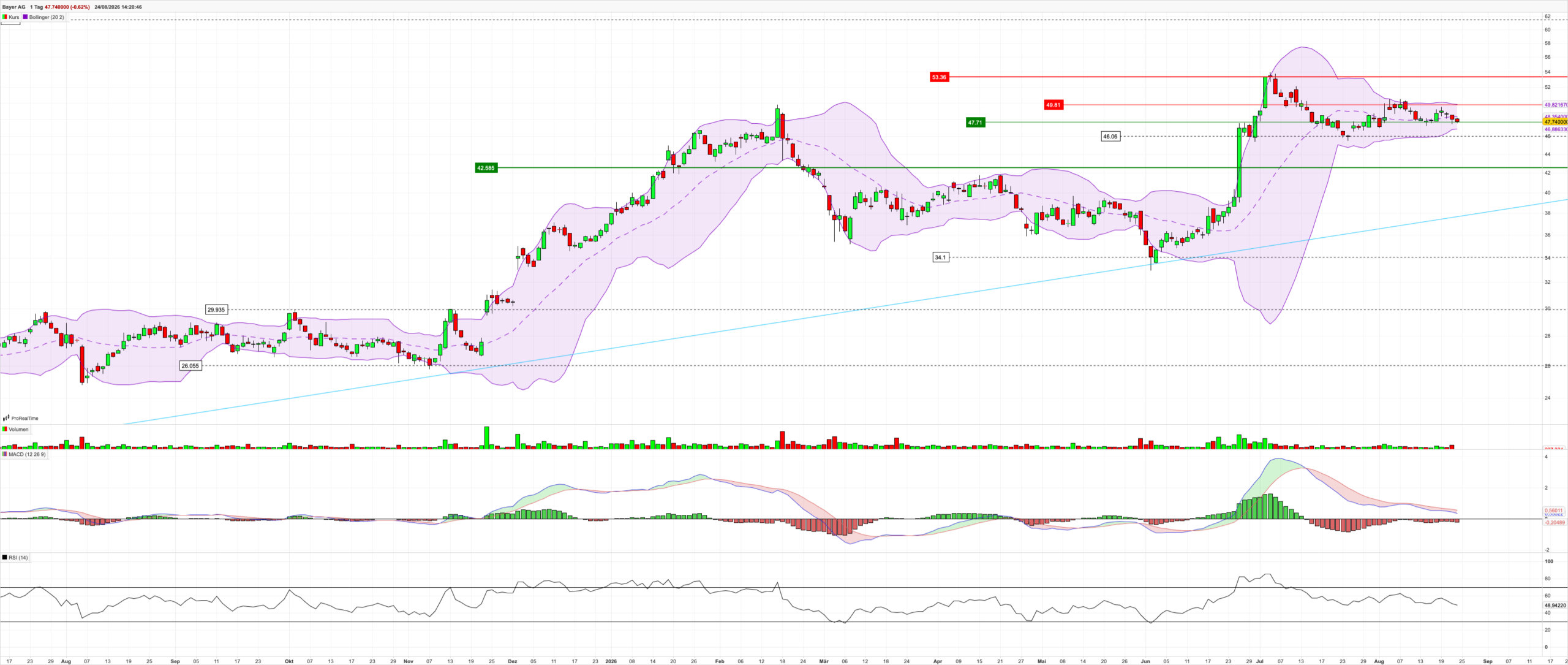
RSI (14)
Neutral
- The RSI is currently at approximately 48.5.
- This places the indicator slightly below the neutral mark of 50.
- Following the significantly higher RSI values during the sharp price increase in June and July, momentum has continued to normalize.
Interpretation
The RSI currently points to consolidation and balanced momentum.
MACD (12/26/9)
Negative
- The MACD line is currently at approximately 0.47, which is below the signal line of about 0.64.
- The bearish crossover indicates weaker short-term momentum following the previous price increase.
- However, both the MACD and the signal line remain above the zero line, meaning the overall recovery trend has not yet been fully invalidated.
Interpretation
The MACD is currently signaling fading short-term momentum and has not yet provided a new positive signal.
Bollinger Bands
Neutral
- The upper Bollinger Band is currently at approximately 51.50 EUR.
- The lower band is at approximately 46.06 EUR.
- The middle band is at approximately 48.78 EUR.
- With a price of around 47.45 EUR, the stock is trading below the middle band but remains above the lower band.
- After the significant expansion of the Bollinger Bands during the price increase in June and July, the bands have narrowed again.
Interpretation
The Bollinger Bands indicate decreasing volatility and an ongoing consolidation phase.
Opportunities
- The important support zone at 46–47 EUR remains intact for now.
- The overall recovery structure since the lows in the spring has not yet been broken.
- The RSI is in neutral territory and does not signal pronounced negative momentum.
- Despite the bearish crossover, both MACD lines remain above the zero line.
- A sustainable breakout above the 49.80–50.50 EUR range could improve the technical picture and bring the recent highs back into focus.
Risks
- Short-term upward momentum has weakened following the previous price increase.
- The stock is currently trading below the middle Bollinger Band.
- The MACD has formed a bearish crossover and has not yet provided a new positive signal.
- The 49.80–50.50 EUR range continues to form short-term resistance.
- A sustainable drop below the support zone at 46–47 EUR would weaken the current recovery structure and increase the risk of a further correction.
Core Statement: Bayer’s technical picture has shifted from positive momentum toward consolidation. The medium-term recovery structure remains intact; however, the MACD crossover and the decline from recent highs indicate weaker short-term momentum.
MUMAK.me Rating Phase 5: Neutral = 0 MUMAK
Bayer AG
What speaks for Bayer?
- The favorable U.S. Supreme Court decision significantly improves Bayer’s position in Roundup litigation.
- Crop Science shows stronger profitability as efficiency measures reduce costs.
- Nubeqa and Kerendia are developing into important growth drivers in the pharmaceutical business.
- The Apollo transaction strengthens Bayer’s capital structure and supports debt reduction.
- Bayer has returned to profitability in terms of reported net income.
- The long-term technical trend of the stock remains positive.
What speaks against Bayer?
- Net financial debt remains high.
- Settlement payments from litigation continue to weigh significantly on free cash flow.
- Xarelto and Eylea are under significant pressure due to patent expirations and competition.
- Group revenue growth remains comparatively low.
- Bayer’s profitability remains below that of many focused pharmaceutical companies.
What we are monitoring
- Legal Developments: Further progress in Roundup litigation and the impact of the Durnell decision.
- Operational Development: The growth of newer pharmaceutical products and the further development of profitability in Crop Science.
- Technical Picture: The support zone at 46–47 EUR and the resistance area at 49.80–50.50 EUR remain important levels.
- Next Quarterly Report: Bayer will publish its results for the third quarter of 2026 on November 3, 2026. These will provide the next major update on operational development and the full-year outlook.
Summary
Since our previous analysis, Bayer’s fundamental picture has remained largely unchanged; at the same time, developments in market sentiment and the technical picture provide additional points of reference for the current assessment.
Operationally, Bayer remains on track following the Q2 2026 results. The company confirmed its currency-adjusted outlook for the full year, while improved profitability at Crop Science provided support.
The legal environment has developed more constructively following the U.S. Supreme Court’s Durnell decision, which strengthens Bayer’s position in Roundup litigation.
Market sentiment remains positive, while the technical picture has transitioned into a neutral consolidation phase following the significant price increase in June and July.
Overall, Bayer is currently combining improved operational execution with progress in the legal environment. The next Q3 results on November 3, 2026, will be a key indicator of whether the current operational development continues.
Rating According to the MUMAK Method
| Category | Rating |
|---|---|
| Geopolitics | Positive |
| Industry | Positive |
| Fundamentals | Positive |
| News & Sentiment | Positive |
| Technical Analysis | Neutral |
Overall Rating


