

Update to the Valuation Analysis
Since our original Bayer analysis, the fundamental assessment has remained largely unchanged.
Instead of recalculating the entire MUMAK model after every market move or quarterly update, this update focuses on the factors that have changed since our previous analysis: legal developments, analyst expectations, market sentiment, and the technical picture.
What has changed since our last analysis?
Bayer’s latest financial figures continue to form the fundamental basis of our assessment. In Q2 2026, group revenue increased by 2.2% to EUR 10.87 billion on a currency- and portfolio-adjusted basis, while EBITDA before special items rose by 1.9% to EUR 2.14 billion. Crop Science in particular showed a positive earnings trend, while Bayer confirmed its currency-adjusted full-year outlook.
At the same time, Bayer lowered its expected net financial debt at year-end to EUR 29–30 billion, after previously expecting EUR 32–33 billion.
In addition to the operating figures, the legal environment has also developed more constructively. The U.S. Supreme Court’s decision in the Durnell case strengthened Bayer’s position in its strategy to limit the remaining Roundup litigation. However, payments related to legal proceedings continue to weigh on cash flow and remain a key factor for valuation.
Updated Valuation Perspective
The fundamental picture has not changed materially since our previous analysis.
Bayer continues to combine health, agriculture, and consumer health. The key company-specific questions remain the renewal of the pharma portfolio, improving profitability, deleveraging, and limiting legal risks.
The latest quarterly figures provide further indications of operational progress, particularly in Crop Science. At the same time, free cash flow continues to be weighed down by payments related to litigation, while the pharma business is facing declining contributions from established products.
From a valuation perspective, Bayer is currently trading largely within the range of the diversified peer group based on the expected 2026e P/E. Profitability and expected revenue growth, however, are below the indicative peer benchmarks.
Updated Analyst Expectations
| Average Recommendation | ACCUMULATE |
| Number of Analysts | 18 |
| Average price target | approx. EUR 56.83 |
| Upside to the average target | approx. +18.3% |
| Highest price target | EUR 65 |
| Lowest price target | EUR 46 |
Source: MarketScreener consensus, August 24, 2026.
Analyst expectations remain constructive. The average price target is above the current share price. However, the range of individual price targets reflects differing expectations regarding Bayer ’s operational recovery and the remaining legal risks.
Market Sentiment
Market sentiment toward Bayer remains positive, supported by operational progress, developments in the pharma pipeline, and a more constructive legal environment.
The Durnell decision represents an important development for the Roundup litigation. At the same time, newer pharma products are expected to increasingly offset the declining contributions from established products.
However, the litigation remains financially relevant. Bayer reported negative free cash flow of EUR 371 million in Q2, partly due to higher payments to settle legal proceedings.
Technical Analysis
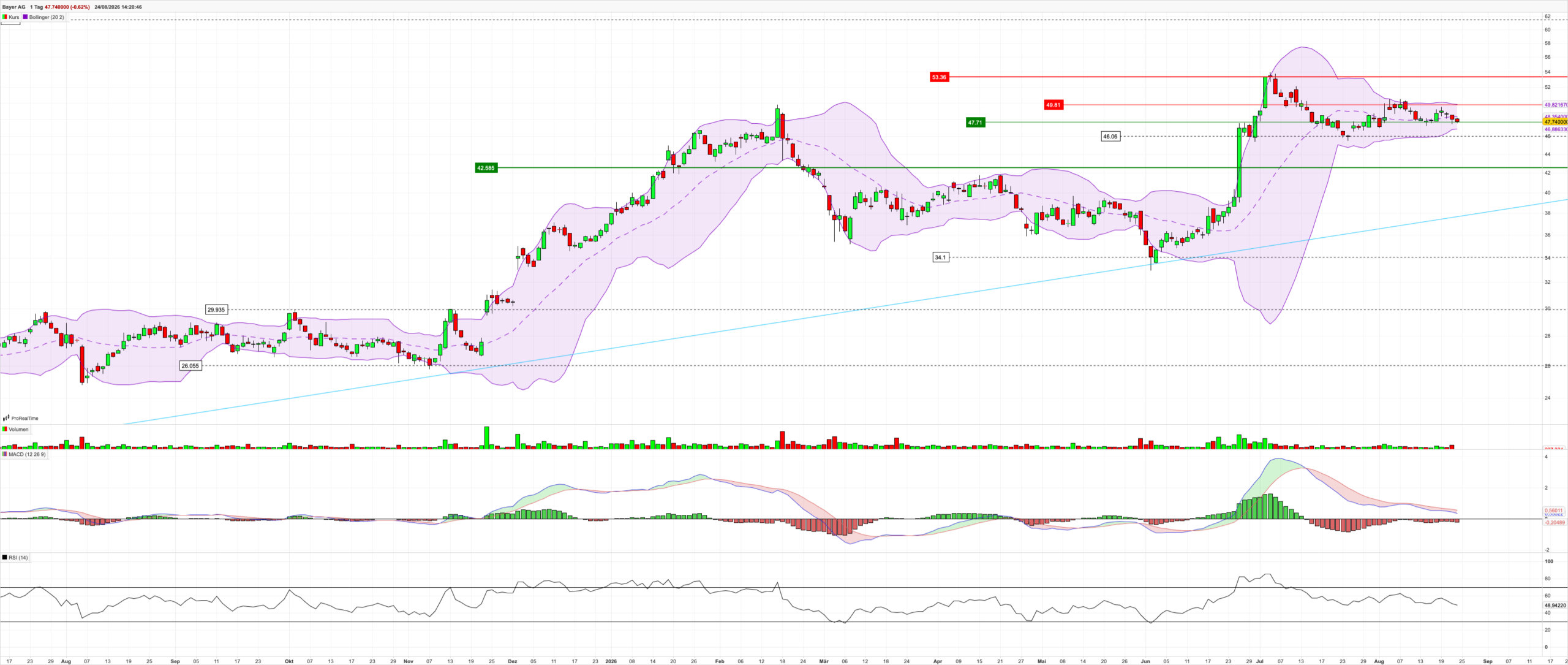
Following the sharp price increase in June and July, the technical picture has moved into a neutral consolidation phase.
As of August 24, 2026, the RSI is around 48.5, indicating balanced momentum. The MACD has weakened and is currently sending a negative short-term signal. However, both MACD lines remain above the zero line.
The stock continues to hold above the key support zone at EUR 46–47, while the EUR 49.80–50.50 area forms the central short-term resistance.
The broader recovery structure therefore remains intact. However, a sustained move above the resistance area would be required to strengthen the technical picture again.
Upcoming Events
| Date | Event |
|---|---|
| November 3, 2026 | Q3 2026 results |
Bayer’s Q3 results will provide the next key financial update and offer the opportunity to assess the further development of operating performance, cash flow, deleveraging, and the full-year outlook.
Conclusion
Our updated MUMAK assessment of Bayer remains largely unchanged.
Its broad positioning across health and agriculture continues to offer attractive long-term opportunities. At the same time, the latest operational and legal developments have provided additional support to the overall picture.
Nevertheless, litigation, cash-flow headwinds, patent expiries, and profitability remain key watchpoints. From a technical perspective, following the sharp recovery in June and July, the stock is currently in a consolidation phase, while the broader recovery structure remains intact.
The full Bayer valuation analysis has therefore been updated to reflect the latest analyst expectations, market sentiment, legal developments, and the technical picture.
