


Eli Lilly and Company
First published: August 11, 2026
Updated: September 2, 2026 | Market data: intraday September 2, 2026
Update to the valuation analysis
Since our original analysis of Eli Lilly, the fundamental picture has remained largely unchanged, while analyst expectations and the technical setup have continued to evolve.
The analyst consensus remains positive, supported by further regulatory progress and an expanding pipeline; at the same time, short-term technical momentum has weakened, shifting our assessment in Phase 5 from Positive to Negative.
This update therefore focuses on analyst views, recent company developments, and technical analysis, while the long-term outlook for Eli Lilly remains unchanged.
Eli Lilly is one of the world’s leading pharmaceutical companies. The business focuses on diabetes, obesity, and other metabolic diseases. Furthermore, the company is active in the fields of oncology, immunology, and neuroscience.
Eli Lilly recorded strong revenue and earnings growth in the second quarter of 2026. Mounjaro and Zepbound are the primary growth drivers, and the full-year guidance was raised once again.
Key risks include the high valuation, increasing price pressure in the US, as well as significant expenditures for expanding production capacities and for acquisitions.
Rating
This analysis evaluates Eli Lilly and Company according to the UMBRELLA strategy using the MUMAK method. The assessment is carried out across five decision-making phases: Geopolitics, Industry, Fundamentals, Market Sentiment, and Technical Analysis.
The goal is not to predict the future precisely. The goal is orientation. We contextualize facts, demonstrate causal relationships, and structure a comprehensible decision logic.
We explain – you decide.
Geopolitics
Classification
Eli Lilly operates at the intersection of health policy, pharmaceutical regulation, and strategically important drug production.
The company continues to expand its production network in the US. An additional $4.5 billion has been allocated for production sites in Indiana. This reduces supply chain and customs risks while simultaneously strengthening domestic drug production.
Obesity and diabetes are also increasingly gaining importance as central public health challenges. Broader access to treatments and improved reimbursement could significantly increase the number of patients treated.
Opportunities
- Production in the USA: Domestic production reduces supply chain and customs risks.
- Strategic Importance: Medications for treating diabetes and obesity address central public health challenges.
- Improved Access: The partnership with CVS could expand access to GLP-1 medications.
- International Expansion: Strong growth outside the US reduces geographic dependency.
- Political Alignment: Investments in the US strengthen Lilly’s position with political decision-makers in the United States.
Risks
- Price Pressure: Governments and insurers could demand lower drug prices.
- High Dependency on the US Market: Around 66.7% of revenue is generated in the United States.
- Trade Restrictions: Tariffs could increase production and logistics costs.
- Price Pressure in China: Volume-based procurement programs limit pricing flexibility in China.
Key Takeaway: Eli Lilly’s expansion of production capacities in the US and the strategic importance of its medications support a positive geopolitical assessment.
MUMAK.me Rating Phase 1: Positive = 1 MUMAK
Eli Lilly and Company
Industry
Assessment
Eli Lilly is active in several major therapeutic areas:
- Endocrinology: Diabetes, obesity, and metabolic diseases, the clearly dominant area with 74 percent of revenue.
- Oncology: Cancer therapies with a 14.4 percent share of revenue.
- Immunology: Therapies for inflammatory diseases at 8.1 percent.
- Neurology: Diseases of the nervous system at 2.1 percent.
The market for GLP-1 therapies continues to grow very rapidly but is shifting from a pure supply shortage toward price and access competition. Lilly and Novo Nordisk largely share the market between them, with positions recently shifting clearly in Lilly’s favor. While Novo Nordisk lowered its guidance, Lilly raised theirs.
Valuation Comparison
| Metric | Eli Lilly 2025e | Industry average* | Rating |
|---|---|---|---|
| P/E Ratio | 34.1x | approx. 15 to 22x | Weaker / Highly valued |
| EBIT margin | 45,6 % | approx. 25 to 35% | Stronger |
| Net margin | 31,7 % | approx. 15 to 25% | Stronger |
| Revenue Growth | approx. 33% | approx. 3 to 7% | Stronger |
| Dividend Yield | 0,59 % | approx. 2 to 4% | Weaker |
Margins based on the 2025 fiscal year. Industry average based on Johnson & Johnson, Roche, Novartis, AstraZeneca, Amgen, Novo Nordisk, and Pfizer.
Lilly is valued significantly higher than the sector. The premium is explained by margins and growth rates that are unparalleled in the pharmaceutical sector. However, the valuation assumes that the pace will only normalize slowly.
Opportunities
- The market for obesity and diabetes therapies continues to grow faster than almost any other pharmaceutical segment.
- Lilly is gaining market share against Novo Nordisk, the only comparable competitor.
- The pipeline extends beyond metabolism into oncology, immunology, and neurology.
- New production capacities are resolving the supply constraints that previously slowed growth.
- Retatrutide is facing its regulatory submission as the next generation of weight therapy.
Risks
- The concentration on endocrinology with 74 percent of revenue means a high dependency on a few products.
- Competition for GLP-1 patients is increasingly shifting to price.
- Oral GLP-1 agents and new providers could fragment the market faster than expected.
- Drug development remains cost-intensive, and clinical success is never guaranteed.
Key takeaway: Lilly is positioned as a leader in one of the most attractive segments across the entire pharma industry and delivers margins well above the sector average.
MUMAK.me Assessment Phase 2: Positive = 1 MUMAK
Eli Lilly and Company
Fundamentals
Assessment
Eli Lilly recorded another strong quarter. Revenue rose by 48% to $22.97 billion in the second quarter of 2026. The decisive factors were, in particular, the higher sales volumes of Mounjaro and Zepbound.
Global sales volume increased by 60%, more than offsetting the 13% decline in realized prices.
Revenue by Geographic Market
| Market | Revenue Q2 2026 | Change vs. Q2 2025 |
|---|---|---|
| United States | $14.4 billion | +33 % |
| Outside the United States | $8.6 billion | +80 % |
| Total Revenue | $22.97 billion | +48 % |
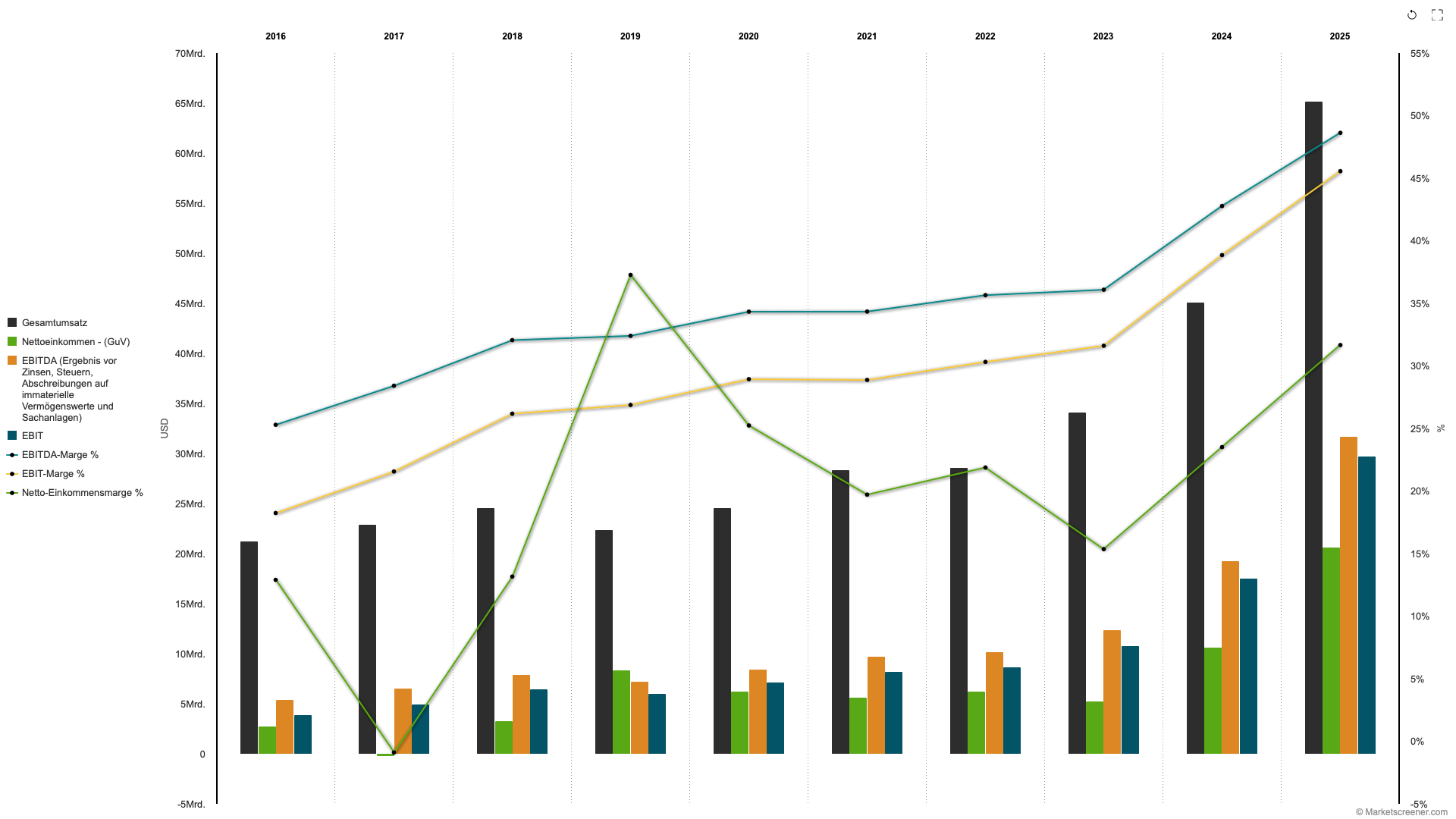
Source: MarketScreener, as of August 2026.
Between 2016 and 2025, revenue increased from around $21 billion to $65.18 billion. The decisive growth acceleration began in 2023, when Mounjaro and Zepbound became Eli Lilly’s most important growth drivers.
Financial performance
| Metric | Q2 2026 | Q2 2025 | Change |
|---|---|---|---|
| Revenue | $22.97 billion | $15.56 billion | +48 % |
| Adjusted operating income | $12.58 billion | $7.14 billion | +76 % |
| Net Income | $7.10 billion | $5.66 billion | +25 % |
| Adjusted earnings per share | $8.38 | $6.31 | +33 % |
| Free Cash Flow | $7.76 billion | $1.39 billion | +458 % |
Source: MarketScreener, August 10, 2026.
Company Guidance for 2026
| Metric | Previous Guidance | Updated Guidance |
|---|---|---|
| Revenue | $82.0–85.0 billion | $85.0–87.0 billion |
| Adjusted earnings per share | $35.50–37.00 | $35.50–$36.50 |
Source: Eli Lilly Financial Results for Q2 2026.
Management raised the midpoint of the revenue guidance by $2.5 billion.
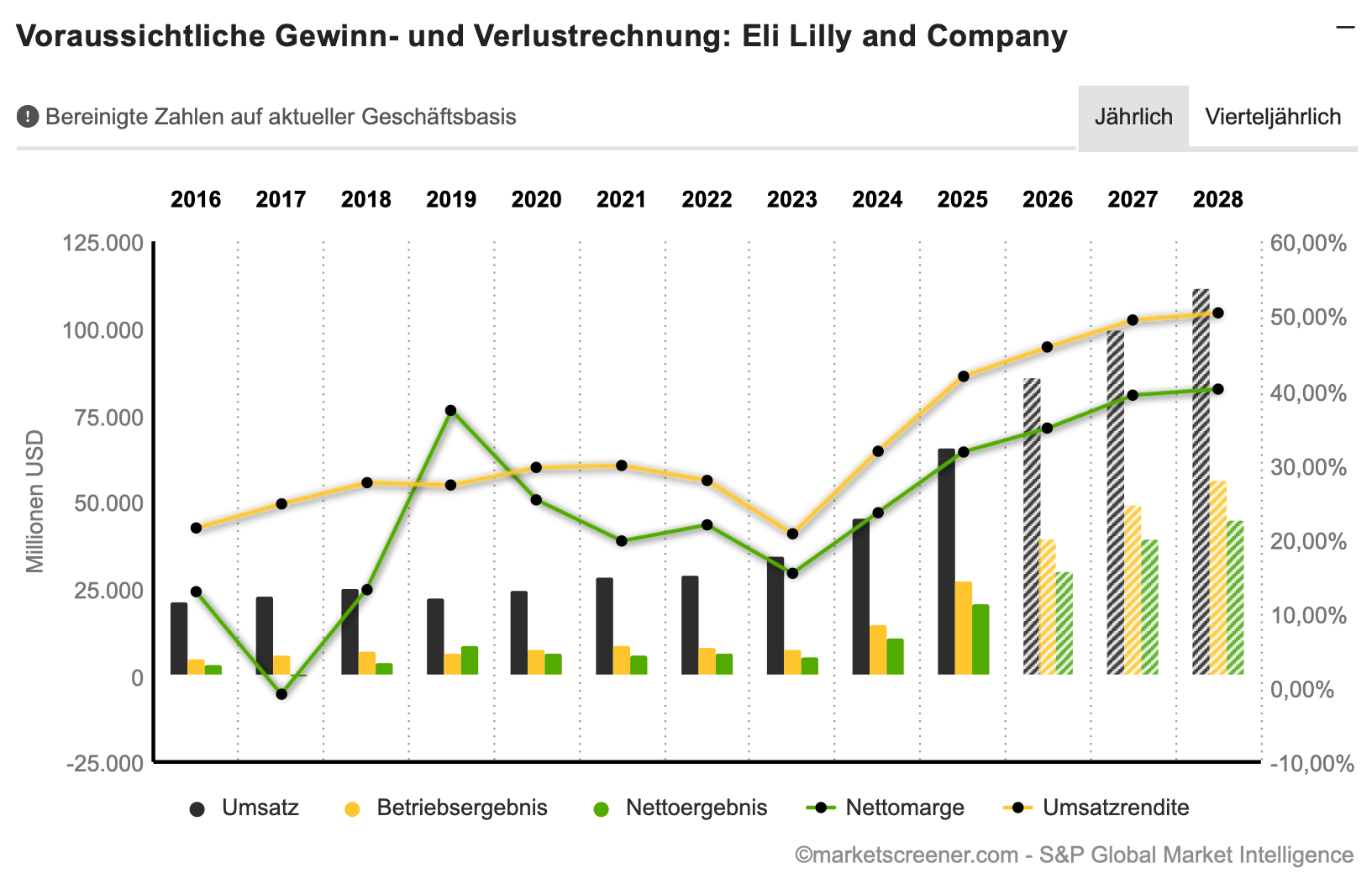
Current estimates assume revenue of around $87 billion in 2026, approximately $100 billion in 2027, and nearly $110 billion in 2028. The forecasts imply operating margins of around 50% and net margins of nearly 40%.
Pipeline and Capacity Development
Lilly expects to complete the Phase 3 development program for retatrutide and plans to apply for regulatory approval of the drug in the first quarter of 2027. A successful market launch would add another important product to Lilly’s obesity portfolio and could strengthen the company’s competitive position beyond Mounjaro and Zepbound.
Revenue by Key Product
| Product | Revenue Q2 2026 | Change vs. Q2 2025 |
|---|---|---|
| Mounjaro | $9.94 billion | +91 % |
| Zepbound | $4.93 billion | +46 % |
| Ebglyss | $201 million | +131 % |
| Jaypirca | $192 million | +56 % |
| Omvoh | $102 million | +36 % |
| Foundayo | $98 million | New Launch |
The company is also beginning to achieve relevant growth outside of its two largest products. Ebglyss, Jaypirca, and Omvoh recorded high percentage growth rates, while Foundayo contributed $98 million to revenue following its market launch. Compared to Mounjaro and Zepbound, these products remain relatively small. However, they broaden the future revenue base.
Opportunities
- Revenue growth of 48% in the second quarter, driven by volume growth of 60%.
- Market-leading positions in the fields of diabetes and obesity through Mounjaro and Zepbound.
- Gross margin of 85.8% and significant operating economies of scale.
- Increase in revenue guidance and underlying earnings expectations for 2026.
- A strong late-stage development pipeline, including retatrutide.
Risks
- Mounjaro and Zepbound account for around 65% of quarterly revenue.
- Globally realized prices fell by 13%, illustrating political and reimbursement-related pressure.
- Competition from Novo Nordisk and future market participants in the obesity sector remains significant.
- Investments and acquisitions are currently weighing on the conversion of earnings into free cash flow.
- Pipeline acquisitions cause implementation risks and significant expenses for acquired research and development projects.
Key Takeaway: Eli Lilly impresses with exceptional, volume-driven growth and increasing profitability, while price pressure and the high dependency on Mounjaro and Zepbound remain the central risks.
MUMAK.me Assessment Phase 3: Positive = 1 MUMAK
Eli Lilly and Company
News, Analysts, and Market Sentiment
Assessment
Market sentiment toward Eli Lilly remains positive, supported by strong operating performance and continued analyst confidence.
Since our previous analysis, the FDA has approved Mounjaro (tirzepatide) to reduce cardiovascular risk in adults with type 2 diabetes, expanding the drug’s clinical potential beyond glycemic control and weight loss.
The pipeline has also been expanded through further acquisitions. At the end of August, Eli Lilly announced the acquisition of Merida Biosciences for up to USD 2.875 billion, strengthening its position in autoimmune and allergic diseases.
Analyst Consensus
| Value | Current | Previous analysis (August 10, 2026) |
|---|---|---|
| Average Recommendation | BUY | BUY |
| Number of analysts | 30 | 28 |
| Average Price Target | approx. USD 1,315 | approx. USD 1,292 |
| Potential to Average Price Target | approx. +13% | approx. +9% |
| Highest price target | USD 1,600 | USD 1,600 |
| Lowest Price Target | USD 800 | USD 800 |
Source: MarketScreener, as of September 2, 2026.
The analyst picture has improved slightly since our previous assessment. The average price target has risen from around USD 1,292 to USD 1,315. Based on the current share price, this implies upside of around 13%.
Several analysts raised their price targets after the Q2 results, reflecting higher expectations for Eli Lilly’s diabetes and obesity franchise as well as its long-term pipeline.
Interesting Fact
Lilly continues to expand beyond obesity and diabetes
Eli Lilly has agreed to acquire Merida Biosciences for up to USD 2.875 billion. Merida develops precision therapies for severe autoimmune and allergic diseases. Its lead program is currently in Phase 1 of clinical development.
The acquisition follows several other transactions in 2026 and underscores Lilly’s strategy of using strong cash generation from its metabolic business to broaden the pipeline into additional therapeutic areas.
At the same time, new Phase 3b data showed sustained improvements from the combination of Taltz and Zepbound in adults with psoriasis conditions and obesity.
Opportunities
- Positive analyst consensus: The consensus remains at BUY, with the average price target around 13% above the current price.
- Mounjaro expansion: The new cardiovascular indication expands the drug’s clinical potential.
- Pipeline diversification: Acquisitions are expanding Lilly’s business beyond diabetes and obesity.
- Strong market position: Mounjaro and Zepbound continue to support a positive growth outlook for Eli Lilly.
Risks
- Price pressure: Lower realized prices remain a key risk for the second half of 2026.
- High expectations: The current valuation still assumes strong results.
- Acquisition risks: The growing number of acquisitions increases execution and integration risks.
- Product concentration: Market expectations remain heavily dependent on Mounjaro and Zepbound.
Key takeaway: Market sentiment toward Eli Lilly remains positive, and analyst expectations have improved slightly.
MUMAK.me Evaluation Phase 4: Positive = 1 MUMAK
Eli Lilly and Company
Technical analysis (as of August 10, 2026)
Assessment
Previous assessment
In our previous analysis, the technical picture for Eli Lilly was positive. After the Q2 results, the share price recovered, momentum improved, and the stock moved back above key technical levels.
Development over recent weeks/months (as of August 10, 2026)
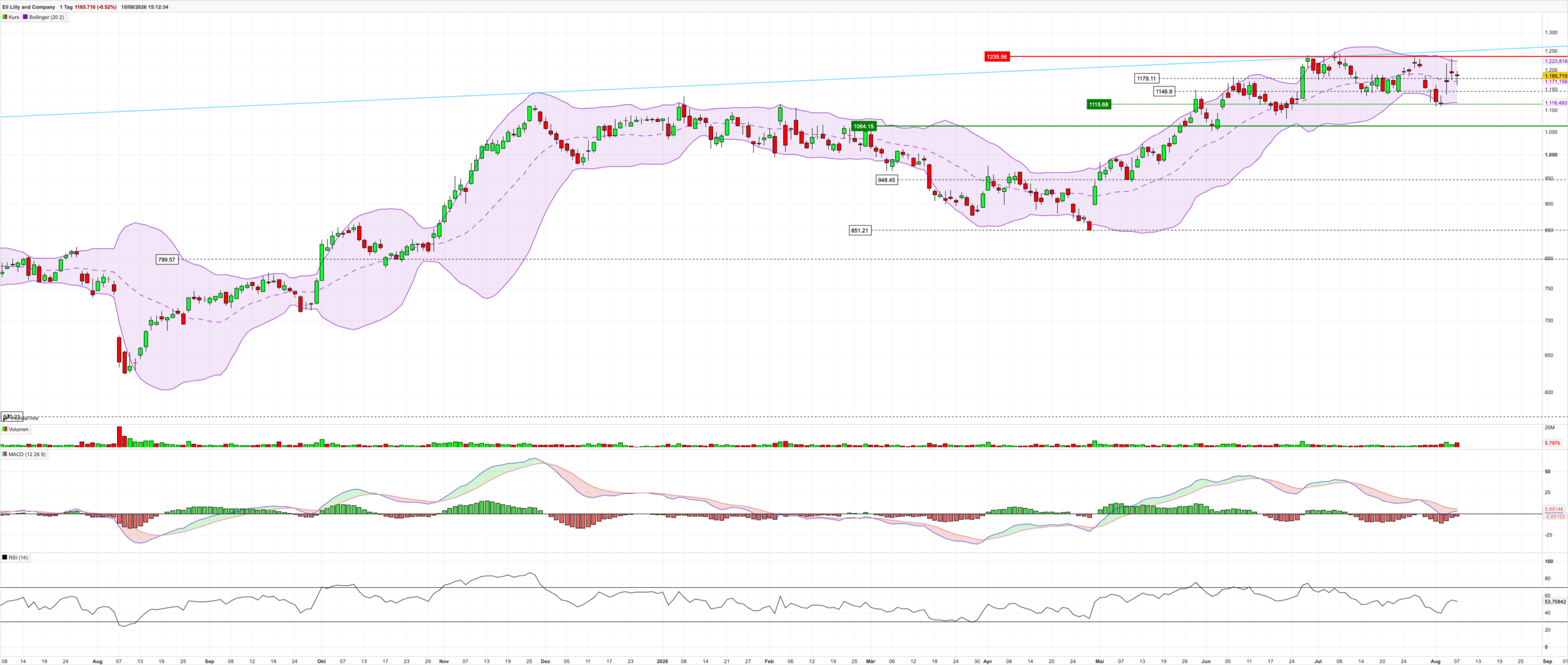
| Indicator | Rating | Interpretation |
| RSI (14) | Positive | Momentum has improved with the price recovery without generating an overbought signal. |
| MACD | Neutral | Downward momentum is weakening, but a confirmed bullish signal is not yet present. |
| Bollinger Bands (20) | Positive | The price has moved away from the lower band and reclaimed the middle band. |
RSI (14)
Positive
- The RSI is at approximately 53.7.
- The indicator has recovered back above the 50 mark.
- Momentum is improving.
- The stock is not in the overbought range.
Interpretation
The RSI confirms increasing buying momentum without indicating an overheated market.
MACD (12/26/9)
Neutral
- The MACD line remains below the signal line.
- The histogram remains negative.
- However, the negative momentum is weakening.
Interpretation
The MACD has not yet confirmed the price recovery. However, the waning negative momentum increases the probability of a positive crossover.
Bollinger Bands
Positive
- Eli Lilly tested the lower Bollinger Band in the area of $1,118.
- The stock recovered above the middle band at around $1,177.
- The price is trading in the upper half of the Bollinger Band range.
Interpretation
The Bollinger Bands confirm that the correction has stabilized and buyers have regained control of the short-term trend.
MUMAK.me Assessment Phase 5: Positive = 1 MUMAK
Technical analysis (as of September 2, 2026)
Assessment
Rating
The technical picture for Eli Lilly has weakened in the short term, while the long-term uptrend remains intact.
After the post-Q2-results rebound, the stock initially extended its advance and reached around USD 1,280. However, the breakout could not be confirmed, and the share price subsequently pulled back to around USD 1,160.
Compared with our previous assessment, momentum has therefore deteriorated: the RSI has fallen below 50, the MACD has turned negative, and the share price is now trading below the middle Bollinger Band.
Development over recent weeks/months (as of September 2, 2026)
Since our previous analysis, Eli Lilly initially continued its upward move and rose into the resistance area around USD 1,280.
However, the stock was unable to establish itself sustainably above this level and then moved into a correction. At around USD 1,160, the share price is now approaching an important support area.
Despite the recent decline, the broader uptrend has not been broken so far.
| Indicator | Rating | Interpretation |
| RSI (14) | Neutral | At around 43; momentum has weakened, but the stock is not oversold. |
| MACD | Negative | The MACD line has fallen below the signal line, pointing to weaker short-term momentum. |
| Bollinger Bands (20) | Negative | The price is below the middle band and is approaching the lower Bollinger Band. |
RSI (14)
Neutral
The RSI has fallen to around 43.
This puts the indicator below the neutral 50 level.
Short-term momentum has weakened.
Interpretation
The RSI reflects the recent loss of momentum; however, since the indicator remains well above 30, it is not yet signaling an oversold condition.
MACD (12/26/9)
Negative
The MACD line has fallen below the signal line.
Short-term momentum has turned negative.
The indicator confirms the recent price weakness.
Interpretation
The MACD is currently providing the clearest negative technical signal.
Bollinger Bands
Neutral
The share price is around USD 1,160.
The middle Bollinger Band is around USD 1,207.
The lower Bollinger Band is around USD 1,139.
The upper Bollinger Band is around USD 1,274.
The stock has moved from the upper part of the range toward the lower band.
Interpretation
The drop below the middle Bollinger Band confirms weaker short-term momentum.
Opportunities
- Long-term trend intact: Despite the recent correction, the broader uptrend remains in place.
- Potential for a rebound: The RSI is not overbought, leaving room for renewed upside momentum.
- Breakout potential: A move above USD 1,280 would confirm renewed technical strength.
Risks
- Weaker momentum: The RSI has fallen below 50.
- Negative MACD: The MACD is currently confirming short-term downside momentum.
- Below the middle Bollinger Band: The stock has slipped below a key short-term technical reference level.
Key takeaway: Eli Lilly’s long-term uptrend remains intact; however, the short-term technical picture has weakened.
MUMAK.me Assessment Phase 5: Negative = 0 MUMAK
Eli Lilly and Company
What speaks in favor of Eli Lilly?
- Strong growth: Mounjaro and Zepbound continue to drive strong demand and high revenue growth.
- Market-leading position: Eli Lilly holds a leading position in the growing diabetes and obesity markets.
- Pipeline expansion: New indications and acquisitions expand the company’s long-term growth opportunities.
- Positive analyst view: The analyst consensus remains positive, with the average price target signaling further upside.
- Long-term perspective: Despite short-term technical weakness, the broader growth story remains intact.
What speaks against Eli Lilly?
- High valuation: The current valuation still assumes strong results.
- Price pressure: Lower realized prices could weigh on future growth and margins.
- Product concentration: A significant portion of current growth depends on Mounjaro and Zepbound.
- Competition: Novo Nordisk and other pharma companies continue to expand their obesity and diabetes pipelines.
- Weak short-term technical signals: RSI, MACD, and Bollinger Bands currently point to weaker momentum.
What we are monitoring
- Mounjaro and Zepbound: Demand, market share, and further regulatory expansions.
- Prices and margins: Impact of price pressure on revenue growth and profitability.
- Next quarterly report: Eli Lilly will publish Q3 2026 results on October 29, 2026.
Summary
Eli Lilly continues to combine strong growth with leading positions in diabetes and obesity, alongside a growing pharmaceutical pipeline. Since our previous analysis, the analyst picture has improved slightly, while further regulatory progress and pipeline developments support the long-term outlook.
At the same time, the short-term technical picture has weakened: the RSI has fallen below 50, the MACD has turned negative, and the share price is trading below the middle Bollinger Band. This shifts our assessment in Phase 5 from Positive to Negative, while the long-term uptrend remains intact.
For the UMBRELLA Strategy, the current technical weakness does not change the long-term view on Eli Lilly. The position is therefore still being held.
Key factors now remain the price action around the key technical support zone, demand for Mounjaro and Zepbound, and the upcoming Q3 results on October 29, 2026.
Rating According to the MUMAK Method
| Category | Rating |
|---|---|
| Geopolitics | Positive |
| Industry | Positive |
| Fundamentals | Positive |
| News & Sentiment | Positive |
| Technical Analysis | Negative |
Overall Rating


