


Revolution Medicines
Rating
This analysis evaluates Revolution Medicines according to the MUMAK UMBRELLA strategy.
The valuation is conducted across five decision-making phases: Geopolitics, Industry, Fundamentals, Market Sentiment, and Technical Analysis.
The goal is not to predict the future precisely. The goal is orientation. We contextualize facts, demonstrate causal relationships, and structure a comprehensible decision logic.
We explain – you decide.
Revolution Medicines has achieved a crucial milestone with Daraxonrasib. The U.S. Food and Drug Administration approved the drug on August 26, 2026, under the brand name RASONQUE for adults with metastatic pancreatic adenocarcinoma who have received at least one prior systemic therapy or are not suitable for multi-agent systemic therapy.
The Phase 3 study RASolute 302 forms the clinical basis of the approval. Daraxonrasib increased median overall survival to 13.2 months compared to 6.7 months with chemotherapy. The risk of death was reduced by 60%. Progression-free survival also improved to 7.2 months compared to 3.6 months.
Particularly relevant for the commercial perspective is the comparatively broad label: The approval applies with or without an identified RAS mutation and does not require a companion diagnostic test.
This significantly shifts the investment case. The central question is no longer whether Daraxonrasib will achieve the first FDA approval, but whether Revolution Medicines can develop a multi-billion dollar RAS oncology platform from it.
Geopolitics
Classification
For Revolution Medicines, the regulatory and health policy environment is more crucial than classical geopolitics.
Here, the initial situation has fundamentally improved.
The FDA granted full approval for RASONQUE on August 26, 2026. The drug is already prescribable in the USA. The approval occurred within an exceptionally accelerated regulatory process and was supported by Breakthrough Therapy Designation, Orphan Drug Designation, and the Commissioner’s National Priority Voucher.
The regulatory process is also progressing internationally. The European Medicines Agency already initiated a rolling review of Daraxonrasib in July to accelerate the assessment of the marketing authorization application.
This eliminates the largest single regulatory risk of the investment case to date.
The new risks now lie more with reimbursement, price acceptance, and international approval.
Opportunities
- FDA approval already achieved: The previous binary approval risk for the first indication has been eliminated.
- Broad FDA label: An identified RAS mutation is not required for prescription.
- No companion diagnostic necessary: This can simplify access in clinical practice.
- Accelerated EMA procedure: A later European approval would expand the addressable market.
- High medical need: Pancreatic cancer remains one of the tumor diseases with a particularly poor prognosis.
Risks
- Price regulation and reimbursement could reduce the actually achievable net revenues compared to the list price.
- International approval outside the USA is not yet complete.
- Political pressure on very high-priced oncology drugs remains relevant in the long term.
Key takeaway: The regulatory environment has significantly improved with FDA approval. The focus now shifts from regulatory risk to reimbursement and commercial implementation.
MUMAK assessment Phase 1: Positive = 1 MUMAK
Revolution Medicines
Industry
Assessment
Precision oncology remains one of the most attractive growth areas in the global biotechnology and pharmaceutical industry.
RAS mutations play a central role in numerous solid tumors. Particularly relevant are pancreatic, lung, and colorectal cancer.
With RASONQUE, Revolution Medicines has demonstrated for the first time that the company’s proprietary RAS(ON) approach is not only clinically effective but also regulatorily successful.
This changes the company’s strategic position.
Revolution Medicines has more than just Daraxonrasib. The pipeline additionally includes mutation-specific agents such as Zoldonrasib against RAS G12D, Elironrasib against RAS G12C, and RMC-5127 against RAS G12V.
Zoldonrasib is already being studied in the global Phase 3 trial RASolute 305 in combination with chemotherapy as first-line treatment for metastatic RAS-G12D pancreatic cancer.
The collaboration with BeOne Medicines also strengthens the platform. BeOne received rights to four RAS(ON) programs in selected Asian markets and will additionally finance and conduct a global registration-enabling Phase 3 trial. Revolution Medicines retains rights outside the designated markets, including Japan and South Korea.
Revolution Medicines is thus increasingly evolving from a single-product story to a RAS franchise.
Valuation Comparison: Revolution Medicines vs. Biotechnology Industry (Clinical Stage)
| Metric | Revolution Medicines | Industry average* | Rating |
|---|---|---|---|
| P/E 2026e | -23x | N/A | Weaker |
| EBIT Margin | Negative | Predominantly negative | In line |
| Net margin | Negative | Predominantly negative | In line |
| Revenue Growth 2026e | Very low (pre-commercialization) | Low to moderate | Weaker |
*Peer Group: BridgeBio Pharma, Blueprint Medicines, BeOne Medicines, Ascendis Pharma, and Exelixis. Source: MarketScreener, July 2026.
Opportunities
- First regulatory validation of the RAS(ON) platform through RASONQUE.
- Daraxonrasib could develop into a new treatment standard for metastatic pancreatic cancer.
- First-line and adjuvant applications could significantly expand the addressable market.
- NSCLC opens a second major potential market for Daraxonrasib.
- Zoldonrasib, Elironrasib, and RMC-5127 create additional independent growth opportunities.
- International partnerships partially reduce development and commercialization risks.
Risks
- The long-term value of the platform requires further successful Phase 3 trials.
- Initial positive data from small studies cannot be automatically extrapolated to large randomized trials.
- Competition in the field of RAS-targeted cancer therapies continues to intensify.
- The current company valuation already assumes multiple successful commercial and clinical programs.
Key takeaway: Revolution Medicines now has a clinically and regulatorily validated RAS platform. The long-term potential is substantial but depends on whether the success of RASONQUE can be replicated across additional lines of therapy and tumor types.
MUMAK.me Assessment Phase 2: Positive = 1 MUMAK
Revolution Medicines
Fundamentals
Assessment
With the approval of RASONQUE, Revolution Medicines’ financial profile is fundamentally changing.
In the future, the company will generate recurring revenue from its own approved product for the first time. At the same time, development costs remain very high due to the exceptionally broad clinical pipeline.
At the end of the second quarter of 2026, Revolution Medicines had approximately USD 3.9 billion in cash, cash equivalents, and marketable securities. Research and development expenses in the second quarter amounted to USD 394.9 million, while administrative and selling expenses were USD 110.2 million. The net loss was USD 644.4 million.
For the full year, the company continues to expect GAAP operating expenses of USD 2.1 to 2.2 billion.
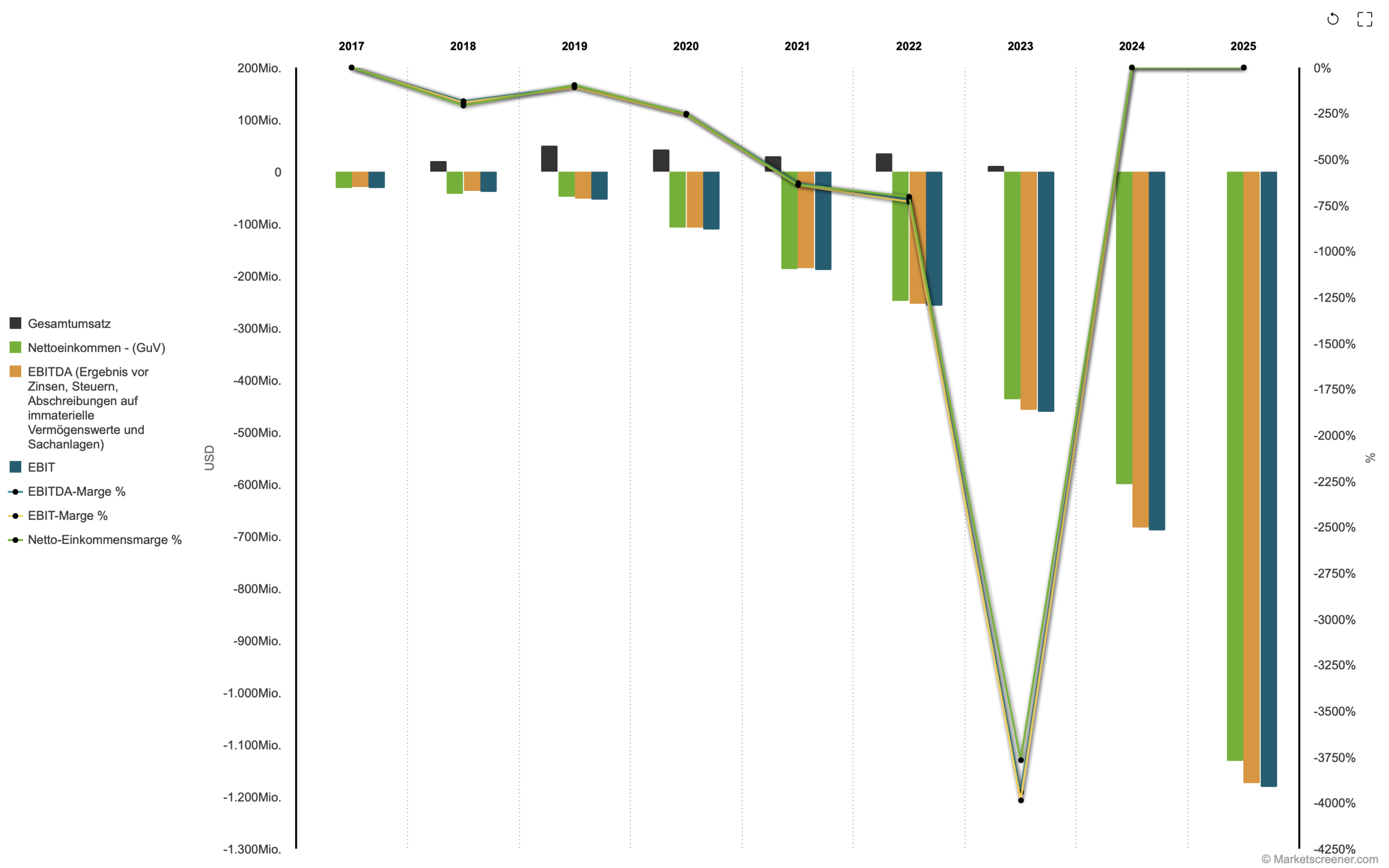
Financial Metrics
| Metric | FY2025 | FY2026e | FY2027e |
|---|---|---|---|
| Revenue | – | approx. $147 million | approx. $1.05 billion |
| EBITDA | -$1.18bn | approx. -$1.85bn | approx. -$1.30bn |
| EBITDA Margin | Negative | Negative | Negative |
| Net Income | -$1.13bn | approx. -$2.07bn | approx. -$1.50bn |
| Free cash flow | -$914 million | approx. -$1.72bn | approx. -$1.12bn |
Source: MarketScreener consensus estimates, August 2026 (pre-approval).
Outlook 2026
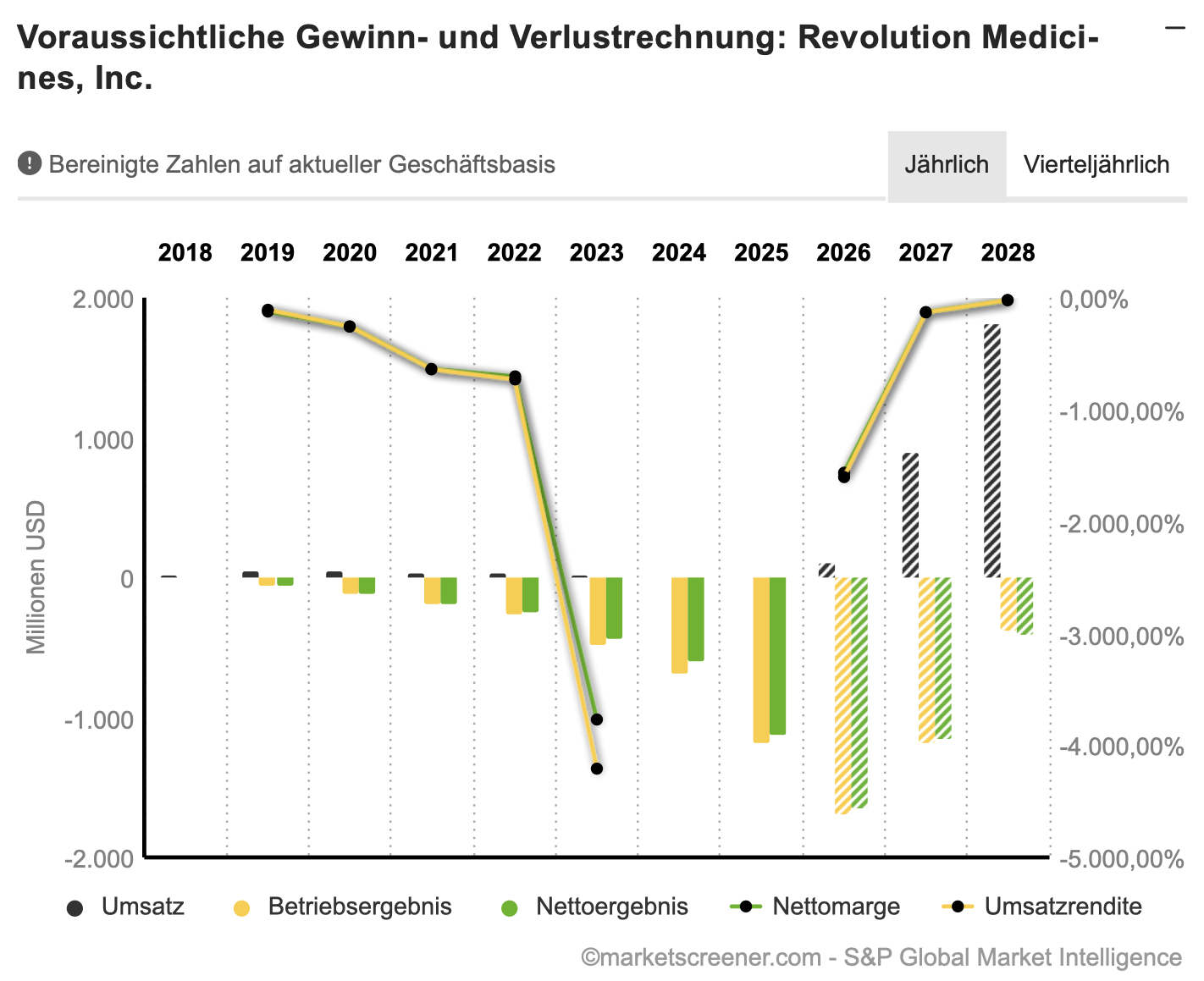
The currently available MarketScreener consensus now projects around $1.05 billion in Net Sales for 2027. At the same time, significant losses are still expected.
RASONQUE Price Changes Revenue Outlook
With FDA approval, the official US price was announced for the first time.
The Wholesale Acquisition Cost is $39,800 for a 30-day supply.
This corresponds to an annualized list price of approximately $477,600 per patient. RASONQUE is already available in the US.
The list price is not equivalent to the subsequent net proceeds for Revolution Medicines. Discounts, insurance agreements, government programs, and other deductions will reduce the actual realized price.
Nevertheless, the pricing is at a level that improves the commercial outlook.
For example, with a treatment duration of approximately seven months, the gross list value per patient would already be well over $250,000.
Thus, the current analyst consensus of around $1.05 billion in revenue in 2027 does not appear ambitious.
Assuming a successful launch, good reimbursement, and increasing market penetration, a revenue range of approximately $1.25 to $1.40 billion for 2027 also seems plausible from MUMAK’s current perspective.
This range represents a MUMAK scenario analysis and is not a consensus estimate.
Even before approval, more than 2,000 patients had access to Daraxonrasib through the Expanded Access Program. While this is not proof of future commercial sales, it could support the transition to regular care.
RBC, for example, already expects approximately $28 million in revenue in the third quarter and $148 million in the fourth quarter of 2026 and sees long-term revenue potential of around $11.5 billion. However, this estimate represents an individual analyst scenario and not a market consensus.
Rating
However, the high revenue potential must be weighed against the already high market valuation.
At a share price of $215.44, Revolution Medicines now has a market capitalization of approximately $46.2 billion.
Based on current analyst estimates for 2027, the expected EV/Sales ratio is still around 43x.
This means the market is already pricing in a very successful future launch and significant additional pipeline values today.
Even if 2027 revenue increases towards $1.3 to $1.4 billion due to the higher price, the valuation remains ambitious.
Opportunities
- RASONQUE generates commercial product sales for the first time.
- The WAC of $39,800 per 30 days supports significant revenue potential.
- The broad label and the absence of a companion diagnostic can facilitate market penetration.
- More than 2,000 Expanded Access patients could support the early commercial ramp-up.
- Liquidity of approximately $3.9 billion enables parallel financing of multiple Phase 3 programs.
- Positive revenue revisions for 2027 and 2028 could provide an additional valuation impetus.
Risks
- The cost base remains exceptionally high.
- Significant operating losses are still expected for 2027 according to current consensus.
- The high list price still needs to prove itself in real-world reimbursement.
- Actual Net Sales may be significantly lower than the calculated list price.
- The market capitalization of approximately $46 billion already includes high expectations for further indications.
- Further capital measures and equity-based compensation may lead to long-term dilution.
Key takeaway: FDA approval and the high RASONQUE price significantly improve the future revenue outlook. At the same time, the valuation remains very demanding given the expected revenues and losses. Nevertheless, we now rate it positively.
MUMAK.me Assessment Phase 3: Positive = 1 MUMAK
Revolution Medicines
News, Analysts, and Market Sentiment
Assessment
Market sentiment toward Revolution Medicines remains positive.
FDA approval of RASONQUE eliminates a central uncertainty factor. At the same time, the immediate price reaction of +1.92% to $215.44 was comparatively moderate.
However, this should not necessarily be interpreted negatively.
The stock had already substantially priced in the successful Phase 3 data and a high probability of approval. Since the beginning of the year, the share price has now risen by around 170%, and even significantly more over a one-year period.
The investment case is therefore shifting from a binary FDA event increasingly toward actual commercial development.
Going forward, the following will be particularly critical:
Net sales, reimbursement, number of patients treated, duration of therapy, and further indication expansions.
Analyst Consensus
| Average Recommendation | BUY |
| Number of Analysts | 22 |
| Average Price Target | approx. $212 |
| Upside to the average target price | approx. +8% |
| Highest price target | $291 |
| Lowest Price Target | $151 |
Source: MarketScreener, retrieved in August 2026.
Interesting Fact
RASONQUE costs $39,800 per 30 days in the U.S. This corresponds to an annualized list price of $477,600—at the same time, no companion diagnostic is required for the approved indication.
This combination of high price and comparatively low diagnostic access barrier is particularly relevant for commercial development.
Opportunities
- FDA approval: The most important near-term regulatory risk has been eliminated.
- High analyst consensus: The consensus remains at Buy.
- Initial price target increases: Analysts are beginning to incorporate approval and label into their models.
- Pricing: The actual WAC could shift revenue estimates upward.
- Commercial expansion: First-line PDAC, NSCLC, and additional RAS indications offer further growth opportunities.
Risks
- High market expectations: A significant portion of the success is already priced in.
- Sell-the-news risk: After the strong price increase, positive news may trigger only limited additional demand in the near term.
- Launch risk: A high list price does not automatically translate into correspondingly high net sales.
- Pipeline dependency: A large portion of the valuation continues to be based on indications not yet approved.
Key takeaway: Market sentiment remains positive. However, the moderate reaction to FDA approval shows that the market had already largely anticipated regulatory success. The next valuation driver increasingly lies in revenue revisions and commercial execution.
MUMAK.me Evaluation Phase 4: Positive = 1 MUMAK
Revolution Medicines
Technical analysis (as of August 27, 2026)
Assessment
The long-term technical picture of Revolution Medicines remains positive.
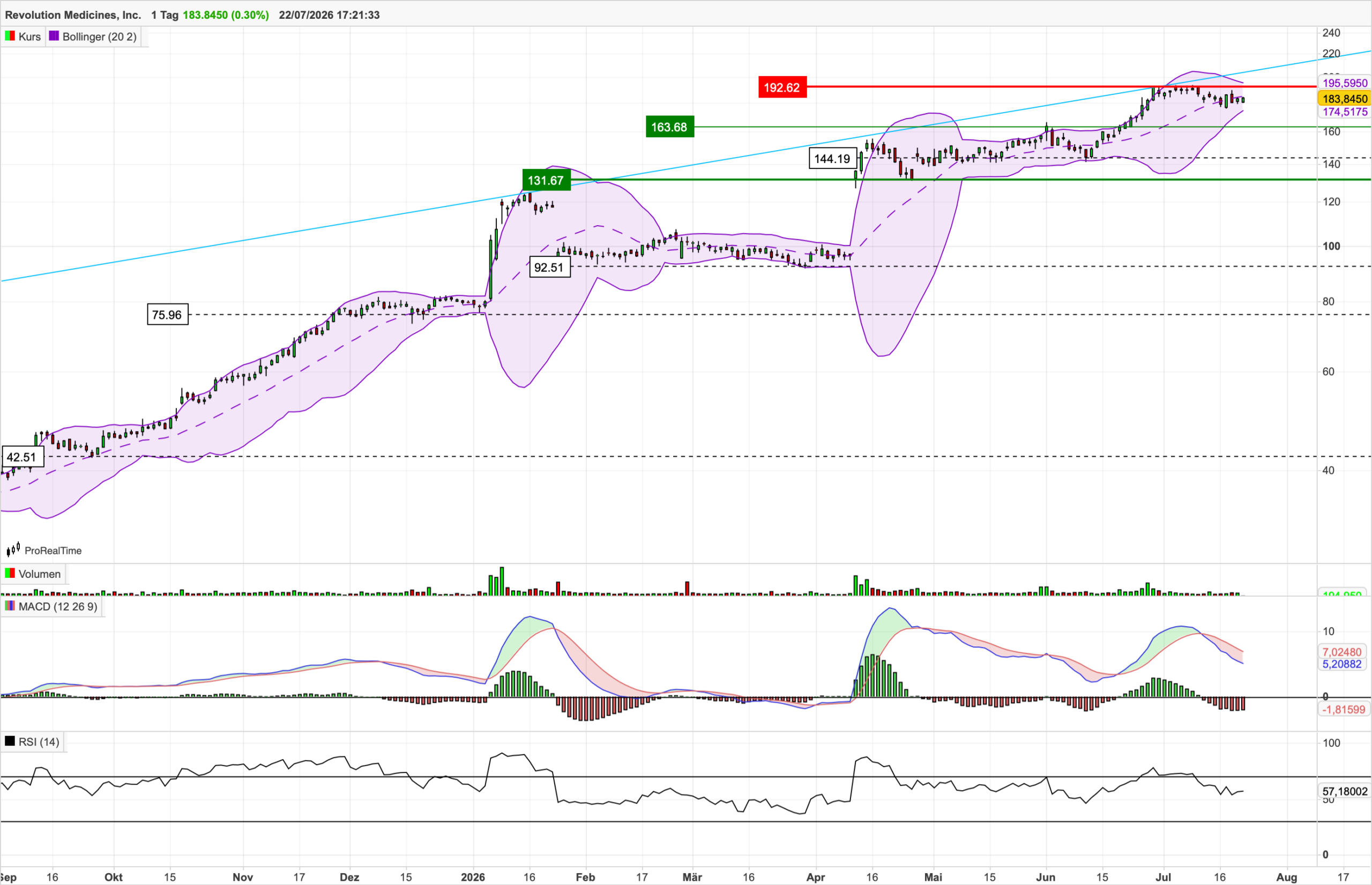
The stock is currently trading at around $215.44, just below the key resistance zone at around $216.
This level is particularly relevant from a technical perspective, as the stock has pushed into this zone several times following the strong upward movement of recent months. At the same time, the upper boundary of the long-term uptrend runs through this area.
The FDA approval has not yet been followed by a dynamic breakout. However, the stock is holding just below resistance and is showing little decline despite the previously strong price performance.
This is initially constructive.
| Indicator | Valuation | Interpretation |
|---|---|---|
| RSI (14) | Positive | At around 66.9, momentum remains strong but is approaching the overbought threshold of 70. |
| MACD | Positive | MACD and signal line remain significantly above the zero line. |
| Bollinger Bands | Positive | The stock is trading well above the middle band and is once again approaching the upper Bollinger Band. |
RSI (14)
Positive
- Current RSI: approx. 66.9
- The RSI confirms the strong upward momentum.
- The indicator remains below the classic overbought threshold of 70.
Interpretation: The RSI confirms the existing uptrend but simultaneously signals that short-term room for maneuver without consolidation is becoming increasingly limited.
MACD (12/26/9)
Positive
- MACD and signal line remain significantly above the zero line.
- The MACD line is still slightly above the signal line.
- Short-term momentum is thus losing some steam immediately below the resistance.
Interpretation: The MACD confirms the primary uptrend but is not yet providing a new strong acceleration signal.
Bollinger Bands (20)
Positive / short-term tension
- Upper Bollinger Band: approx. $222.75
- Middle Bollinger Band: approx. $204.08
- Lower Bollinger Band: approx. $185.41
- The stock is trading at $215.44, significantly above the middle band.
Interpretation: The position within the Bollinger Bands confirms the positive trend. At the same time, the price is again approaching the upper band, meaning both a breakout and a consolidation remain possible in the short term.
Key price levels
$216 – central short-term resistance
A sustained daily close above this level would be an initial new technical buy signal.
Above that, the next relevant zone follows with the previous high in the $220–$223 range. The upper Bollinger Band is currently at around $222.75.
A successful breakout above this area would lead the stock technically into a new phase and could open up the $230 and above range in the medium term.
$204 – first short-term support
The middle Bollinger Band runs here. A pullback to this area would initially be technically non-problematic within the existing uptrend.
$196.73 – central support
This zone forms a much more important medium-term support. As long as it holds, the current upward structure remains clearly intact.
$185–$179 – second support zone
The lower Bollinger Band is at around $185.4. Below that, at $179.18, is another prominent support zone.
A drop below this area would significantly weaken the overall technical picture.
Opportunities
- The long-term uptrend is clearly intact.
- The stock is trading immediately at the crucial resistance of $216.
- RSI and MACD generally confirm the positive momentum.
- The stock is holding its gains despite the FDA event and the previous rally.
- A breakout above $216–$223 could trigger a new technical impulse.
- Above $223, additional room for maneuver towards $230 and beyond would open up in the medium term.
Risks
- The breakout above $216 is not yet confirmed.
- The RSI is approaching the overbought zone at around 67.
- The MACD shows fading short-term momentum.
- A drop below the middle band at around $204 could trigger a consolidation towards $196.73.
- Below $196.73, the short-term technical picture would weaken significantly.
Key takeaway: The overall technical picture remains positive. However, Revolution Medicines is facing a crucial decision. A sustained breakout above $216 to $223 would confirm the long-term uptrend and could trigger a new impulse. Without a breakout, a consolidation between approximately $196 and $216 remains possible for now.
MUMAK.me Assessment Phase 5: Positive = 1 MUMAK
Revolution Medicines
What speaks in favour of Revolution Medicines?
- FDA approval of RASONQUE: The most important short-term regulatory risk has been removed.
- Exceptional Phase 3 data: Median overall survival increased from 6.7 to 13.2 months.
- Broad label: The therapy can be used regardless of a previously identified RAS mutation.
- No companion diagnostic required: This facilitates access to treatment.
- High RASONQUE price: $39,800 per 30 days creates significant revenue potential.
- Leading RAS(ON) platform: Daraxonrasib is complemented by several mutation-specific agents.
- Large liquidity position: Around $3.9 billion supports broad clinical development.
- Positive analyst sentiment: The consensus remains at Buy.
- Technical uptrend: The stock is immediately ahead of a possible new breakout.
What speaks against Revolution Medicines?
- Very high valuation: A market capitalization of around $46 billion already assumes significant future revenues.
- Continued high operating losses: A significantly negative result is still expected for 2027.
- High cash burn: The broad pipeline continues to require billions in investment.
- Commercialization risk: The actual net price and reimbursement have yet to be seen.
- Pipeline expectations: A large part of the valuation depends on first-line PDAC, NSCLC, and other programs.
- Competition: The success of the RAS class is likely to attract further pharma and biotech companies.
- High price volatility: Following the strong price increase, even positive news can lead to short-term consolidations.
What we are watching
- Initial commercial revenues from RASONQUE in the third and fourth quarters of 2026.
- Net selling price and reimbursement compared to the WAC of $39,800.
- Revision of analyst estimates for 2027, currently around $1.05 billion.
- Further price target hikes following FDA approval.
- Breakout above the technical resistance zone of $216 to $223.
- Progress in the European approval process.
- First-line development in pancreatic cancer.
- Phase 3 data in NSCLC.
- Further clinical data on Zoldonrasib and the rest of the RAS(ON) pipeline.
Summary
Revolution Medicines has reached a decisive turning point with the FDA approval of RASONQUE.
A company with an exceptionally promising clinical pipeline has become a commercial oncology company with an approved product for the first time.
The clinical foundation is strong. In the Phase 3 study, RASONQUE reduced the risk of death by 60% compared to chemotherapy and increased median overall survival from 6.7 to 13.2 months.
The commercial starting position is also interesting.
With a WAC of $39,800 per 30 days, the list price is at a high level. At the same time, the approved label does not require a companion diagnostic test. Together with the more than 2,000 patients already treated via expanded access, this could support a rapid market ramp-up.
The current analyst consensus of around $1.05 billion in net sales for 2027 does not appear aggressive under these conditions. From today’s perspective, there is certainly the possibility of positive revenue revisions.
This is contrasted, however, by an already very high company valuation.
Rating According to the MUMAK Method
| Category | Rating |
|---|---|
| Geopolitics | Positive |
| Industry | Positive |
| Fundamentals | Positive |
| News & Sentiment | Positive |
| Technical Analysis | Positive |
Overall Rating


