

International Business Machines (IBM)
Analysis Result: 3 out of 5 MUMAKS
Rating
This analysis evaluates IBM according to the UMBRELLA strategy using the MUMAK method. The assessment is carried out across five decision-making phases: Geopolitics, Industry, Fundamental Data, Market Sentiment, and Technical Analysis.
The goal is not to predict the future precisely. The goal is orientation. We contextualize facts, demonstrate causal relationships, and structure a comprehensible decision logic.
We explain – you decide.
Geopolitics
Classification
We live in a world where global technology competition is intensifying at an ever-faster pace. The rapid emergence of new AI models from China, including DeepSeek, illustrates the accelerating pace of innovation and intensifies geopolitical competition in the field of artificial intelligence.
While IBM’s enterprise-focused business model is less immediately affected than that of consumer-oriented AI solution providers, increasing trade conflicts, export restrictions, and stricter technology regulations remain important factors to monitor.
Key Takeaway
✓ Enterprise AI, cybersecurity, and digital sovereignty are likely to remain structural growth drivers in the long term.
✓ A geographically broadly diversified revenue base with approximately 40% of revenues in the US, 31% in the EMEA region, and 19% in the Asia-Pacific region reduces concentration risk.
✓ The focus on heavily regulated enterprise customers, including financial institutions, governments, and industrial companies, is likely to make IBM less politically vulnerable than consumer-oriented AI companies.
⚠ Increasing technology competition from China, particularly from companies and platforms like DeepSeek, could increase pricing pressure and further accelerate innovation cycles in the AI industry.
⚠ Stricter export controls or further escalation of global trade conflicts could negatively impact IBM’s international operations.
→ MUMAK.me rating Phase 1: positive = 1 MUMAK
International Business Machines (IBM)
Geopolitics Rating: positive
Industry
Assessment
Compared to many other technology companies, IBM combines an established, recurring software business with stable consulting and infrastructure activities. Although expected revenue growth is somewhat below that of the fastest-growing software companies, IBM continues to generate above-average cash flows and offers one of the most attractive dividend profiles within the technology sector.
Key Takeaway
✓ Enterprise AI, automation, and hybrid cloud solutions continue to support long-term demand in the software and IT services industry.
✓ IBM is trading at a similar or slightly lower valuation level compared to leading enterprise software companies, even as profitability and cash flow continue to improve.
✓ IBM generates above-average free cash flow margins and offers one of the most attractive dividend yields within the industry.
⚠ Expected revenue growth remains somewhat below that of the fastest-growing software companies.
⚠ Competition with Microsoft, Oracle, SAP, and the major cloud providers (hyperscalers) remains intense.
Valuation Comparison: IBM vs. Enterprise Software & IT Service Companies
| Key Figure | IBM | Industry average* | Rating |
|---|---|---|---|
| P/E Ratio (2026e) | 27–29x | 28–32x | Slight discount |
| EV / EBITDA | 18–19x | 19–22x | Slight discount |
| Operating Margin | 18–20% | 17–21% | At industry level |
| Free Cash Flow Margin | 15–17% | 12–15% | Premium |
| Expected Revenue Growth (2026e) | approx. 6–7% | 7–10% | Slight discount |
| Dividend Yield | 2.2–2.4% | 1.0–1.8% | Premium |
*The peer group includes Microsoft, Oracle, SAP, Accenture, and Cisco based on the MarketScreener Enterprise Software & IT Services sector. Source: MarketScreener, July 2026.
MUMAK.me Assessment Phase 2: Positive = 1 MUMAK
International Business Machines (IBM)
Industry Rating: positive
Fundamentals
Assessment
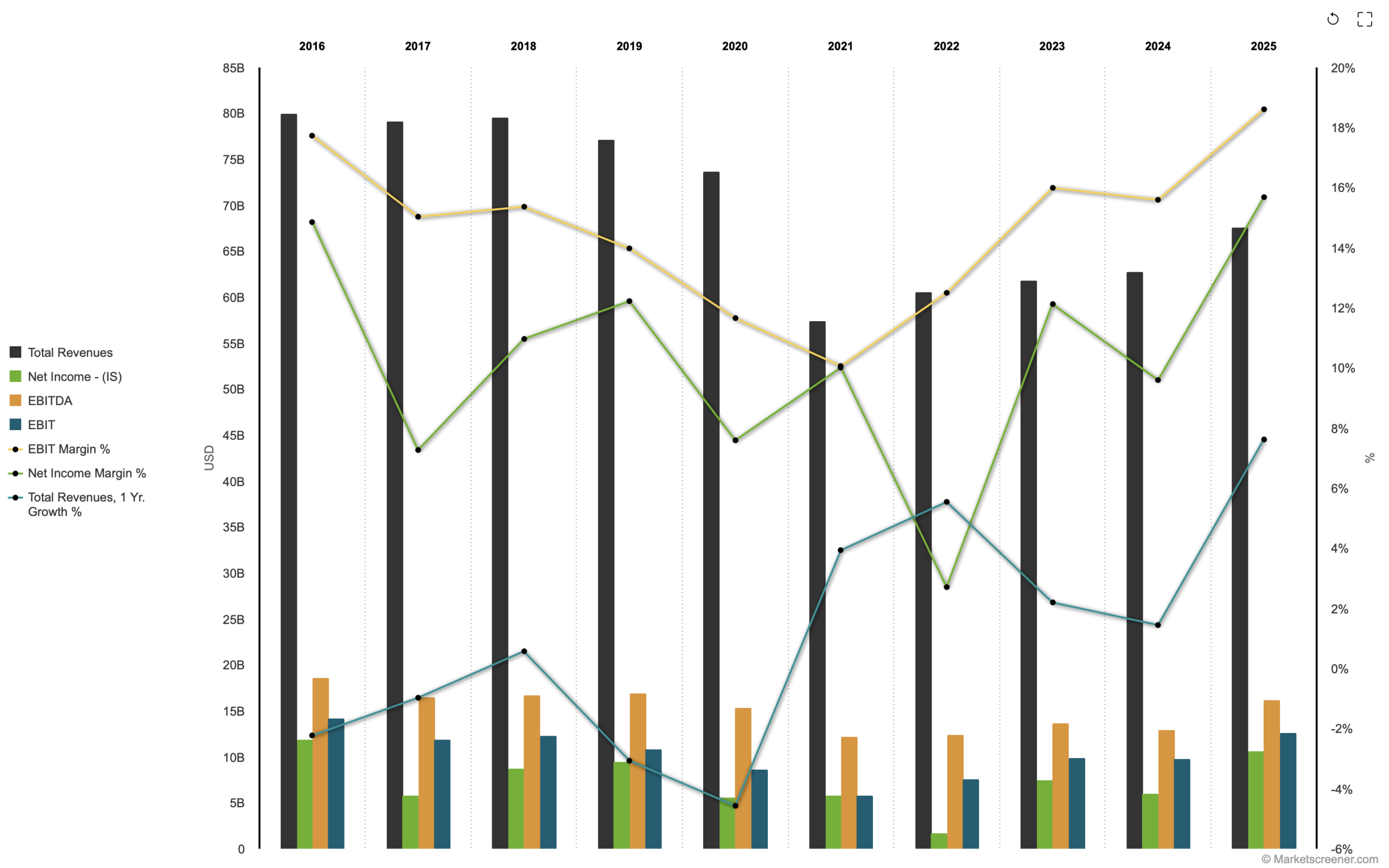
IBM’s financial profile has continued to improve as the multi-year transformation toward software, hybrid cloud, and enterprise AI increasingly takes effect. In fiscal year 2025, revenue rose 7.6% to $67.5 billion. According to MarketScreener consensus estimates, revenue is expected to reach approximately $71.5 billion in 2026 and nearly $79 billion by 2028. Drivers of this development include sustained high demand for AI software, automation solutions, and hybrid cloud offerings.
Key Takeaway
✓ Revenue growth has significantly accelerated, with analyst consensus expecting an increase to around $79 billion by 2028. This reflects the continued high demand for enterprise AI and hybrid cloud solutions.
✓ Profitability is continuously improving, with the EBITDA margin expected to rise to just under 29%. At the same time, operating margins remain among the highest in the enterprise IT sector.
✓ Free Cash Flow is expected to rise to around $15.6 billion in 2026, underscoring IBM’s extremely cash-flow-rich and capital-light business model.
✓ IBM continues to have one of the most reliable dividend profiles in the technology sector. An annual dividend of approximately $6.75 per share is expected for 2026.
⚠ Net debt is expected to rise to around $50.6 billion in 2026, primarily due to acquisitions. With a debt-to-EBITDA ratio of around 2.5x, the balance sheet remains solid, but debt is higher than that of many other mega-cap technology companies.
According to MarketScreener consensus estimates, capital expenditures (Capex) in 2026 will only amount to approximately 2–3% of revenue. This highlights IBM’s capital-light business model and its ability to generate sustainably high free cash flows.
Financial overview
| Key Figure | FY 2024 | FY 2025 | FY 2026e |
|---|---|---|---|
| Revenue | USD 62.8 billion | USD 67.5 billion | USD 71.5 billion |
| Revenue Growth | +1,4 % | +7,6 % | +5,9 % |
| EBITDA | USD 16.4 billion | USD 19.2 billion | USD 20.5 billion |
| EBITDA Margin | 26,1 % | 28,4 % | 28,7 % |
| EBIT Margin | 18,0 % | 20,9 % | 21,4 % |
| Net margin | 9,6 % | 15,7 % | 14,0 % |
| Free Cash Flow | USD 12.7 billion | USD 14.7 billion | USD 15.6 billion |
| Earnings per share (EPS) | USD 6.43 | USD 11.17 | USD 10.31 |
| Net Debt | USD 40.2 billion | USD 46.8 billion | USD 50.6 billion |
| Dividend per Share | USD 6.67 | USD 6.71 | USD 6.75 |
Source: MarketScreener estimates, July 2026.
MUMAK.me Assessment Phase 3: Positive = 1 MUMAK
International Business Machines (IBM)
Fundamentals Rating: positive
News, Analysts, and Market Sentiment
Assessment
Market sentiment towards IBM remains constructive, as investors continue to show confidence in the company’s strategy in enterprise AI, hybrid cloud, and software. After the strong share price performance of recent months, the stock is now trading near its all-time high.
Recent news flow has also been positive. IBM continues to expand its AI infrastructure portfolio with the new z17 mainframe and LinuxONE 5 systems. At the same time, the watsonx platform is gaining further importance as more and more companies integrate AI solutions into their day-to-day business processes.
Although analysts continue to rate IBM mostly positively, the strong share price increase has significantly reduced the remaining upside to the average analyst price target. Further price performance is therefore likely to depend increasingly on operational execution, quarterly results, and the successful monetization of the AI strategy, and less on further valuation expansion.
Key Takeaway
✓ Investor sentiment remains positive, supported by confidence in the strategy around enterprise AI, hybrid cloud, and software.
✓ The launch of the z17 mainframes, LinuxONE 5, and the expansion of the watsonx platform strengthen IBM’s competitive position in enterprise AI infrastructure.
✓ Analysts continue to mostly recommend the stock as “Add”, reflecting confidence in the company’s long-term transformation.
⚠ The share price is now trading around and above the average analyst price target, suggesting that a large part of short-term expectations is already priced in.
⚠ Further share price performance will increasingly depend on operational execution and the monetization of AI initiatives, as further valuation expansion is likely to become more difficult after the strong rally.
Analyst Consensus
| Average analyst recommendation | ACCUMULATE |
| Number of analysts | ~USD 277 |
| Average Price Target | approx. $295 |
| 1-month price performance | approx. +6.61% |
| Highest Price Target | $390 |
| Lowest Price Target | $195 |
Source: MarketScreener, as of July 2026.
Interesting Fact
IBM now supports more than 8,000 enterprise AI projects worldwide. The watsonx platform is now one of the company’s fastest-growing software offerings. Together with Red Hat OpenShift, IBM is positioning itself as one of the leading providers of enterprise AI solutions that enable companies to deploy artificial intelligence securely across hybrid cloud environments.
MUMAK.me Rating Phase 4: Neutral = 0 MUMAK
International Business Machines (IBM)
Market Sentiment Rating: neutral
Technical Analysis
Assessment
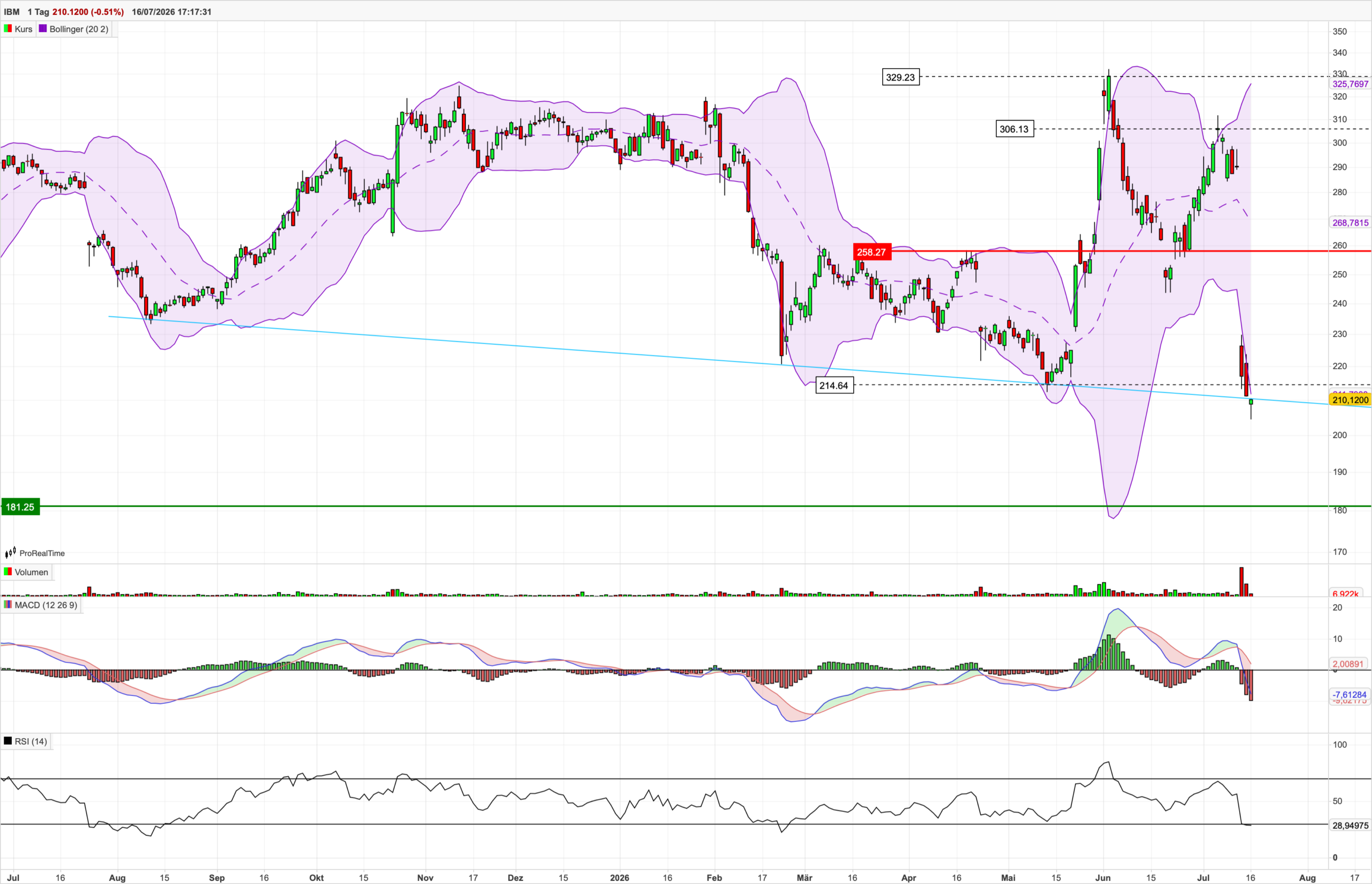
The technical picture for IBM has clouded over significantly. After a striking rise to an all-time high of around $329, the stock has entered a dynamic downward movement and has fallen below several key support levels within just a few trading days.
Particularly negative is the break of support at around $258, which previously served as a solid base. At the same time, the stock is now trading well below the 20-day moving average of the Bollinger Bands, confirming the short-term downtrend.
Momentum indicators have also clearly deteriorated. The RSI has fallen into oversold territory, while the MACD has generated a fresh sell signal. The high trading volume during the downward move also points to increased selling pressure from institutional market participants.
While a technical counter-reaction could occur at any time in the short term, the overall chart pattern has clearly worsened. Only a recapture of the former support zones would brighten the technical picture again.
| Indicator | Valuation | Interpretation |
|---|---|---|
| RSI (14) | Negative | The RSI is in oversold territory, signaling very weak short-term momentum. |
| MACD (12/26/9) | Negative | The MACD is trading below the signal line, confirming the existing downtrend. |
| Bollinger Bands (20) | Negative | The stock is trading at the lower Bollinger Band, showing significantly increased downward momentum. |
Key Takeaway
- The short-term chart pattern has deteriorated significantly.
- The break of support at $258 represents a clear sell signal.
- The next important support level is now in the $214 range.
- Should this level also be breached, the correction could extend into the $181 range.
- Only a sustained return above $258 would stabilize the technical picture again and noticeably reduce selling pressure.
RSI (14)
Negative
- Current RSI: approx. 29
- The RSI is just inside the oversold range.
- Momentum has deteriorated massively in a short period of time.
Interpretation: The RSI signals strong short-term selling pressure.
MACD (12/26/9)
Negative
- The MACD is well below the signal line.
- The histogram is deep in negative territory.
- Downward momentum has recently accelerated once again.
Interpretation: The MACD confirms the short-term downtrend.
Bollinger Bands (20)
Negative
- The stock is trading at or slightly below the lower Bollinger Band.
- The Bollinger Bands have widened significantly, indicating rising volatility.
- The price is trading clearly below the rising average of the Bollinger Bands.
Interpretation: The sharp price decline has led to a technical overextension.
MUMAK.me Assessment Phase 5: Negative = 0 MUMAK
International Business Machines (IBM)
Technical Analysis Evaluation: negative
What supports the current investment thesis?
- Leading position in enterprise AI, hybrid cloud, and mission-critical IT infrastructure.
- Recurring software revenues support rising margins and strong cash flow generation.
- Long-standing customer relationships with governments, financial institutions, and global corporations create high barriers to entry.
- Reliable dividend policy and disciplined capital allocation promote long-term shareholder returns.
- Continuous AI innovations through watsonx, Red Hat, and the z17 mainframe platform strengthen the competitive position.
What speaks against the current investment thesis?
- The valuation has become more demanding following the strong share price rally.
- Revenue growth remains below that of the fastest-growing enterprise software companies.
- Intense competition with Microsoft, Oracle, AWS, Google Cloud, and new AI providers remains high.
- Net debt is above the level of most mega-cap technology companies.
- Short-term share price performance increasingly depends on operational execution and the successful monetization of the AI strategy.
What we are watching
- Q2 2026 quarterly results as well as management’s outlook on software revenues, AI bookings, and free cash flow.
- Further adoption of the watsonx platform and other enterprise AI solutions.
- Growth of the hybrid cloud business, particularly around Red Hat.
- Progress in expanding operating margins as well as further growth in free cash flow.
Summary
IBM has successfully completed the transition from a traditional infrastructure company to one of the leading providers of enterprise AI, hybrid cloud, and mission-critical software solutions. The strongest revenue growth in more than a decade, rising margins, and record-high free cash flow show that this strategic transformation is increasingly reflected in the financial metrics. Combined with recurring software revenues, a capital-light business model, and one of the most reliable dividends in the technology sector, IBM continues to offer an attractive combination of growth and stability.
At the same time, a significant portion of this positive development is now priced into the share price. Following the strong rally, IBM is trading near its all-time high, while investor expectations for the monetization of the AI strategy continue to rise. Further upside potential is therefore likely to depend less on a higher valuation in the future and more on the company’s ability to continue revenue growth, further increase profitability, and successfully monetize its enterprise AI platform.
However, the current price slide was a shock.
Rating According to the MUMAK Method
| Category | Rating |
|---|---|
| Geopolitics | Positive |
| Industry | Positive |
| Fundamentals | Positive |
| News & Sentiment | Negative |
| Technical Analysis | Negative |


