
IBM Earnings Warning Shocks Markets! Are Fundamentals Back in Focus?
The international stock markets experienced a volatile trading week as the second-quarter earnings season gained significant momentum. Market sentiment was primarily shaped by the surprising earnings warning from IBM. It reminded investors that after months of AI euphoria, company fundamentals and their outlooks are now once again determining price development.
At the same time, geopolitical risks returned to sharper focus. Developments surrounding Iran, in particular, and the associated uncertainties in the Middle East increased nervousness in the capital markets. The unpredictable political course of the US government under President Donald Trump further amplified this uncertainty. In such an environment, companies with stable business models, robust cash flows, and predictable earnings development are regaining importance.
IBM surprised the market with preliminary quarterly figures that fell short of expectations in both revenue and profit. Many corporate customers temporarily shifted their IT spending from software and consulting projects to investments in AI infrastructure such as servers, storage solutions, and semiconductors. At the same time, several larger customer orders were postponed. The result was a stock price drop of around 25%, marking the largest single-day loss in the company’s history and weighing on the entire technology sector.
From a fundamental perspective, however, this price reaction appears to have been significantly stronger than the deterioration in short-term business prospects would suggest. The market, especially in phases of increased uncertainty, often tends to overreact – both upwards and downwards. The development at IBM also illustrates that high valuations alone are not enough. Long-term, operational development, earnings quality, and a company’s ability to sustainably meet capital market expectations remain crucial.
In contrast, the healthcare sector once again confirmed its defensive strength, while within the technology sector, a significantly stronger differentiation between individual companies emerged. Industrial and defense stocks partially continued their consolidation of recent months.
Development of the UMBRELLA Strategy
The UMBRELLA Strategy recorded a mixed trading week. The first important quarterly reports led to a stronger differentiation between individual sectors and companies.
Following the preliminary earnings warning, the position in IBM was completely exited from the UMBRELLA Strategy, as the company’s short-term prospects have noticeably worsened and the stop-loss in the strategy was triggered. Long-term, IBM could still be well positioned in enterprise AI, hybrid cloud, and mission-critical software. However, the weaker operational outlook made the stock less attractive in the short term. The focus was therefore further directed towards NextEra Energy and MercadoLibre.
A new long-term growth stock, MercadoLibre, was added. This slightly increases the UMBRELLA Strategy’s exposure to the Latin American e-commerce company.
Apple was the strongest performer within the strategy this week. Key factors were continued investor confidence in the growing AI ecosystem, the robust services business, and attractive long-term growth prospects. Additionally, Apple received the RED HOT CHILI™ MUMAK award last week, reflecting the currently positive result of our analysis model.
The healthcare sector once again proved to be one of the most stable components of the strategy. Johnson & Johnson published better-than-expected quarterly figures and simultaneously raised its full-year 2026 outlook. This once again confirmed the resilience of its broadly diversified healthcare business – despite an overall more volatile market environment.
From our perspective, the figures underscore our above-average weighting of the healthcare sector. Especially in healthcare, the capital market currently seems to be paying more attention to classic fundamental factors such as earnings development, cash flow, balance sheet quality, and valuation.
Bayer and Revolution Medicines also performed positively during the week. Eli Lilly, however, declined slightly. This could also be due to the upcoming release of its quarterly figures. Who doesn’t sometimes want to secure profits in advance?
Tesla remained volatile, even quite weak towards the end of the week. Demand development in the electric vehicle market, price trends, and progress in autonomous driving ahead of this week’s quarterly figures had a negative impact.
NextEra Energy moved slightly positively and continues to benefit from long-term growth trends such as electrification, the expansion of renewable energies, and the increasing demand for electricity due to AI infrastructure and data centers.
Rheinmetall continued its consolidation of recent months. However, our long-term positive assessment has not changed. Structurally increasing European defense budgets, higher NATO investments, and a record order backlog continue to form a solid foundation for future development. It remains to be seen whether this positive assessment will also be reflected in the share price or if the stop-loss in the UMBRELLA Strategy will be triggered instead.
Strategy positioning
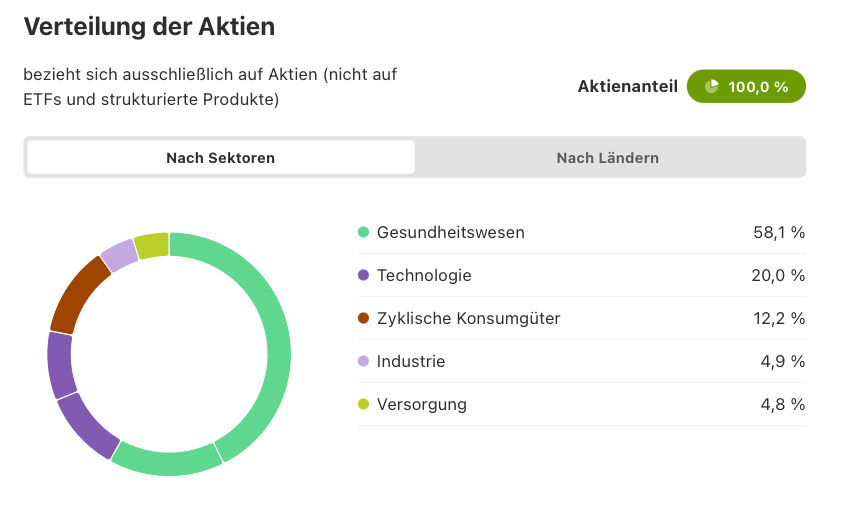
Last week, several adjustments were made within the strategy. Through the complete sale of IBM, the increase in NextEra Energy, and the new establishment of MercadoLibre , the orientation of the UMBRELLA Strategy was slightly adjusted in favor of the Latin American e-commerce and FinTech market.
However, the strategic focus remains unchanged on long-term growth trends. These include artificial intelligence, innovations in healthcare, electrification, digital commerce, FinTech, and the European defense industry.
Outlook
Geopolitically, the situation has recently clouded over again. Developments surrounding Iran, in particular, are once again causing greater uncertainty in the capital markets. At the same time, the often unpredictable political course of US President Donald Trump contributes to geopolitical risks moving back into investors’ focus in the short term.
Against this backdrop, the UMBRELLA Strategy is currently deliberately more strongly positioned in the healthcare sector. Many companies in this industry have comparatively stable business models and are significantly less dependent on geopolitical tensions or economic fluctuations than numerous industrial or technology companies. These defensive characteristics can make a stabilizing contribution to the overall portfolio in a more volatile market environment.
With the ongoing earnings season, one of the more important weeks of the quarter for corporate figures is now beginning. Above all, the forecasts of company managements are likely to have the greatest influence on sentiment in the stock markets. Following recent reactions to individual quarterly reports, the capital market is likely to punish short-term disappointments more consistently, while also rewarding companies with convincing fundamental data accordingly.
Our focus therefore remains unchanged on companies with sustainable earnings growth, strong competitive advantages, and attractive long-term fundamentals. Especially in a market environment characterized by geopolitical uncertainties and increasing differentiation, we consider these factors to be more crucial.
Upcoming Events
| Date | Company | Event |
|---|---|---|
| July 22, 2026 | Tesla | Publication of results for the 2nd quarter of 2026 |
| July 24, 2026 | NextEra Energy | Publication of results for the 2nd quarter of 2026 |
