

Brief Introduction – ConocoPhillips
This analysis evaluates ConocoPhillips according to the UMBRELLA Strategy using the MUMAK Method. The assessment is structured along five decision phases: geopolitics, industry, fundamental data, market sentiment, and technical analysis.
Structure: Classification → Core Statement → Rationale → Conclusion
The goal is not to predict the future precisely. The goal is orientation. We contextualize facts, demonstrate causal relationships, and structure a comprehensible decision logic.
We explain – you decide.
ConocoPhillips
Analysis Result: 5 out of 5 MUMAKS
Introduction
The energy sector is once again moving into sharper focus in capital markets. Geopolitical tensions in the Middle East, rising oil prices, and potential disruptions to key trade routes are currently changing the environment for oil producers. Companies with efficient production structures and clear capital discipline particularly benefit disproportionately during such phases.
ConocoPhillips is among these companies. The U.S. corporation combines a broad production base with a consistent focus on exploration and production. At the same time, the geopolitical situation—particularly around the Strait of Hormuz—is creating a risk premium in oil prices that directly impacts the cash flows of major producers.
The result upfront: All five categories currently deliver a positive signal. ConocoPhillips thus achieves a rating of 5 out of 5 MUMAKS.
Rating
Geopolitics
Assessment
The geopolitical environment for Oil and gas companies remains highly relevant, as energy supply, security of supply and geopolitical power remain strongly interconnected . At the same time. , political pressure from decarbonization and the energy transition is increasing in the long term . long-term to.
Key Takeaway
For ConocoPhillips, the geopolitical environment is structurally positive in the short and medium term, as oil and gas remain essential for global energy supply, industry, and geopolitical stability. In the long term, however, risks arise from the energy transition, regulatory pressure, and potential demand weakness.
Rationale
Energy Supply Remains Geopolitically Critical
Global conflicts and geopolitical tensions continue to demonstrate the strategic importance of fossil fuels:
- Middle East conflicts
- Russia/Ukraine issue
- LNG supply to Europe
- US supply security
Oil and gas production thus remains a central geopolitical power factor.
ConocoPhillips benefits from this as one of the world’s largest independent exploration and production companies with globally diversified production.
USA as a Geopolitical Advantage
A large portion of production is located in the USA and politically stable regions:
- Permian Basin
- Eagle Ford
- Alaska
- Canada
This reduces the risk of extreme geopolitical dependencies compared to state-dominated producers or emerging markets.
LNG and Global Gas Demand
Global LNG demand continues to grow:
- Europe replaces Russian gas
- Asia increases energy consumption
- AI and data centers increase electricity demand
ConocoPhillips is strategically expanding its LNG position, including through Qatar and US LNG projects.
Geopolitical Risks Remain High
At the same time, the industry is highly dependent on:
- Oil price cycles
- OPEC policy
- Sanctions
- Global economy
- Trade conflicts
Additionally, stricter climate policies and decarbonization could weigh on demand in the long term.
The geopolitical situation therefore simultaneously creates:
- short-term supply risks → higher prices
- long-term transformation risks → structural pressure
Conclusion
ConocoPhillips currently benefits from the strategic importance of fossil fuels and global supply security.
Its strong positioning in the US and LNG markets has a stabilizing effect. At the same time, oil prices, geopolitical conflicts, and the energy transition remain key risk factors.
→ MUMAK.me Rating Phase 1: positive (cyclical and geopolitically dependent) = 1 MUMAK
ConocoPhillips
Geopolitics Rating: positive
Industry
Assessment
The oil and gas industry remains highly profitable in the short term, but faces long-term structural challenges from decarbonization, the energy transition, and increasing regulatory requirements.
Key Takeaway
ConocoPhillips is strongly positioned within the traditional oil and gas industry and benefits from its size, scale, and high-quality assets. Nevertheless, the industry remains cyclical and structurally pressured in the long term by the global energy system transformation.
Rationale
Structurally High Demand Continues
Despite the energy transition, global oil and gas demand remains high:
- Industry
- Transport
- Chemicals
- Air travel
- Power supply
- LNG
Emerging markets, in particular, continue to drive energy consumption.
High-Quality Production Base
ConocoPhillips has:
- global diversification
- large reserves
- low production costs
- strong US shale position
Additionally, the Marathon Oil acquisition further strengthened the production base and scale.
Consolidation Strengthens Large Producers
The industry is increasingly in a consolidation phase:
- Economies of scale become more important
- Capital discipline increases
- Smaller producers come under pressure
Large companies with strong balance sheets and efficient production benefit from this.
Long-Term Transformation Pressure
However, structural risks remain significant:
- Expansion of renewable energies
- Electrification
- CO₂ regulation
- ESG pressure
- Political interventions
This could lead to slower long-term growth or a potential decline in demand for fossil fuels.
No Real Platform Expansion
Unlike integrated energy companies or technology firms, ConocoPhillips currently lacks a strong additional growth story outside of its traditional oil and gas business.
The investment logic therefore remains primarily:
→ Cash flow + commodity cycle + capital returns
Conclusion
ConocoPhillips is operationally strongly positioned within the oil and gas industry and benefits from its size, scale, and high-quality assets.
However, the industry remains structurally challenged in the long term by the energy transition and decarbonization. While this continues to generate an attractive cash flow profile, it does not offer a clear structural future market like AI, software, or electrification.
→ MUMAK.me Evaluation Phase 2: positive = 1 MUMAK
ConocoPhillips
Industry Rating: positive
Fundamentals
Assessment
The fundamentals show how efficiently ConocoPhillips can convert high commodity prices, production growth, and capital discipline into cash flows and shareholder returns.
Key Takeaway
ConocoPhillips’ fundamentals are strong. The company boasts high cash flows, solid profitability, strong reserves, and a robust balance sheet. However, results remain highly dependent on the oil and gas price cycle.
Rationale
Revenue and Earnings Development
Revenue: ~$55–60 billion USD
Net profit: remains clearly positive
Operating cash flow: very strong
Production: ~2.3–2.4 million BOE/day
This demonstrates:
- high operational strength
- strong scaling
- robust cash generation
High Profitability Despite Oil Price Fluctuations
ConocoPhillips remains profitable even with declining oil prices.
The company benefits from:
- low production costs
- efficient capital allocation
- high-quality asset portfolio
- disciplined cost structure
Balance Sheet Quality and Shareholder Returns
The balance sheet is considered robust:
- High liquidity
- strong free cash flow generation
- high dividends
- Share buybacks
ConocoPhillips is currently one of the most capital-disciplined companies in the energy sector.
Production Growth Through Marathon Acquisition
The Marathon Oil acquisition strengthens:
- reserves
- production volume
- Economies of scale
- free cash flow potential
At the same time, however, it also increases dependence on the oil price cycle.
Cyclical Dependence Remains Central
Earnings continue to fluctuate significantly with:
- Brent price
- gas prices
- global demand
- geopolitical events
This means visibility remains significantly more cyclical than for structural growth companies.
Conclusion
ConocoPhillips boasts strong fundamentals with high profitability, robust cash flow, and solid balance sheet quality.
Its core strength lies in capital discipline and efficient assets. At the same time, the business model remains highly dependent on the global oil and gas price cycle.
→ MUMAK.me Rating Phase 3: positive = 1 MUMAK
ConocoPhillips
Fundamentals Rating: positive
News, Analysts, and Market Sentiment
Assessment
Market sentiment towards ConocoPhillips is currently strongly influenced by oil price developments, geopolitical risks, and expectations of global demand.
Key Takeaway
Overall sentiment towards ConocoPhillips is constructive, but significantly more cautious than for structural growth industries. The stock is primarily valued as a cyclical cash flow and dividend play.
Rationale
Positive Factors
The market currently views positively:
- high free cash flows
- dividends
- Share buybacks
- production growth
- Marathon integration
Additionally, geopolitical tensions regularly provide support for oil prices.
Analyst Sentiment
Analyst sentiment is predominantly constructive:
- focus on cash flow strength
- strong balance sheet
- attractive capital returns
- favorable valuation relative to the market
At the same time, price targets remain highly dependent on the expected oil price level.
Limited Valuation Upside
Unlike technology or AI companies, however, there is no major narrative expansion.
The valuation is primarily based on:
- oil price assumptions
- production growth
- capital returns
This creates:
- lower valuation multiples
- but also lower structural growth potential
Market Remains Cyclical
Sentiment can change quickly with:
- falling oil prices
- recession fears
- OPEC decisions
- demand weakness
This means sentiment remains significantly more volatile and cyclical.
Conclusion
Market sentiment for ConocoPhillips is generally constructive, supported by strong cash flows, dividends, and solid fundamentals.
At the same time, the valuation remains highly dependent on the oil price environment and offers less structural growth potential than technology or future-oriented industries.
→ MUMAK.me Rating Phase 4: positive = 1 MUMAK
ConocoPhillips
Market Sentiment Rating: positive
Technical Analysis
Assessment
Technical analysis helps to examine entry points in a structured manner. It does not replace fundamental analysis but can support the timing of a position.
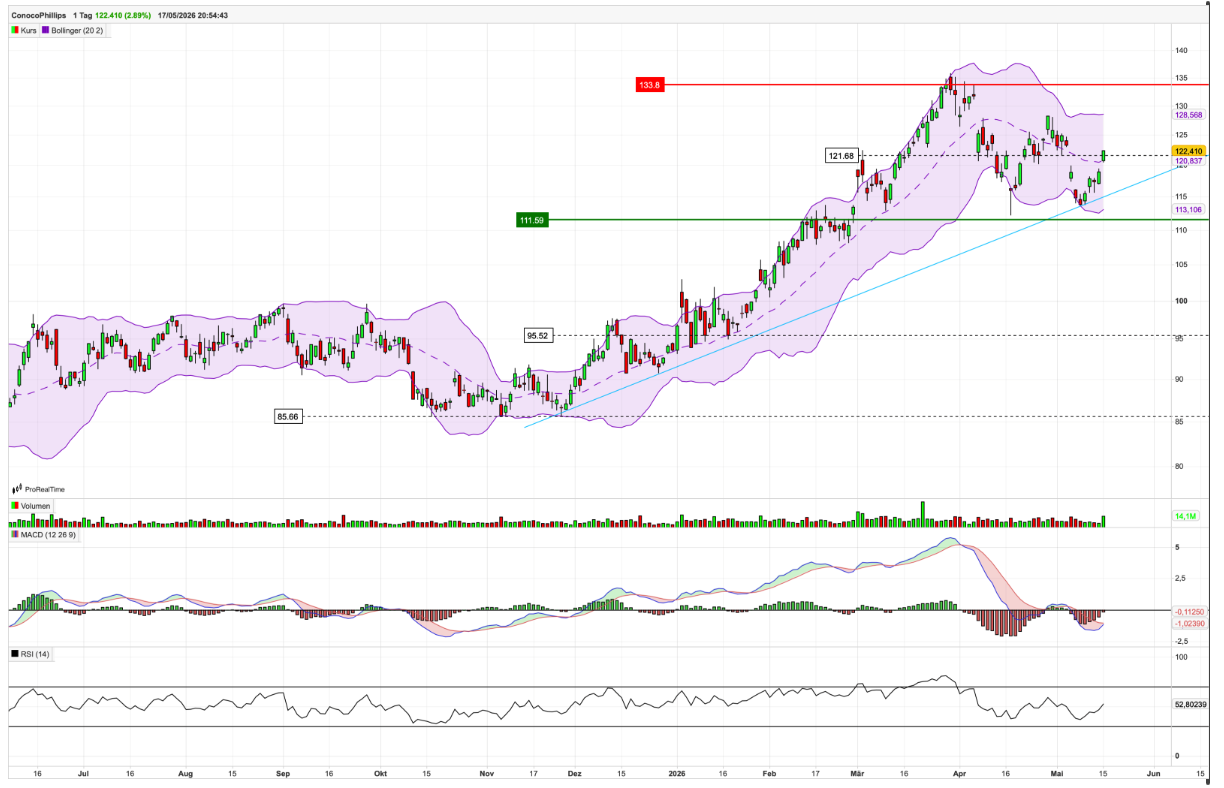
At ConocoPhillips, the technical structure is currently showing an improved picture again following a previous correction phase within the primary uptrend.
Key Takeaway
The long-term uptrend remains intact. After the significant correction from the high around 133.80 USD, the stock is stabilizing above key support zones and showing initial signs of a technical recovery.
Rationale
Development in recent weeks/months
The stock has been moving in a clear uptrend since late 2025 with a series of higher highs and higher lows. After the strong rise to the 133.80 USD range, a technically healthy consolidation occurred.
The long-term uptrend line remains intact and was recently successfully defended. The area around 111.50 USD is currently acting as central support.
The price is now trading back above the middle Bollinger Band and is approaching the 122–123 USD range. This signals increasing stabilization of the short-term market structure.
Development in recent weeks/months:
Bollinger Bands
The return toward the centerline signals easing selling pressure and a possible trend stabilization. A sustained breakout above the 128–130 USD range could release momentum toward the high of 133.80 USD again.
RSI
The RSI is currently slightly above 50, confirming a return to a neutral to positive market phase without yet being overbought.
This means:
- the strong downward momentum has significantly eased
- the market is no longer in oversold territory
- further upside potential remains technically possible
There is currently no talk of overheating.
MACD
The MACD is showing initial signs of bottoming out. The negative histogram bars are getting smaller and momentum is gradually improving.
A bullish crossover could generate a further technical buy signal in the short term and provide additional support for the recovery.
Additional Observation (Chart Structure)
The defended uptrend line since November remains particularly important. As long as this structure holds, the medium-term trend remains constructive.
Key technical levels:
- Support: ~111.50 USD
- Short-term support: ~120 USD
- Resistance: ~128–130 USD
- Main resistance: ~133.80 USD
A breakout above 133.80 USD would reconfirm the primary uptrend.
Plus: An “island gap” was able to form in a positive direction during the trading days of May 5–7 and May 14– 15.
In the Umbrella strategy, such a MUMAK wave is often seen in the run-up to a MUMAK breakout.
→ MUMAK.me Evaluation Phase 5: positive = 1 MUMAK
ConocoPhillips
Technical Analysis Rating: positive
Summary
The analysis shows a solid, but cyclically influenced overall picture.
Geopolitics → Industry → Fundamentals → Sentiment → Technical Analysis
Three out of five levels provide a positive signal, while the industry and technical analysis currently offer no clear positive impulses.
ConocoPhillips benefits from:
- geopolitical importance of fossil energy supply
- strong cash flows and capital discipline
- high-quality production base
- dividends and share buybacks
- global LNG and oil demand
The investment logic is primarily based on:
→ Oil + Gas + Cash Flow + Capital Returns
The key difference from structural growth companies:
- high cyclicality
- strong commodity dependence
- lower long-term growth potential
Assessment According to the MUMAK Method
| Category | Rating |
|---|---|
| Geopolitics | Positive |
| Industry | Positive |
| Fundamentals | Positive |
| News & Sentiment | Positive |
| Chart Analysis | Positive |


