


Moderna, Inc.
Moderna is a biotechnology company whose business model is based on its own messenger RNA (mRNA) platform. After gaining global recognition for its COVID-19 vaccine, Moderna is working to expand its business into other areas such as respiratory diseases, oncology, infectious diseases, and rare diseases.
This transformation has gained importance as revenues from COVID-19 vaccines have significantly declined from their peak during the pandemic.
Two developments in August 2026 significantly improved the company’s strategic position. On August 5, 2026, the FDA granted approval for mFLUSIVA, Moderna’s seasonal influenza vaccine for adults aged 50 and older. Even more significant was the announcement on August 19, 2026: Moderna and Merck released positive topline results from the Phase 3 study of Intismeran Autogene in melanoma.
Assessment
This analysis assesses Moderna according to the MUMAK UMBRELLA Strategy.
The valuation is carried out across five decision phases: Geopolitics, Industry, Fundamentals, Market Sentiment, and Technical Analysis.
The goal is not to predict the future exactly. The goal is orientation. We classify facts, show the interdependencies, and structure a transparent decision logic.
We explain – you decide.
Geopolitics
Classification
Moderna operates in an environment where biotechnology, vaccine production, and pandemic preparedness are increasingly of strategic importance to governments.
The COVID-19 pandemic demonstrated the importance of rapid vaccine development, proprietary production capacities, and secure pharmaceutical supply chains. Governments in the US, Europe, and other regions continue to work on improving their preparedness for future health crises.
Moderna benefits from this development through its mRNA technology platform, which allows vaccines and therapeutics to be developed comparatively quickly and adapted to new pathogens or therapeutic targets.
International relations with government agencies also increase the company’s strategic relevance. In 2026, Moderna continued deliveries under its long-term partnership with the UK government. At the same time, a joint procurement agreement with the European Commission for up to 24 million doses of mRESVIA for six European countries was concluded.
At the same time, the political environment for mRNA vaccines in the US has become more challenging. Changes in government policy and reduced government support for certain mRNA vaccine development programs increase uncertainty, particularly in the area of respiratory diseases.
However, the increasing expansion into oncology and personalized medicine reduces Moderna’s dependence on government vaccine programs and extends the strategic importance of the technology beyond infectious diseases.
Opportunities
- The continued importance of pandemic preparedness supports demand for technologies that can respond quickly to emerging infectious diseases.
- Governments increasingly view proprietary biotechnology and pharmaceutical production capacities as strategically important.
- European and international vaccine procurement programs create additional opportunities for Moderna’s products in respiratory diseases.
- The flexibility of the mRNA platform allows for comparatively rapid adaptation to new pathogens and health threats.
- Expansion into oncology and personalized medicine reduces dependence on politically sensitive vaccine programs.
Risks
- Changes in US vaccine policy could reduce government support for certain mRNA programs.
- Health policy decisions and vaccine recommendations can directly influence demand for respiratory disease vaccines.
- Government procurement programs remain dependent on political priorities and health budgets.
- Pharmaceutical supply chains and varying international regulatory requirements can complicate global commercialization.
- Increased political discussion about mRNA technology could affect public acceptance and future government funding.
Key takeaway: The increasing focus on pandemic preparedness, medical sovereignty, and secure pharmaceutical supply chains supports the long-term strategic relevance of the mRNA platform.
MUMAK.me Rating Phase 1: Positive = 1 MUMAK
Moderna, Inc.
Industry
Classification
Moderna operates in the global biotechnology and pharmaceutical industry, with a particular focus on mRNA-based vaccines and therapeutics.
The biotechnology industry continues to benefit from structural growth drivers such as aging populations, rising healthcare expenditures, advances in personalized medicine, and growing demand for new treatment options in oncology and infectious diseases.
In this environment, mRNA technology represents an important area of innovation. The platform can potentially be used in multiple therapeutic areas without the need to develop a completely new technological approach for each new product.
Moderna’s business model is therefore gradually evolving from a company primarily associated with respiratory disease vaccines to a broader biotechnology platform with activities in oncology, infectious diseases, rare diseases, and other therapeutic fields.
The recent positive Phase 3 results in melanoma are particularly relevant for this development, as they provide further clinical validation for the use of mRNA technology outside of traditional vaccines.
Moderna in Valuation Comparison
| Key Figure | Moderna 2026e | Industry Average* | Valuation |
|---|---|---|---|
| P/E ratio | −15.5x | approx. 15–25x for profitable peers | Weaker / not meaningful |
| EBIT margin | −166% | approx. −100% to +35% | Weaker |
| Net margin | −161% | approx. −75% to +20% | Weaker |
| Revenue growth 2026e | approx. 8.4% | approx. −25% to +10% | In line |
*The peer group includes BioNTech, Pfizer, Merck & Co., Gilead Sciences as well as other pharmaceutical companies focusing on vaccines and biotechnology.
Source: MarketScreener consensus estimates and market data, August 2026.
Unlike established pharmaceutical companies such as Pfizer or Merck, Moderna continues to bear high research and development costs while simultaneously rebuilding its revenue base after the decline in COVID-19 vaccine sales.
The comparison with BioNTech is more relevant from a technological and developmental perspective. BioNTech is also expected to report negative EBIT and net margins in 2026 and is investing heavily in its oncology pipeline.
Pfizer, on the other hand, is expected to achieve an EBIT margin of around 35% and a net margin of approximately 17% in 2026.
For Moderna, therefore, the current P/E ratio is less critical than the question of whether the pipeline can generate sufficient future revenues to cover the currently high development costs.
Opportunities
- The expansion of mRNA technology into oncology could significantly broaden the addressable market beyond respiratory vaccines.
- Personalized cancer therapies represent a structurally growing area within biotechnology.
- Moderna’s platform enables multiple therapeutic programs to utilize shared research and production capacities.
- The approval of additional respiratory vaccines broadens the commercial product base.
- Positive results in advanced clinical trials in oncology could also validate mRNA technology for further cancer indications.
- The increasing demand for targeted and personalized therapies supports the long-term development of the pipeline.
Risks
- The development of biotechnological products is associated with significant clinical and regulatory risks.
- Moderna currently shows significantly weaker profitability than established pharmaceutical companies.
- High research and development expenditures will continue to weigh on margins until additional products reach the commercialization phase.
- Competition from BioNTech and large pharmaceutical companies remains high.
- Personalized cancer therapies require more complex production and logistics processes than conventional drugs.
- Positive results in one cancer indication cannot automatically be transferred to other tumor types.
Key takeaway: Moderna operates in a structurally attractive biotechnology industry that offers significant opportunities in mRNA technology, oncology, and personalized medicine.
Current profitability remains significantly below that of established pharmaceutical companies. However, the growing pipeline and increasing clinical validation of the mRNA platform support a positive long-term industry valuation.
MUMAK.me Rating Phase 2: Positive = 1 MUMAK
Moderna, Inc.
Fundamentals
Assessment
Moderna is currently in a comprehensive financial transition phase after demand for COVID-19 vaccines collapsed.
Revenues have declined significantly from their pandemic peaks; at the same time, continued high investment in research and development is resulting in substantial operating losses. However, the company maintains a solid liquidity position and is actively working to reduce its cost base.
Latest results for the second quarter of 2026 show that this transition is not yet complete. Moderna generated revenue of $145 million, while management simultaneously improved its outlook for operating costs and the expected year-end cash balance.
Financial Development
| Key Figure | Q2 2026 | Q2 2025 | Change |
|---|---|---|---|
| Revenue | $145 million | $142 million | +2% |
| Net Loss | $0.8 billion | $0.8 billion | largely stable |
| Loss per Share | $1.97 | $2.13 | improved |
| R&D Expenses | $651 million | $744 million | −13% |
| Selling and Administrative Expenses | $216 million | $268 million | −19% |
| Cash & Investments | $6.9 billion | – | strong liquidity position |
Source: Moderna Q2 2026 Results.
The quarterly figures show progress in cost reduction. However, the current revenue base is not yet sufficient to cover the significant expenses associated with the research and development pipeline.
Management confirmed its expectation of revenue growth of up to 10% in 2026 and raised its forecast for cash and investments at year-end to $4.7–$5.2 billion.
Development Since the Pandemic
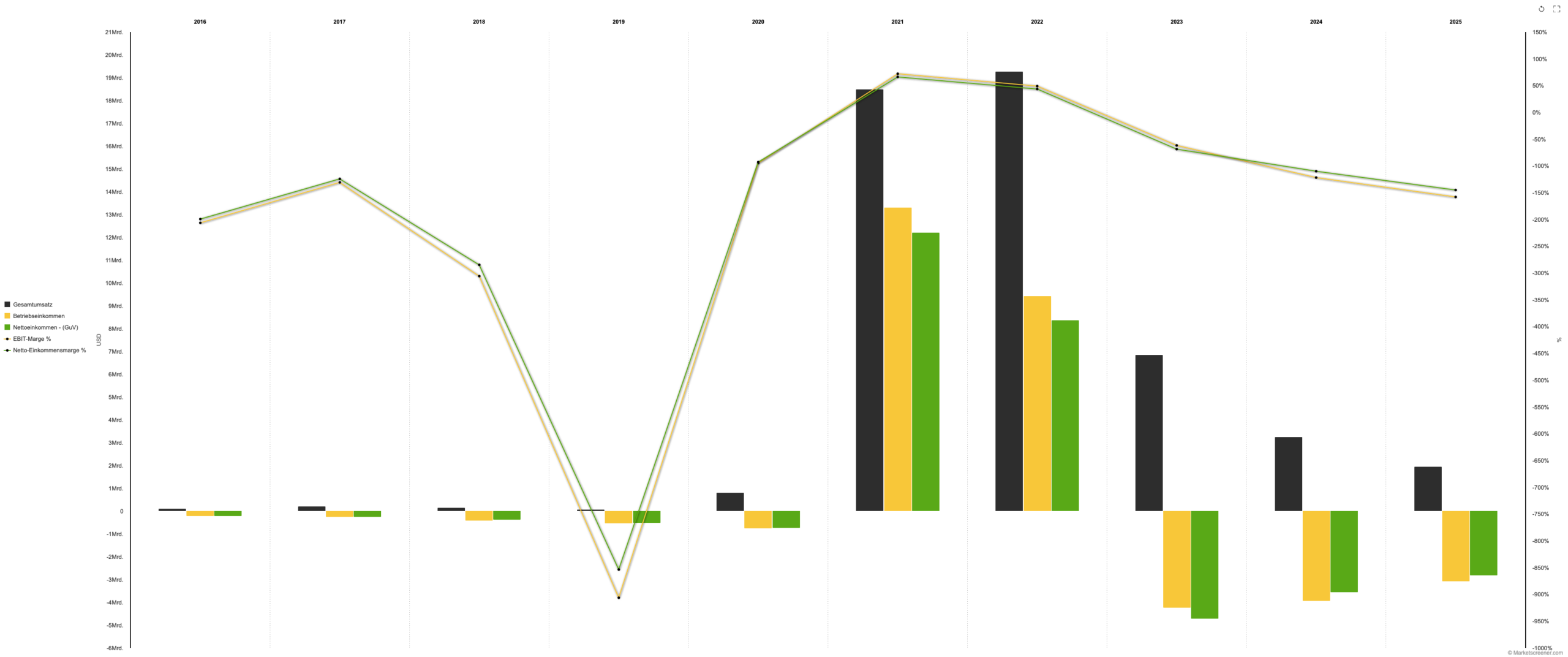
Historical financial performance illustrates the extent of Moderna’s transformation.
During the COVID-19 pandemic, revenue surged, reaching approximately $19.3 billion in 2022, primarily driven by the company’s COVID-19 vaccine.
With the normalization of pandemic-related demand, revenue subsequently declined significantly:
- 2022: approx. $19.3 billion
- 2023: $6.8 billion
- 2024: $3.2 billion
- 2025: $1.9 billion
At the same time, Moderna evolved from a highly profitable company to one with operating losses, as significant funds continue to flow into the broader research and development pipeline.
Outlook 2026–2028
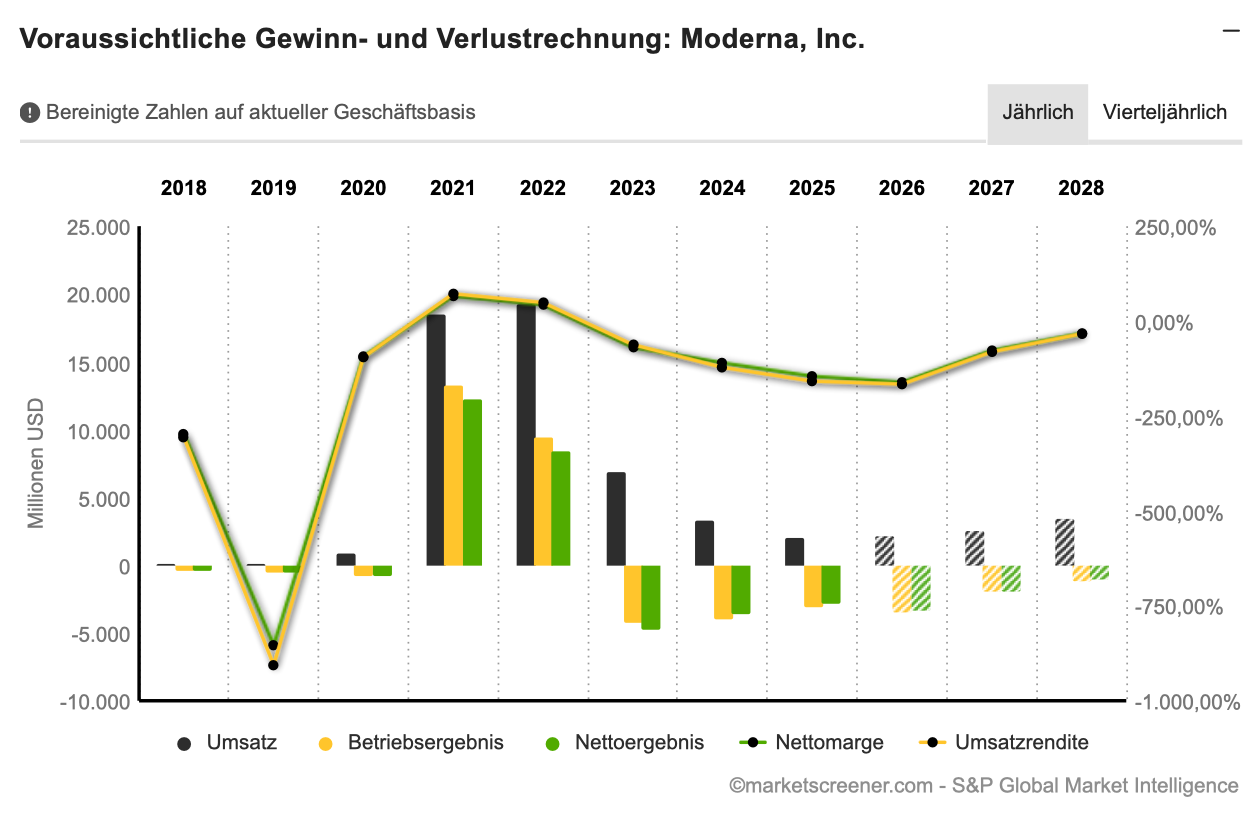
Consensus estimates suggest that 2025 could represent the preliminary low point in revenue development. For the coming years, analysts currently expect a gradual recovery.
Source: MarketScreener consensus estimates, August 2026.
The estimates can be divided into two distinct phases.
For 2026, moderate revenue growth is again expected. However, operating and net losses are likely to remain high as Moderna continues to fund its pipeline and commercial infrastructure.
From 2027 onwards, the financial picture is expected to gradually improve. Consensus currently expects revenue growth of around 15% in 2027 and 35% in 2028. At the same time, the net loss is projected to decrease from approximately $3.4 billion in 2026 to $1.2 billion in 2028.
However, analysts currently do not expect a return to profitability until 2028. The fundamental development therefore largely depends on whether new products can generate sufficient commercial revenues while management simultaneously continues to reduce operating costs.
Balance Sheet and Liquidity Position
Liquidity remains a key financial strength for Moderna.
At the end of the second quarter of 2026, the company had approximately $6.9 billion in cash and investments. By year-end, management expects a decrease to about $4.7–5.2 billion, primarily due to further expenditures for research, development, and commercialization.
The existing liquidity provides Moderna with financial flexibility to further develop its pipeline without relying on external financing in the short term.
Revenue Diversification
The central fundamental question is whether Moderna can successfully replace its former dependence on COVID-19 vaccine revenues with a broader commercial product base.
The company is increasingly moving towards a diversified model with focus areas on:
- respiratory vaccines,
- oncology,
- further programs against infectious diseases.
Successful commercialization of new products would gradually broaden the revenue base. Progress in oncology could become particularly relevant in the medium to long term.
This transformation is not yet visible in current profitability. However, consensus estimates suggest that revenue growth could accelerate once additional products and indications contribute to sales.
Key takeaway: Moderna’s fundamentals currently show a mixed, but long-term improved picture.
The company continues to report significant losses and high cash burn. At the same time, the strong liquidity position provides financial flexibility, operating costs are being reduced, and consensus estimates project revenue growth again from 2026.
MUMAK.me Rating Phase 3: Neutral = 0 MUMAK
Moderna, Inc.
News, Analysts, and Market Sentiment
Classification
The news flow surrounding Moderna significantly improved in August 2026. Two developments were particularly decisive: the approval of a new influenza vaccine and positive Phase 3 results in personalized oncology.
On August 5, 2026, the FDA granted approval for mFLUSIVA, Moderna’s mRNA-based influenza vaccine for adults aged 50 and older. The approval expands the commercial offering in respiratory diseases and represents further regulatory validation of the mRNA platform.
The more significant development followed on August 19, 2026, when Moderna and Merck announced positive topline results from the Phase 3 INTerpath-001 study.
The study investigated Intismeran Autogene in combination with Merck’s Keytruda in patients with completely resected Stage IIB–IV melanoma. The study met both its primary endpoint of recurrence-free survival and the important secondary endpoint of distant metastasis-free survival. Clinically relevant improvements were achieved compared to Keytruda monotherapy.
The results represent an important milestone as they provide clinical validation of mRNA technology in personalized cancer therapy in a Phase 3 study. This significantly expands the potential application area of the Moderna platform beyond infectious diseases.
The market reaction was correspondingly strong. Moderna’s stock rose by approximately 177% on August 19, reflecting a rapid revaluation of the oncology pipeline’s potential. A counter-movement then ensued as the market increasingly assessed how much of the future commercial potential might already be priced into the higher stock level.
Analyst Consensus
| Average Recommendation | HOLD |
| Number of Analysts | 23 |
| Average Price Target | approx. $89 |
| Distance to Average Target | approx. -33% |
| Highest Price Target | $170 |
| Lowest Price Target | $25 |
Source: MarketScreener consensus estimates. The latest available consensus largely predates the announcement of positive Phase 3 results on August 19, 2026.
Prior to the release of the melanoma results, analyst expectations were comparatively cautious.
The strong market reaction has simultaneously led to a wide range of differing assessments. While the Phase 3 results provide important clinical confirmation, some analysts point out that the current valuation might already assume high future revenues in the oncology sector.
UBS, for example, noted that the valuation after the announcement could imply annual revenues of approximately $20 billion – a level that, in the analysts’ view, would be difficult to justify at this point.
Market Sentiment
Sentiment towards Moderna has shifted from cautious to significantly more positive.
Before August 19, three factors were primarily in focus:
- declining COVID-19 revenues,
- ongoing operating losses,
- uncertainty about whether the broader mRNA pipeline can yield commercially relevant products.
The positive Phase 3 results in melanoma address one of these central questions. They show that Moderna’s mRNA platform can achieve clinically relevant results in oncology as well.
At the same time, the strength of the stock’s reaction has significantly raised expectations.
The full data from the Phase 3 study have not yet been published. Data on overall survival are also not yet available, and regulatory approval is still pending.
Moderna and Merck plan to present the full study results at an upcoming medical conference and to initiate discussions with the relevant regulatory authorities regarding potential submissions.
Interesting Fact
Intismeran Autogene is an individualized cancer therapy and not a conventional standardized vaccine.
A patient’s tumor is analyzed to identify specific mutations and so-called neoantigens. Moderna then produces an individually tailored mRNA therapy designed to train the immune system to recognize precisely these tumor-specific characteristics.
This approach combines genome sequencing, personalized medicine, and mRNA technology. At the same time, it creates more complex requirements for production and logistics than conventional pharmaceutical products.
Opportunities
- The positive Phase 3 results in melanoma provide important clinical validation for Moderna’s oncology platform.
- FDA approval of mFLUSIVA expands the commercial product base.
- Regulatory progress for Intismeran could create a significant new business area outside of respiratory vaccines.
- Further Phase 2 and Phase 3 studies could expand the use of Intismeran to additional cancer indications.
- Successful commercialization would further reduce dependence on seasonal vaccine revenues.
- Recent clinical developments have significantly improved the perception of the broader mRNA platform’s potential.
Risks
- The full Phase 3 data for the melanoma study have not yet been published.
- Overall survival data are not yet available.
- Regulatory approval for Intismeran Autogene is still pending.
- Current analyst price targets largely predate the Phase 3 announcement and therefore have limited relevance at this time.
- The strong stock price increase has significantly raised market expectations.
- Personalized cancer therapies place high demands on production and commercialization.
- Positive results in melanoma do not guarantee comparable results in other cancer indications.
Key takeaway: News flow and market sentiment surrounding Moderna have significantly improved following the FDA approval of mFLUSIVA and especially the positive Phase 3 results in melanoma.
MUMAK.me Rating Phase 4: Positive = 1 MUMAK
Moderna, Inc.
Technical Analysis
Classification
Moderna’s technical picture has changed significantly after the positive Phase 3 results in melanoma.
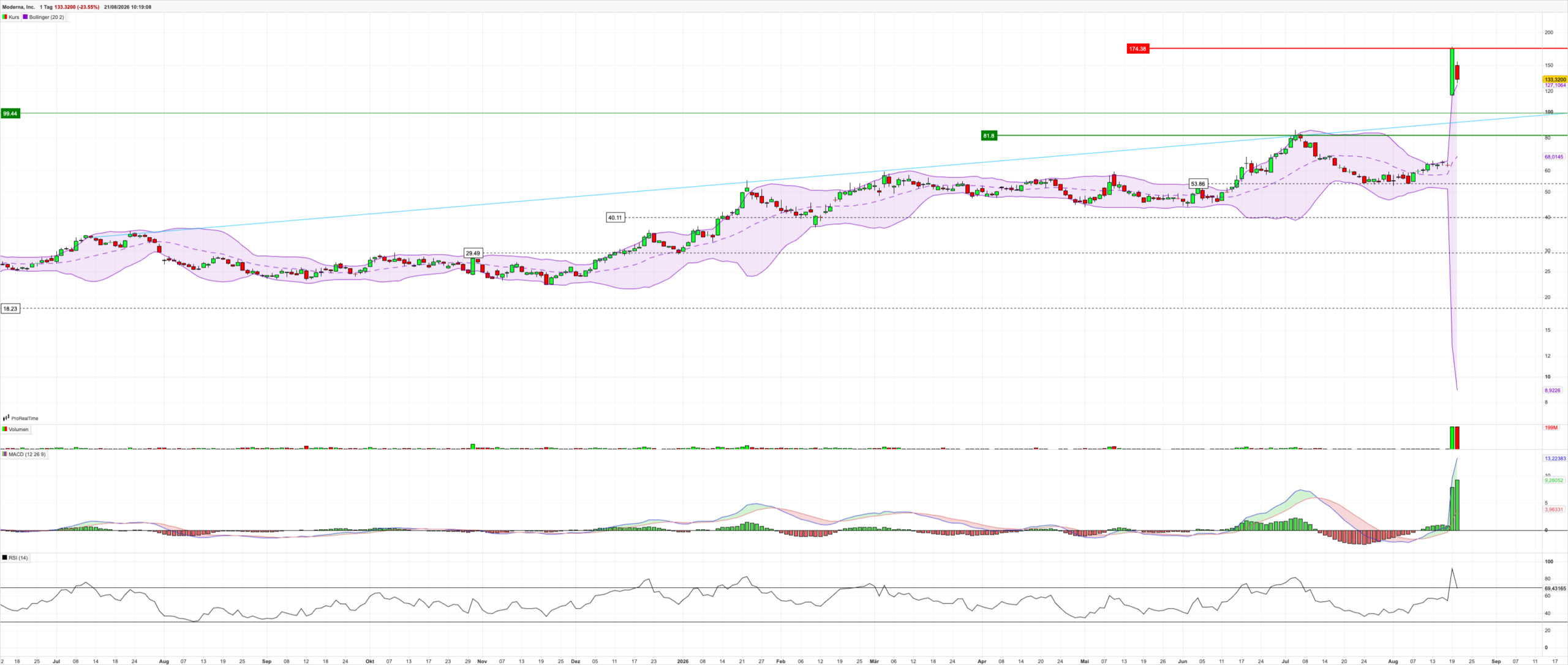
On August 19, 2026, the stock initially broke significantly above the previous resistance at around $81.80 and subsequently also above the longer-term resistance at approximately $99.44. The breakout was accompanied by very high trading volume, thus confirming a significant change in market momentum.
After a high of around $174.38, a counter-movement ensued. At the time of analysis, the stock is trading at approximately $133.32. Despite this correction, the price remains clearly above the previously overcome resistance levels.
The technical trend is therefore positive, although the speed and extent of the recent price movement also indicate very high short-term volatility.
Development of the past weeks/months
(As of: August 21, 2026)
| Indicator | Assessment | Interpretation |
| RSI (14) | Positive | At around 69.4; momentum remains strong, but the stock is approaching the overbought area. |
| MACD | Positive | The MACD is significantly above the signal line, confirming the positive momentum after the breakout. |
| Bollinger Bands | Positive | The bands have widened significantly after the strong price increase. This signals strong momentum but also very high volatility. |
RSI (14)
Positive
- The RSI is currently around 69.4.
- Momentum has significantly strengthened after the August breakout.
- The indicator is near the overbought area but has already moved away from the very high level during the initial price surge.
Interpretation
The RSI confirms positive momentum. However, the still elevated level increases the likelihood of further short-term consolidation.
MACD (12/26/9)
Positive
- The MACD has risen significantly above the signal line.
- Momentum has considerably strengthened after the breakout.
- The indicator continues to support the current positive technical trend.
Interpretation
The MACD confirms the significant improvement in momentum after the recent breakout.
Bollinger Bands (20)
Positive
- The Bollinger Bands have widened significantly after the strong price increase on August 19.
- During the initial breakout, the stock moved significantly above the upper Bollinger Band.
- The current counter-movement represents a partial normalization after the very strong price increase.
Interpretation
The Bollinger Bands confirm the strength of the breakout, but also show that volatility is currently unusually high.
Opportunities
- The breakout above $81.80 and $99.44 represents a significant improvement in the longer-term technical structure.
- The very high trading volume confirms broad market participation in the breakout.
- The MACD remains clearly positive and supports the current uptrend.
- Despite the counter-movement, the RSI continues to show strong momentum.
Risks
- The exceptionally strong price increase has led to very high short-term volatility.
- The RSI remains close to the overbought area.
- The recent high of $174.38 represents the first significant resistance after the strong upward movement.
- A drop below $99.44 would weaken the current breakout structure.
Key takeaway: Moderna’s technical picture has significantly improved after the breakout above $81.80 and $99.44.
Positive signals from RSI and MACD continue to support the overarching uptrend. At the same time, the exceptionally strong recent price movement and the significantly expanded Bollinger Bands indicate that short-term volatility is likely to remain high.
MUMAK.me Rating Phase 5: Positive = 1 MUMAK
Moderna, Inc.
What supports the case for Moderna?
- The positive Phase 3 results in melanoma provide important clinical validation for Moderna’s personalized mRNA oncology platform.
- The FDA approval of mFLUSIVA expands the commercial product base beyond COVID-19 and RSV vaccines.
- Moderna’s mRNA platform covers several areas, including respiratory diseases, oncology, and infectious diseases.
- The company maintains a solid liquidity position with $6.9 bn in cash and investments at the end of the second quarter of 2026.
- Ongoing cost-cutting measures are gradually reducing research, development, and administrative costs.
- Consensus estimates project a return to revenue growth starting in 2026, with stronger growth momentum expected for 2028.
- The technical picture has significantly improved following the breakout above $81.80 and $99.44.
What are the risks for Moderna?
- Moderna continues to report significant operating and net losses.
- Current revenues remain well below the levels reached during the COVID-19 pandemic.
- Consensus estimates currently assume that the company will remain loss-making until at least 2028.
- Ongoing cash burn makes the development of the liquidity position a key factor to monitor.
- The development of biotechnological products involves significant clinical and regulatory risks.
- Autogene Intismeran has not yet received regulatory approval, despite the positive Phase 3 results in melanoma.
- The strong recent price increase has significantly raised market expectations and short-term volatility.
- Changes in US vaccination policy continue to pose a risk to parts of the respiratory vaccine business.
What we are watching
- The full Phase 3 data from the INTerpath-001 study in melanoma, as well as further information on efficacy and safety.
- Regulatory discussions and potential marketing applications for Autogene Intismeran.
- Progress in Intismeran trials in additional cancer indications.
- The commercial development of mFLUSIVA in the 2026/2027 flu season.
- Whether Moderna can meet its 2026 revenue guidance while further reducing operating costs.
- The development of cash and investments, as well as the rate of cash burn.
- Progress within the broader respiratory and infectious disease pipeline.
Summary
Moderna is undergoing a comprehensive transformation from a company primarily dependent on COVID-19 vaccine sales to a more broadly positioned mRNA-based biotechnology platform.
The financial transformation is not yet complete. Revenues remain significantly below pandemic levels, the company is recording substantial losses, and current consensus estimates do not expect a return to profitability until 2028.
At the same time, the outlook has improved significantly in August 2026. The FDA approval of mFLUSIVA expands the commercial business in the respiratory disease segment. Even more significant are the positive Phase 3 results for Autogene Intismeran in melanoma, which represent an important clinical validation of mRNA technology in oncology.
This development is particularly relevant as it expands the potential application of the Moderna platform beyond infectious diseases and could establish oncology as an additional long-term growth area.
The technical picture has also improved significantly following the recent breakout. However, the strength of the price movement has simultaneously increased short-term volatility.
The decisive factor now will be whether Moderna can translate its clinical progress into regulatory approvals, additional commercial products, and an improvement in financial performance. Progress in these areas will determine whether the recent improvement develops into a sustainable long-term transformation.
Rating According to the MUMAK Method
| Category | Rating |
|---|---|
| Geopolitics | Positive |
| Industry | Positive |
| Fundamentals | Neutral |
| News & Sentiment | Positive |
| Technical Analysis | Positive |
Overall Rating


