


Thales S.A.
Since our Thales analysis at the end of July, the stock price has continued to recover, temporarily reaching levels last observed in spring. Following this movement, the stock has recently pulled back from its August highs.
At the same time, the company’s latest financial figures continue to provide a solid fundamental basis, while several analysts have adjusted their assessments and price targets after the half-year results.
We have therefore updated our Thales analysis to reflect the latest valuation data, analyst expectations, market sentiment, and the changed technical picture.
Rating
This analysis assesses Thales under the UMBRELLA strategy using the MUMAK method.
The valuation is conducted across five decision-making phases: Geopolitics, Industry, Fundamentals, Market Sentiment, and Technical Analysis.
The goal is not to predict the future precisely. The goal is orientation. We contextualize facts, demonstrate causal relationships, and structure a comprehensible decision logic.
We explain – you decide.
Geopolitics
Classification
Thales operates in a market environment that continues to benefit from structural geopolitical changes. Rising defense spending in Europe, increased NATO commitments, and growing investments in air defense, cybersecurity, and military communication systems support long-term demand for the company’s technologies.
Furthermore, Thales benefits from increasing government investments in critical infrastructure, secure digital systems, and space technologies. This makes the company less dependent on individual large-scale military projects.
The results for the first half of 2026 confirm this development: Order intake in the defense business increased by 28% year-on-year, while management confirmed the full-year outlook despite the discontinuation of the German F126 frigate program.
Opportunities
- Rising NATO defense spending supports long-term demand for defense electronics, radar, communication, and missile systems.
- Increasing geopolitical tensions raise the need for air defense, cybersecurity, secure communication solutions, and surveillance technologies.
- Growing investments in space infrastructure and satellite technologies open up additional long-term growth opportunities.
- The trend towards digital sovereignty strengthens demand for Thales’ cybersecurity and digital identity solutions.
Risks
- Defense budgets remain dependent on political priorities and government procurement decisions.
- Delays in major international orders can lead to short-term fluctuations in order intake.
- Export restrictions and geopolitical tensions can delay or restrict international defense business.
- Large defense programs carry execution risks, as shown by the discontinuation of the German F126 frigate program. However, the impact on Thales’ operational profitability remains limited.
Key Takeaway: The current geopolitical environment continues to offer attractive long-term conditions for Thales.
MUMAK.me Rating Phase 1: Positive = 1 MUMAK
Thales S.A.
Industry
Assessment
Thales operates in an attractive segment of the European aerospace and defense industry. Unlike many traditional defense companies, it is less dependent on individual aircraft, ship, or vehicle platforms. Instead, Thales supplies technologies used in a wide range of military and civilian systems.
Additionally, the company benefits from the modernization of civil aviation and long-term investments in satellite and space systems.
Thales: Valuation Comparison
| Metric | Thales 2026e | Industry Average* | Rating |
|---|---|---|---|
| P/E Ratio | 30.6x | approx. 20–26x | Weaker / Highly valued |
| EBIT margin | 12,6 % | approx. 9–15% | In line |
| Net margin | 7,1 % | approx. 7–14% | In line |
| Revenue Growth | approx. 7.7% | approx. 7–17% | In line |
*Peer group: Airbus, BAE Systems, Leonardo, Rheinmetall, Saab, and Dassault Aviation. Source: MarketScreener consensus estimates and market data, August 2026.
The comparison shows that while Thales does not achieve the highest growth within the industry, it offers a balanced combination of profitability, stable earnings, and high visibility.
Opportunities
- Rising European defense spending supports long-term demand for radar, sensor, air defense, and military communication systems.
- Increasing cyber threats raise the need for cybersecurity, encryption, and digital identity solutions.
- Military modernization programs increase the share of electronic systems in aircraft, ships, and land vehicles, thereby increasing the value of Thales’ technologies.
- Investments in satellite infrastructure, secure connectivity, and space surveillance create additional long-term growth opportunities.
- Thanks to its broadly diversified technology portfolio, Thales can participate in numerous defense programs without being dependent on the success of a single platform.
Risks
- Government procurement cycles can lead to longer periods between political decisions and revenue realization.
- Competition with European and US defense technology companies could put pressure on margins and pricing.
- The civil aviation and space sectors remain vulnerable to program delays, supply chain issues, and changes in customer demand.
Key Takeaway: Thales is positioned in an attractive and structurally growing industry, combining above-average operational profitability with a broad presence in defense electronics, cybersecurity, aerospace, and space technologies.
MUMAK.me Assessment Phase 2: Positive = 1 MUMAK
Thales S.A.
Fundamentals
Assessment
Thales showed strong operational development in the first half of 2026. Particularly noteworthy is not only the revenue growth but, above all, the significantly higher momentum in order intake.
The reported consolidated net income was impacted by a special effect related to the termination of the German F126 frigate program. However, operational development remained largely unaffected and continued its positive trend.
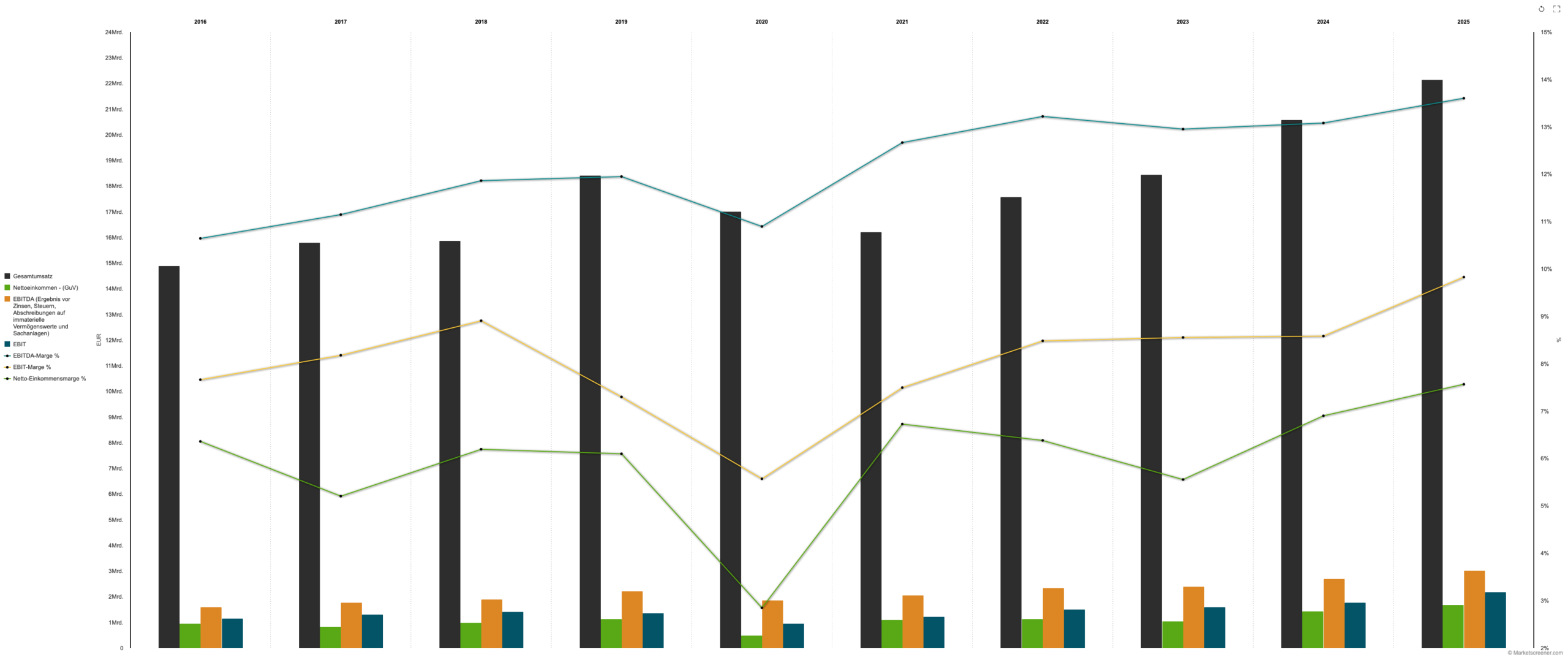
Financial Metrics
| Key Figure | H1 2026 | H1 2025 | Change |
|---|---|---|---|
| Revenue | EUR 10.95 billion | EUR 10.26 billion | +6,7 % |
| Adjusted EBIT | EUR 1.37 billion | EUR 1.25 billion | +9,9 % |
| Adjusted EBIT margin | 12,5 % | 12,2 % | +0.3 percentage points |
| Adjusted net income | EUR 990 million | EUR 877 million | +13,0 % |
| Net income (shareholders' share) | EUR 485 million | EUR 664 million | −27.0% |
| Free Operating Cash Flow | EUR 1.87 billion | EUR 499 million | +274,0 % |
Source: Thales Half-Year Results 2026.
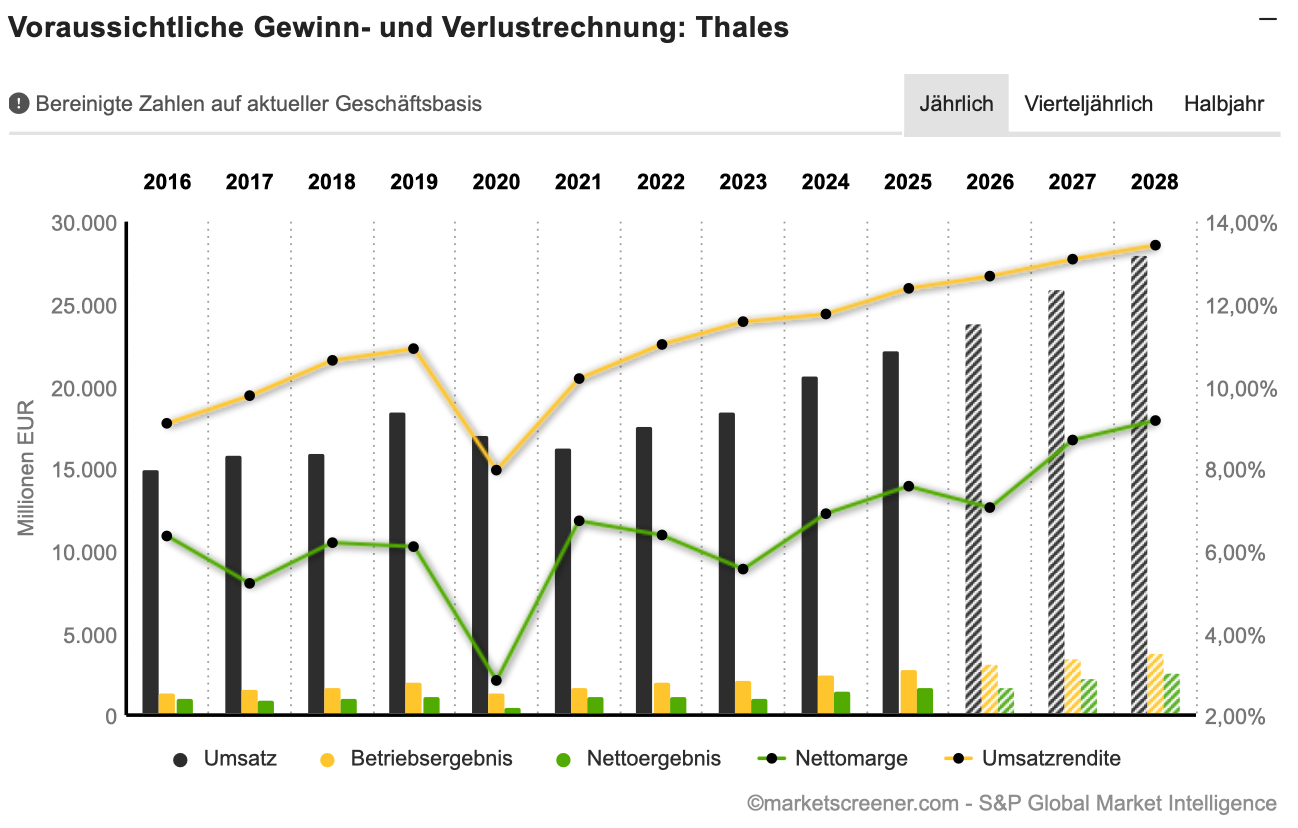
According to MarketScreener, Thales is expected to continue its profitable growth trajectory at least until 2028.
Order Intake and Order Backlog
| Key Figure | H1 2026 | H1 2025 | Change |
|---|---|---|---|
| Group Order Intake | EUR 12.47 billion | EUR 10.35 billion | +21,0 % |
| Book-to-Bill Ratio | 1.14x | 1.01x | Improved |
| Order Backlog | EUR 52.4 billion | approx. EUR 49.9 billion* | +5,0 % |
* Based on order backlog at year-end 2025.
The order backlog thus increased to EUR 52.4 billion, representing more than two years of revenue based on 2025 revenue levels. This ensures exceptionally high visibility for future business development.
The strong order intake was primarily driven by the Defence and Aerospace segments.
| Segment | Order Intake H1 2026 | Change |
|---|---|---|
| Defence | EUR 7.35 billion | +28,0 % |
| Aerospace | EUR 3.26 billion | +23,0 % |
| Cyber & Digital | EUR 1.81 billion | −4.0% |
| Total Operating Segments | EUR 12.42 billion | +21,0 % |
The Aerospace segment also recorded strong growth in order intake, supported by high demand for avionics and new satellite orders. These included a telecommunications satellite for a Qatari operator and two satellites for the European Space Agency (ESA).
Only the Cyber & Digital segment saw a slight decline in order intake.
Dividend
Thales pursues a dividend policy with a payout ratio of approximately 40% of adjusted net income attributable to shareholders.
| Dividend Metric | FY 2025 |
|---|---|
| Dividend per Share | EUR 3.90 |
| Previous Year's Dividend | EUR 3.70 |
| Growth | +5,4 % |
| Target Payout Ratio | approx. 40% |
The dividend yield is comparatively moderate due to the strong increase in the share price. However, the payout is solidly supported by rising adjusted earnings and significantly improved cash flow.
Key Takeaway: Thales combines solid revenue growth, rising margins, exceptionally strong cash flow development, and a record order backlog, ensuring high planning certainty for the coming years.
MUMAK.me Assessment Phase 3: Positive = 1 MUMAK
Thales S.A.
News, Analysts, and Market Sentiment
Assessment
Analyst sentiment towards Thales remains positive following the company’s recent half-year results.
The current analyst consensus is ACCUMULATE, based on 19 analysts covering the company. The range of analyst price targets remains relatively wide.
Analyst Consensus
| Average Recommendation | ACCUMULATE |
| Number of Analysts | 19 |
| Average Price Target | approx. EUR 295 |
| Upside to the average target | approx. +14% |
| Highest price target | EUR 335 |
| Lowest Price Target | EUR 250 |
Source: MarketScreener, retrieved in August 2026.
Interesting Fact
Thales is one of the world’s leading providers of defense electronics. The company’s technologies are used in numerous military and civilian platforms – from fighter jets and frigates to satellites, secure communication, and cybersecurity solutions. This broad positioning reduces dependence on individual major programs and ensures high stability of the business model.
Analyst expectations have evolved following Thales’s recent half-year results.
Several analysts have adjusted their recommendations and price targets. This reflects both the company’s operational development and the strong structural outlook for European defense spending.
Opportunities
- Positive Analyst Consensus: The average recommendation remains ADD.
- Structural Defense Demand: The sustained growth in European defense spending forms an important basis for analyst expectations.
- Earnings Growth: Continued revenue growth, margin improvements, and the execution of the order backlog could support further upward revisions to earnings estimates.
Risks
- Reduced Upside Potential After Price Recovery: The recent recovery has narrowed the gap between the current stock price and the average analyst price target.
- Wide range of price targets.
- Higher Expectations: The current valuation increasingly depends on further earnings growth and successful operational execution.
Key Takeaway: The current news flow, positive half-year figures, and analyst consensus continue to support a positive outlook for Thales.
MUMAK.me Evaluation Phase 4: Positive = 1 MUMAK
Thales S.A.
Technical Analysis
Assessment
Thales’s technical picture has become more balanced after the strong recovery since mid-July.
After a strong recovery in July and the first half of August, the stock price temporarily rose above EUR 270, approaching the important resistance area around EUR 271.90.
However, the stock failed to establish a sustainable breakout above this level and has subsequently pulled back.
| Indicator | Rating | Interpretation |
|---|---|---|
| RSI (14) | Neutral | At around 55.4; momentum remains slightly positive but has weakened after the recent pullback. |
| MACD | Negative | The MACD line has slightly fallen below the signal line, indicating weakening short-term momentum. |
| Bollinger Bands | Neutral | The stock price has moved away from the upper Bollinger Band and returned to the middle range of the Bollinger Band span. |
Development in Recent Weeks/Months (As of 2026-08-20)
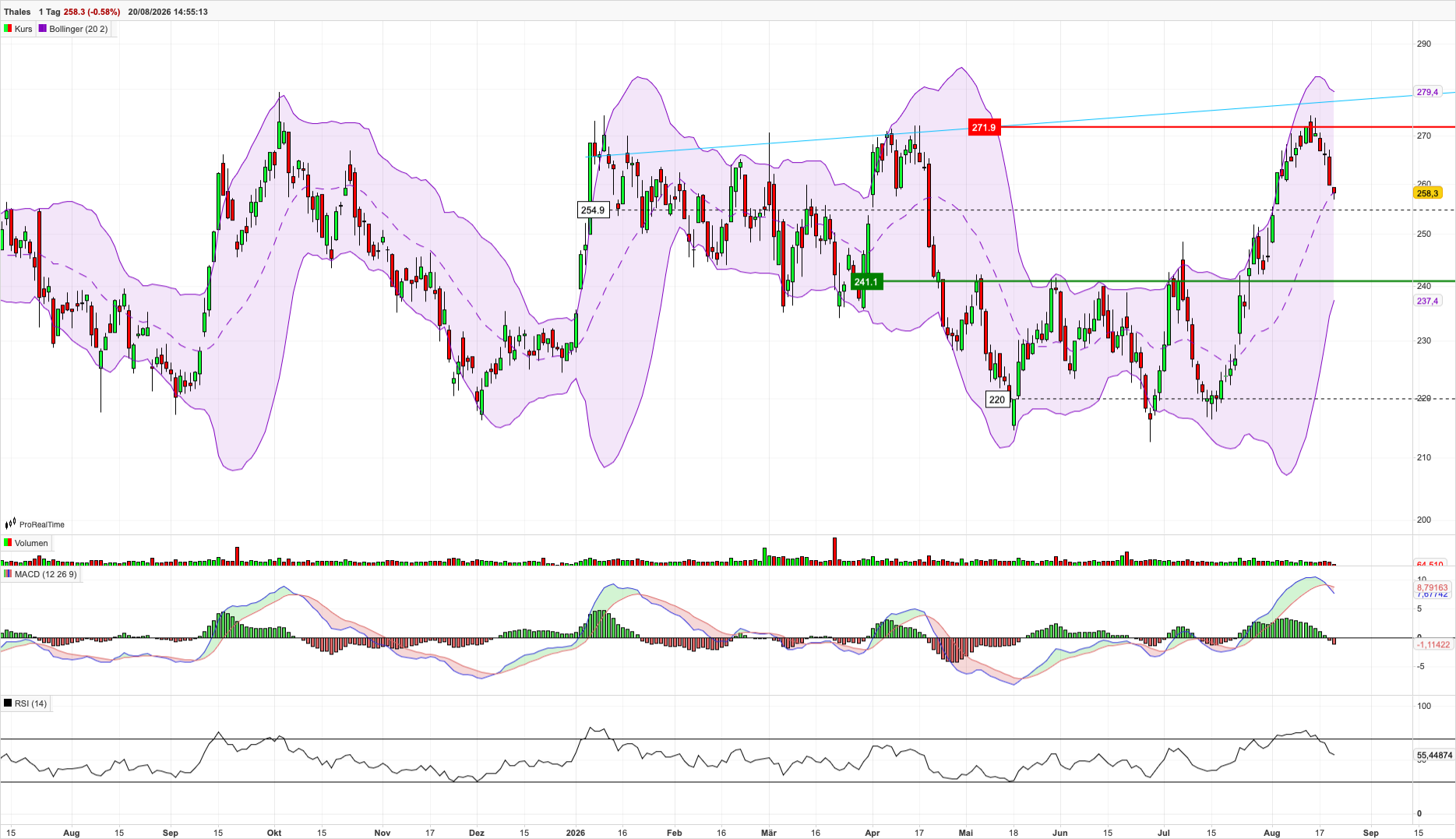
RSI (14)
Neutral
- RSI at around 55.4: Momentum remains slightly positive but has weakened compared to the levels reached during the August rally.
- Above 50: Buying pressure still has a slight advantage over selling pressure.
- Not Overbought: The RSI remains well below the usual overbought threshold of 70.
Interpretation
The RSI indicates a more balanced technical situation. Momentum remains slightly positive, but the decline from recent higher levels shows that the strength of the previous upward movement has diminished.
MACD (12/26/9)
Negative
- MACD remains above zero: The broader positive momentum generated by the previous recovery has not yet fully dissipated.
- Bearish Crossover: The MACD line has recently fallen slightly below the signal line, indicating weakening short-term momentum.
- Loss of Momentum: The recent MACD development suggests that the strength of the previous upward movement is fading.
Interpretation
The MACD currently provides a cautious technical signal.
Bollinger Bands (20)
Neutral
- Upper Band: The upper Bollinger Band is approximately EUR 279.40.
- Lower Band: The lower Bollinger Band is approximately EUR 237.40.
- Recent Development: During the August rally, the stock price approached the upper Bollinger Band but subsequently moved downwards again.
- Resistance at EUR 271.90: The stock price failed to establish a sustainable breakout above this important resistance area.
Interpretation
The Bollinger Bands reflect both the strong recent recovery and the subsequent loss of momentum.
Opportunities
- Medium-Term Recovery: Despite the recent pullback, the stock price remains significantly above its July lows.
- RSI above 50: Momentum has weakened but has not yet turned clearly negative.
- Potential Stabilization: The area around EUR 254.90 could provide short-term support and create a basis for a renewed upward movement.
- Breakout Potential: A sustained move above EUR 271.90 would strengthen the technical picture and could open the way towards the upper Bollinger Band.
Risks
- Failed Breakout: The stock price could not sustain the move above the EUR 270 area and has pulled back from its August highs.
- Weakening RSI: The decline to approximately 55.4 shows that upward momentum is losing strength.
- Negative MACD Signal: The MACD line has slightly fallen below the signal line, indicating weaker short-term momentum.
Key Takeaway: The technical picture for Thales has shifted from positive to neutral after the strong August rally and subsequent pullback.
MUMAK.me Rating Phase 5: Neutral = 0 MUMAK
Thales S.A.
What speaks for Thales?
- Strong position in European defense technology.
- Supported by increasing European defense spending and NATO procurement programs.
- Solid performance in H1 2026 with higher order intake, improved profitability, and stronger cash flow.
- Order Backlog: EUR 52.4 billion, with high revenue visibility.
- Diversified business model across Defense, Aerospace, Cyber & Digital, and Space.
- Improved medium-term technical picture after the recovery from July lows.
What speaks against Thales?
- Dependence on government procurement and public budgets.
- Implementation risks in major programs, including the F126 frigate program.
- Risk of delays in large international contracts.
- Project, supply chain, and demand risks in the aerospace business.
- Export and geopolitical risks.
- Comparatively higher valuation compared to some European competitors.
- Weaker short-term technical momentum after the pullback from above EUR 270.
What we are monitoring
- Development of European defense spending and NATO programs.
- New contract awards in Defense, Cyber & Digital, Aerospace, and Space.
- Progress towards 2026 targets, especially revenue growth and adjusted EBIT margin.
- Impact of the F126 program.
- Further changes in analyst estimates and price targets.
- Next business update for Q3 2026 in October.
Summary
Since our previous analysis, the Thales stock has overcome the resistances of EUR 241 and EUR 251 and temporarily traded above EUR 270. The subsequent pullback led the price back towards EUR 258 and weakened short-term momentum.
Fundamentally, the picture remains largely unchanged. Order intake, order backlog, profitability, and cash generation continue to form the basis of the assessment. The outlook for 2026 remains unchanged.
After the half-year figures, several price targets and analyst ratings were adjusted. Technically, the most important resistance area is now at EUR 270–272.
Rating According to the MUMAK Method
| Category | Rating |
|---|---|
| Geopolitics | Positive |
| Industry | Positive |
| Fundamentals | Positive |
| News & Sentiment | Positive |
| Technical Analysis | Neutral |
Overall Rating


UMBRELLA Strategy: Inflation and Interest Rates Move the Markets