

Microsoft Corporation
Analysis Result: 5 out of 5 MUMAKS
The business model of Microsoft combines Azure, Microsoft 365, Dynamics 365, LinkedIn, Windows, cybersecurity solutions, and gaming into an ecosystem used globally by businesses, governments, and consumers.
Recent results show how strongly cloud computing and artificial intelligence are driving Microsoft’s next growth phase. In the fourth quarter of fiscal year 2026, revenue increased by 18% to $90.0 billion.
Rating
This analysis evaluates Microsoft according to the UMBRELLA strategy using the MUMAK method. The assessment is conducted across five decision phases: geopolitics, industry, fundamentals, market sentiment, and technical analysis.
The goal is not to predict the future precisely. The goal is orientation. We contextualize facts, demonstrate causal relationships, and structure a comprehensible decision logic.
We explain – you decide.
Geopolitics
Classification
Microsoft operates one of the world’s largest platforms for cloud services, software, and digital infrastructure.
Cloud computing and artificial intelligence are increasingly considered strategically important infrastructure. Governments want more control over where sensitive data is stored, who can access it, and which jurisdiction the respective cloud services fall under.
This topic is particularly important in Europe. Microsoft has introduced solutions there designed to store customer data within European regions, enable more control over encryption, and restrict certain operational access to European personnel.
Microsoft’s strong position in cloud solutions for government agencies and cybersecurity offers the company an additional strategic advantage.
Opportunities
- The growing demand for cloud infrastructure strengthens Microsoft’s position with governments, regulated industries, and European companies.
- Government spending on digitization and cybersecurity creates new opportunities for Azure, Microsoft 365, Copilot, and Microsoft Security.
- The combination of cloud and cybersecurity services makes Microsoft an important partner for countries looking to improve their digital resilience.
Risks
- Technology tensions between the US and China could restrict Microsoft’s access to certain markets or semiconductor components.
- Governments might try to reduce their dependence on US technology companies, especially for critical infrastructure in the public sector and defense.
- Export controls and sanctions could limit the availability of advanced cloud and AI services in certain countries.
- International conflicts and supply chain disruptions could delay the construction of new data centers.
Key takeaway: Microsoft’s global position in cloud and cybersecurity positions the company well to benefit from increasing government demand for secure digital services.
MUMAK.me Rating Phase 1: Positive = 1 MUMAK
Microsoft Corporation
Geopolitics Rating: positive
Industry
Assessment
The technology sector is undergoing one of its most significant transformations in decades. Artificial intelligence is increasingly integrated into enterprise software, cloud computing, and cybersecurity.
Microsoft is exceptionally well-positioned to benefit from this shift.
Azure continues to be one of the fastest-growing cloud platforms globally and is gaining additional market share. At the same time, Microsoft has further strengthened its leading position in generative AI through Copilot, Azure AI Services, and its long-standing partnership with OpenAI.
Unlike many technology companies that rely on a single growth driver, Microsoft generates broadly diversified and recurring revenues from cloud subscriptions, enterprise software, cybersecurity, business applications, and productivity services.
Competition remains intense, however. Salesforce, Oracle, ServiceNow, and Adobe are also integrating AI functionalities into their enterprise software, thereby increasing competitive pressure.
Valuation Comparison
| Key Figure | Rheinmetall | Industry average* | Rating |
|---|---|---|---|
| P/E Ratio | 32.5x | approx. 23–28x | Weaker |
| EBIT Margin | 18,3 % | approx. 12–16% | Stronger |
| Net margin | 11,5 % | approx. 8–11% | Stronger |
| Revenue Growth | approx. 41% | approx. 8–18% | Stronger |
*Peer companies: Amazon, Alphabet, Oracle, Salesforce, Adobe, and ServiceNow. Source: MarketScreener consensus estimates, August 2026.
Opportunities
- Artificial intelligence is creating a new software cycle. Copilot expands Microsoft’s addressable market in enterprise productivity.
- The subscription model of Microsoft 365 ensures predictable recurring revenues and strong customer loyalty.
- Demand for cybersecurity continues to grow, benefiting Microsoft’s integrated security platform.
- The combination of Azure, OpenAI models, and proprietary AI services strengthens Microsoft’s competitive position in enterprise AI.
Risks
- Competition in cloud computing and artificial intelligence remains intense, particularly from Amazon AWS and Google Cloud.
- AI infrastructure requires exceptionally high investments, which burden free cash flow before they generate their full return.
- Rapid technological development forces Microsoft to make continuous investments to maintain its leading market position.
- Increasing regulatory scrutiny of large technology companies could affect acquisitions, the bundling of software products, and the use of AI.
Key takeaway: Microsoft’s leading position in cloud computing and artificial intelligence provides a strong foundation for continued long-term growth.
MUMAK.me Assessment Phase 2: Positive = 1 MUMAK
Microsoft Corporation
Industry Rating: positive
Fundamentals
Assessment
Microsoft once again delivered an outstanding quarter. Growth in core businesses accelerated as demand for cloud computing and artificial intelligence continued to increase. Revenue rose by 18% to $90.0 billion, while net income grew by 31% to $35.8 billion. This shows that Microsoft is increasingly able to translate its AI investments into profitable growth.
Microsoft benefits from three complementary business segments. Intelligent Cloud remains the largest earnings driver, while Productivity and Business Processes generates predictable subscription revenues. More Personal Computing provides additional cash flows from Windows, gaming, and search.
Revenue by Business Segment
| Segment | Revenue Q4 2026 | Revenue Q4 2025 | Growth |
|---|---|---|---|
| Productivity and Business Processes | $37.8 billion | $33.1 billion | +14 % |
| Intelligent Cloud | $39.3 billion | $30.4 billion | +29 % |
| More Personal Computing | $12.9 billion | USD 12.7 billion | +2 % |
Source: Microsoft, Q4 FY26 Results.
The quarter was once again dominated by Azure. Total cloud revenue reached $59.3 billion, while Azure revenue grew by 43% and exceeded $100 billion on an annualized basis for the first time.
Microsoft also announced that Microsoft 365 Copilot now has more than 30 million paying users. This shows that artificial intelligence is increasingly developing into a significant commercial business.
Although Microsoft continues to invest heavily in AI infrastructure, profitability remains exceptionally high. Capital expenditures reached approximately $41 billion in the quarter as the company expands data centers, AI chips, and cloud capacity. Despite these high expenditures, Microsoft’s operating margins remain among the strongest in the global technology sector.
Financial performance
| Key Figure | Q4 2026 | Q4 2025 | Change |
|---|---|---|---|
| Revenue | $90.0 billion | $76.4 billion | +18 % |
| Operating Income | $40.6 billion | $34.4 billion | +18 % |
| Net Profit | $35.8 billion | 27.3 billion USD | +31 % |
| Diluted EPS | $4.81 | $3.65 | +32 % |
Source: Microsoft, Q4 FY26 Results.
Historical Financial Development
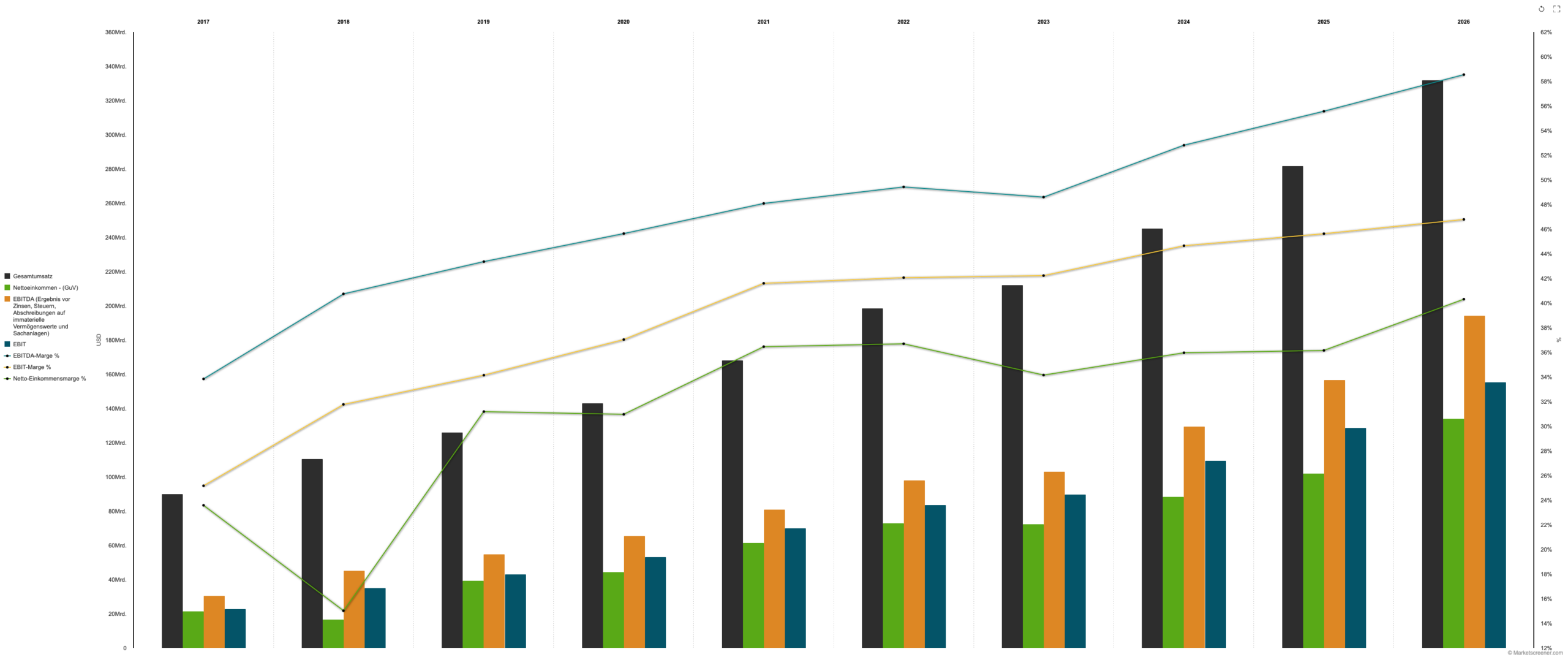
- Revenue has increased continuously, driven by the expansion of Azure and Microsoft 365.
- Operating income has grown even faster than revenue, demonstrating strong operating leverage.
- Net income continues to reach new record highs.
- Operating margin and net margin have remained exceptionally high.
- The cloud business has fundamentally changed Microsoft’s earnings profile: revenues are now more predictable and less dependent on traditional software licenses.
Forecast for Revenue, Operating Income, and Net Income
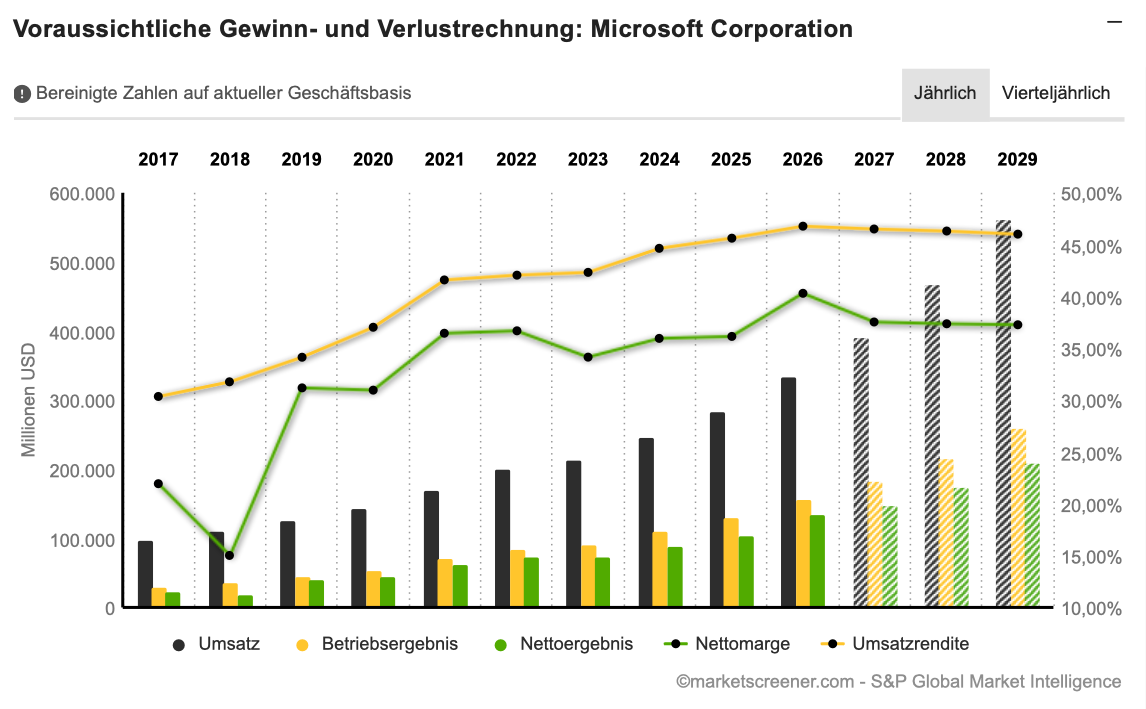
Analyst consensus suggests that Microsoft’s growth story is far from over.
Opportunities
- Azure has entered another phase of accelerated growth.
- Microsoft combines cloud computing, enterprise software, cybersecurity, and artificial intelligence into an integrated ecosystem, creating significant cross-selling opportunities.
- Recurring subscription revenues from Microsoft 365 and enterprise software ensure high predictability of earnings.
- Industry-leading profitability enables Microsoft to make high AI investments while maintaining strong cash flows.
- Copilot is rapidly developing into a significant commercial platform, creating an additional long-term growth driver.
Risks
- Artificial intelligence infrastructure requires enormous investments, temporarily reducing free cash flow.
- Competition from Amazon AWS and Google Cloud remains intense, especially in cloud computing and AI services.
- Microsoft must translate increasing AI usage into sustainable revenue growth to justify ongoing investments.
- Gaming and Windows currently contribute significantly less to growth than Microsoft’s cloud businesses.
Key takeaway: Strong financial figures show that Microsoft’s cloud and AI businesses continue to drive profitable growth.
MUMAK.me Assessment Phase 3: Positive = 1 MUMAK
Microsoft Corporation
Fundamentals Rating: positive
News, Analysts, and Market Sentiment
Assessment
Microsoft’s recent quarterly figures have significantly strengthened market confidence in the company’s long-term growth strategy.
The central question is no longer whether Microsoft should invest heavily in artificial intelligence, but how quickly these investments can be monetized.
According to the current MarketScreener consensus, analysts remain optimistic.
Analyst Consensus
| Analyst Consensus | BUY |
| Number of Analysts | 57 |
| Average Price Target | approx. $563 |
| Potential to Average Price Target | +21,16 % |
| Highest price target | $870 |
| Lowest Price Target | $400 |
Source: MarketScreener consensus, August 2026.
Interesting Fact
Microsoft is the first software company to achieve over $100 billion in annualized revenue with Azure. This demonstrates how cloud computing has evolved into one of the world’s largest enterprise technology sectors.
Opportunities
- Azure continues to gain momentum, supported by rapidly growing demand for cloud infrastructure and artificial intelligence.
- Microsoft 365 Copilot is developing into a significant new revenue stream.
- The integrated ecosystem allows Microsoft to monetize artificial intelligence across multiple products, including Azure, Microsoft 365, Dynamics 365, GitHub, and Microsoft Security.
- Strong enterprise demand and long-term customer relationships provide a solid foundation for continued earnings growth.
Risks
- Microsoft continues to invest heavily in AI infrastructure. To justify these high capital expenditures, sustained revenue growth is required.
- Competition from Amazon AWS and Google Cloud remains intense, especially in cloud computing and enterprise AI.
- A slowdown in Azure or Copilot adoption could weigh on expectations for Microsoft’s long-term earnings growth.
- Following the recent rally after the quarterly results, market expectations have also risen significantly.
Key takeaway: Strong quarterly results and continued analyst optimism support the positive outlook for Microsoft.
MUMAK.me Rating Phase 4: Positive = 1 MUMAK
Microsoft Corporation
Market Sentiment Rating: positive
Technical Analysis
Assessment
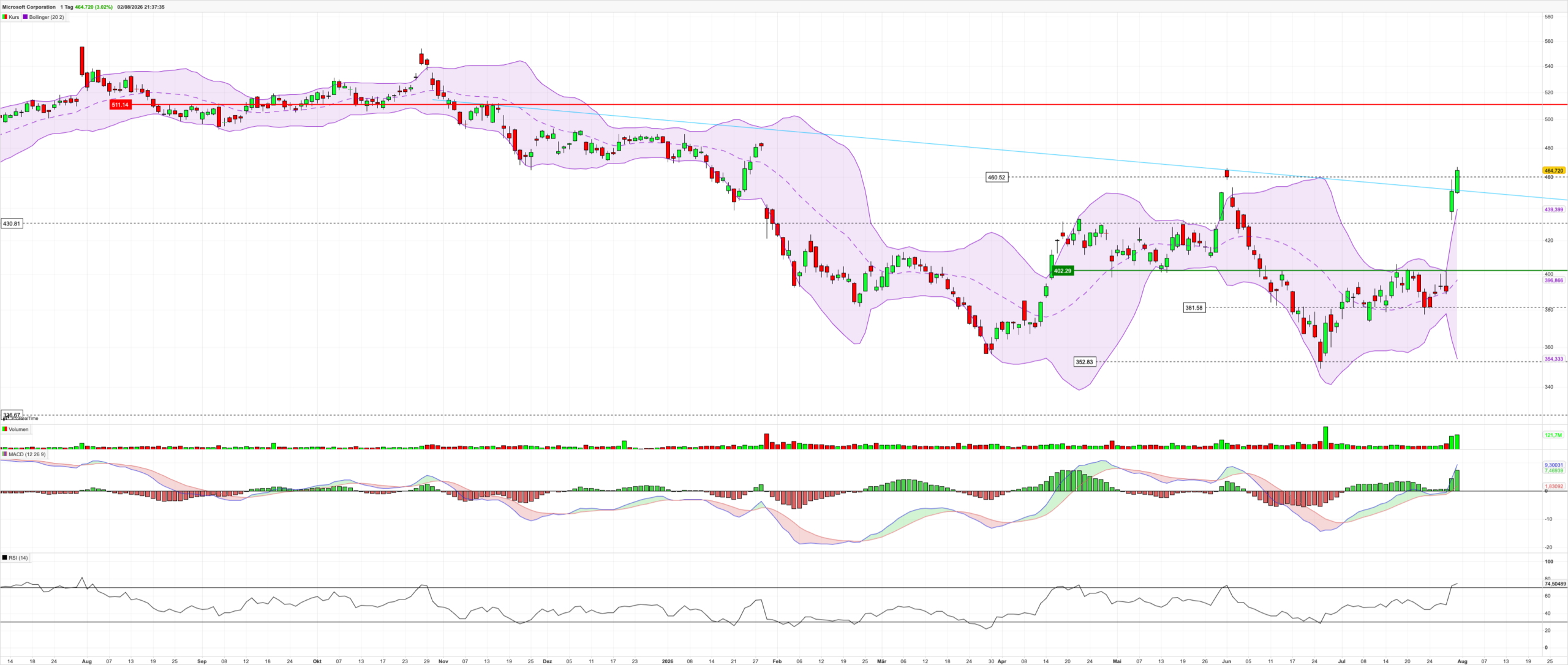
Microsoft achieved a strong technical breakout after the latest quarterly figures. The stock price rose above the previous resistance at around $400 with significantly higher trading volume and is now testing the long-term downtrend line in the range of $465.
| Indicator | Rating | Interpretation |
|---|---|---|
| RSI (14) | Positive | The RSI has risen to around 75, signaling very strong momentum. Although the stock is in overbought territory, strong trends can remain overbought for extended periods. |
| MACD | Positive | The MACD has clearly crossed the signal line upwards and continues to rise. This confirms the improved medium-term momentum. |
| Bollinger Bands | Positive | Microsoft broke out above the upper Bollinger Band after the rally triggered by the quarterly figures. This indicates exceptionally strong buying interest and confirms the breakout. |
Development over recent weeks/months (as of August 2, 2026)
RSI (14)
Positive
- The RSI has risen to approximately 75.
- Momentum has significantly strengthened after the quarterly figures.
- Although the indicator is now in overbought territory, this is not unusual for strong breakouts after quarterly results.
Interpretation: The RSI confirms that buyers are currently dictating the short-term trend.
MACD (12/26/9)
Positive
- The MACD has crossed above the signal line.
- Momentum has clearly shifted in favor of buyers.
Interpretation: The MACD confirms that Microsoft’s medium-term trend is positive again after the release of the quarterly figures.
Bollinger Bands (20)
Positive
- Microsoft has broken out above the upper Bollinger Band.
- The breakout was supported by significantly higher trading volume.
Interpretation: The Bollinger Bands confirm the strength of the recent breakout.
Opportunities
- A sustained rise above the long-term trend line at around $465 would be an important technical signal and could open the way to the previous all-time highs around $511.
- The high trading volume increases the significance of the recent price movement.
- The long-term uptrend remains intact and is supported by Microsoft’s fundamental strength.
Risks
- The RSI is in overbought territory, making short-term profit-taking more likely.
- The current rally has pushed the stock price above the upper Bollinger Band. This is often followed by a consolidation phase.
- The long-term resistance at around $465 remains the crucial technical hurdle.
Key takeaway: Microsoft achieved a technically convincing breakout after the quarterly figures, while momentum indicators have clearly turned positive.
MUMAK.me Assessment Phase 5: Positive = 1 MUMAK
Microsoft Corporation
Technical Analysis Rating: positive
What speaks for Microsoft?
- Azure is growing increasingly faster, driven by rising demand for cloud infrastructure and artificial intelligence.
- Microsoft has built one of the most comprehensive AI ecosystems. Copilot is integrated into Microsoft 365, GitHub, Dynamics 365, Azure, and Microsoft Security, creating multiple long-term growth opportunities.
- Recurring subscription revenues from Microsoft 365, Azure, and enterprise software ensure exceptionally high predictability of earnings and reliable cash flows.
- Industry-leading profitability and cash flow generation enable Microsoft to make further investments in AI infrastructure and capital returns through dividends and share buybacks.
What speaks against Microsoft?
- Artificial intelligence has become Microsoft’s largest investment priority and requires high annual capital expenditures before the full financial benefits are realized.
- Competition remains intense, particularly from Amazon AWS, Google Cloud, and new AI platforms, which continue to invest heavily.
- The company’s premium valuation already reflects high market expectations.
What we are monitoring
- Azure’s revenue growth and whether enterprise demand for AI infrastructure remains at current levels.
- The commercial adoption of Microsoft 365 Copilot and its contribution to recurring software revenues.
- The development of Microsoft Cloud’s profitability as AI services gain a larger share of the business.
- Regulatory developments impacting artificial intelligence, cybersecurity, and cloud services.
Summary
Microsoft has once again demonstrated why it is one of the world’s most important technology companies. Azure continues its dynamic growth, Copilot is gaining importance, and artificial intelligence is becoming an increasingly important growth driver. The focus is now shifting from high investments to execution: Microsoft must translate its leading position in AI into the next phase of long-term growth.
Rating According to the MUMAK Method
| Category | Rating |
|---|---|
| Geopolitics | Positive |
| Industry | Positive |
| Fundamentals | Positive |
| News & Sentiment | Positive |
| Technical Analysis | Positive |


