

Brief Introduction – ExxonMobil
The global energy market continues to be shaped by geopolitical tensions, limited supply, and structurally robust demand. Rising oil and gas prices, combined with disciplined capital allocation in the industry, are strengthening the earnings power of major integrated oil companies.
In this environment, companies with a diversified value chain benefit in particular, as they profit not only from rising prices but also from operational flexibility and more stable margins.
ExxonMobil is one of the strongest representatives of this model. The company combines upstream production with downstream refining and chemical businesses, creating a robust and diversified earnings structure.
This analysis structures the investment decision along five categories: Geopolitics, Industry, Fundamentals, Market Sentiment, and Technical Analysis.
The goal is not to predict the future precisely. The goal is orientation. We contextualize facts, demonstrate causal relationships, and structure a comprehensible decision logic.
We explain – you decide.
ExxonMobil
Analysis Result: 5 out of 5 MUMAKS
Rating
Geopolitics
Assessment
Geopolitics is a central driver of global energy markets. Conflicts in the Middle East, supply risks, and energy policy strategies directly influence oil and gas prices.
Key Takeaway
ExxonMobil benefits directly from rising oil and gas prices, while global diversification reduces geopolitical downside risks.
Rationale
Direct Price Exposure
As an integrated oil company, ExxonMobil immediately monetizes rising commodity prices:
- Higher upstream profits during rising oil and gas prices
- LNG exposure benefits from global gas demand
Geopolitical Risk Premium
Tensions in regions such as:
- Middle East (Strait of Hormuz)
- Russia/Ukraine
lead to:
- Supply uncertainty
- Strategic stockpiling
- Risk premiums in the oil price
Diversified Asset Base
ExxonMobil is active globally:
- USA (Permian Basin)
- Guyana (central growth driver)
- LNG projects worldwide
This reduces dependency on individual regions.
Conclusion
Geopolitical tensions support higher energy prices and thus directly strengthen ExxonMobil’s earnings power.
ExxonMobil
Geopolitics Rating: positive
Industry
Assessment
The energy sector remains cyclical, but is currently characterized by supply discipline and underinvestment in new capacities.
Key Takeaway
ExxonMobil’s integrated business model offers structural advantages throughout the entire cycle.
Rationale
Integrated Business Model
ExxonMobil is active along the entire value chain:
- Upstream (Production)
- Downstream (Refining)
- Chemicals
This leads to:
- Diversified earnings
- More stable margins
Anti-cyclical Elements
When oil prices fall:
- Refinery margins can rise
- Demand in the chemical sector often remains stable
This reduces earnings volatility compared to pure upstream companies.
Economies of Scale and Efficiency
ExxonMobil is one of the largest players worldwide:
- Economies of scale
- Strong cost control
- Access to high-quality projects
Strategic Projects (e.g., Guyana)
Low-cost and high-margin production projects significantly improve long-term profitability.
Conclusion
Due to its integrated and diversified model, ExxonMobil is structurally better positioned than many competitors.
ExxonMobil
Industry Rating: positive
Fundamentals
Assessment
Fundamental data shows whether a company can sustainably translate the current market environment into earnings, cash flows, and capital returns.
Key Takeaway
ExxonMobil remains highly profitable and cash-flow strong, but shows a moderate normalization of results after a very strong previous year.
Rationale
Revenue and Earnings (Fiscal Year 2025)
| Revenue and Earnings (Fiscal Year 2025) | ||
|---|---|---|
| Revenue: | ~$324 billion | (vs. ~$339 billion YoY) |
| Net Income: | ~$28.8 billion | (vs. ~$33.7 billion YoY) |
| Diluted EPS: | ~$6.70 | (vs. $7.84 YoY) |
The development shows:
- Continued very high absolute earnings level
- However, declining momentum after the peak cycle
→ Classic normalization within a commodity cycle
Margin Development
| Margin Development | |
|---|---|
| EBITDA Margin: | ~18.3% |
| Net Margin: | ~8.9% (vs. ~9.9% YoY) |
Interpretation:
- Operating profitability remains strong
- Slight margin pressure due to lower energy prices
→ Still robust, but no further margin expansion
Rating
| Rating | |
|---|---|
| P/E 2026: | ~19.4 |
| P/E 2027: | ~17.8 |
→ Fairly valued within the cycle
Profitability
| Profitability | Table Header | Table header |
|---|---|---|
| EBITDA: | ~$59.4 billion | |
| EBIT: | ~$35.4 billion |
This highlights:
- Strong economies of scale
- High operating earnings power
Cash Flow and Capital Discipline
| Cash Flow & Capital Discipline | Table Header |
|---|---|
| Operating Cash Flow: | ~$52 billion |
| Free Cash Flow: | ~$26 billion |
This enables:
- Extensive share buybacks (~$20 billion)
- Stable and attractive dividend policy
→ Capital return remains a central component of the strategy
Dividend and Capital Allocation
| Dividend & Capital Allocation | Table Header |
|---|---|
| Annual Dividend: | ~$4.12 per share |
| Dividend Yield: | ~2.5–2.6% |
ExxonMobil has a very stable and continuously growing dividend policy, supported by strong and resilient cash flows.
Additionally, the company pursues extensive share buybacks:
| Share buybacks | |
|---|---|
| Share buybacks: | ~$20 billion program |
→ Combination of dividends and buybacks as a central component of the total return strategy.
Conclusion
ExxonMobil demonstrates exceptionally strong cash flow generation and high profitability.
The decline in key figures is an expression of cyclical normalization and not a structural weakness.
ExxonMobil
Fundamentals Rating: positive
News, Analysts, and Market Sentiment
Assessment
Market sentiment and capital flows influence short- to medium-term valuation.
Key Takeaway
Investor sentiment toward ExxonMobil remains constructive, supported by strong results and the dynamics of the energy markets.
Rationale
Analyst Estimates
| Analyst Overview | Table Header |
|---|---|
| Average Price Target | ~$160 |
| Upper Range: | $195 |
| Lower Range: | $123 |
→ Analysts rate the quality of ExxonMobil positively, but are cautious regarding short-term upside potential due to the already strong price performance.
Market Positioning
ExxonMobil is frequently used as:
- Core investment in the energy sector
- Inflation protection
- High-dividend income stock
Macro Narrative
Energy stocks currently benefit from:
- Inflation concerns
- Geopolitical uncertainty
- Supply constraints
Capital Flows
Institutional investors are increasingly allocating capital to:
- Large-cap, stable energy companies
- Companies with strong dividends and solid cash flows
Conclusion
Sentiment and capital flows support ExxonMobil as a core position in energy portfolios.
ExxonMobil
Market Sentiment Rating: neutral
Technical Analysis
Assessment
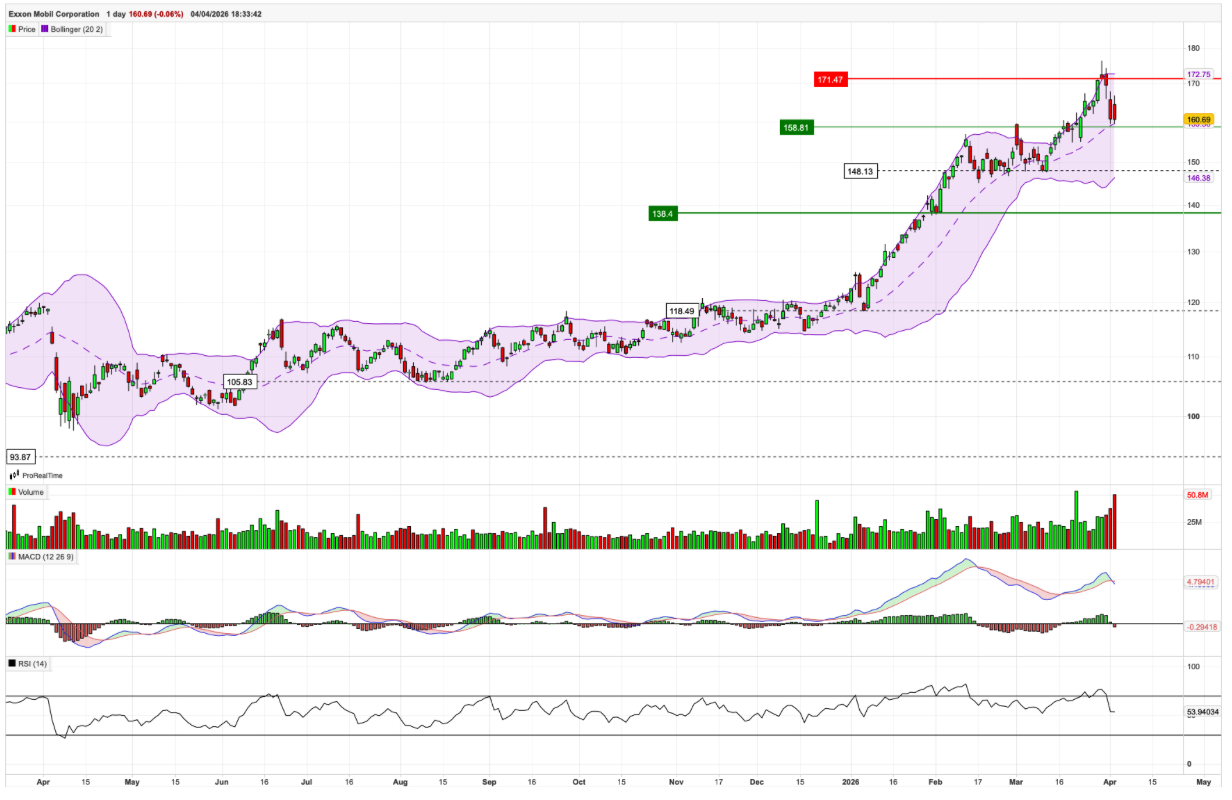
Technical analysis structures the timing framework for a position.
Key Takeaway
The technical structure suggests an intact upward trend with short-term consolidation.
Rationale
Bollinger Bands
The price previously moved above the upper Bollinger Band and subsequently returned to the range.
This signals:
- Previous trend acceleration
- Currently ongoing consolidation within the trend
RSI
The RSI is in the range above 50.
This confirms:
- Intact upward trend
- No short-term overheating
→ Further upside potential exists
MACD
The MACD shows a weakening after previously strong momentum.
This indicates:
- Short-term trend pause
- Possible rebuilding of momentum
Resistance and Support
The area around the recent highs acts as resistance.
Below this, a stable support zone is forming.
→ Classic structure within an upward trend
Conclusion
The technical structure confirms the overall upward trend while simultaneously showing short-term consolidation.
ExxonMobil
Technical Analysis Rating: positive
Summary
The analysis shows a highly consistent and robust overall picture:
Geopolitics → Industry → Fundamentals → Sentiment → Technical Analysis
All five levels deliver a positive signal.
ExxonMobil benefits directly from rising energy prices while ensuring stability through its integrated business model. Strong cash flows, disciplined capital allocation, and global diversification create a resilient investment profile.
Decision Logic
- Direct beneficiary of rising oil and gas prices
- Integrated business model reduces cyclicality
- Strong fundamental data and solid cash flow generation
- constructive market sentiment
- intact technical uptrend
Rating According to the MUMAK Method
| Category | Rating |
|---|---|
| Geopolitics | Positive |
| Industry | Positive |
| Fundamentals | Positive |
| News & Sentiment | Positive |
| Technical Analysis | Positive |


